

GXRP launched on NYSE Arca in November 2025 trading north of forty dollars a share. By the summer of 2026 it was changing hands in the mid-twenties, down roughly 30% for the year, and the fund had bled over $160 million in assets in a single quarter. If you searched for the Grayscale XRP ETF expecting a simple “how to buy it” explainer, you’re about to get the fuller picture instead, the one that actually explains why that happened and whether it changes anything for you.
This isn’t a hype piece and it isn’t a hit piece either. It’s a straight look at how the Grayscale XRP ETF is structured, what you’re actually paying for, how it stacks up against five other XRP ETFs now competing for the same investor dollars, and where the real risk sits, because a spot crypto ETF is not the same animal as a index fund tracking the S&P 500, no matter how similar the brokerage screen looks.
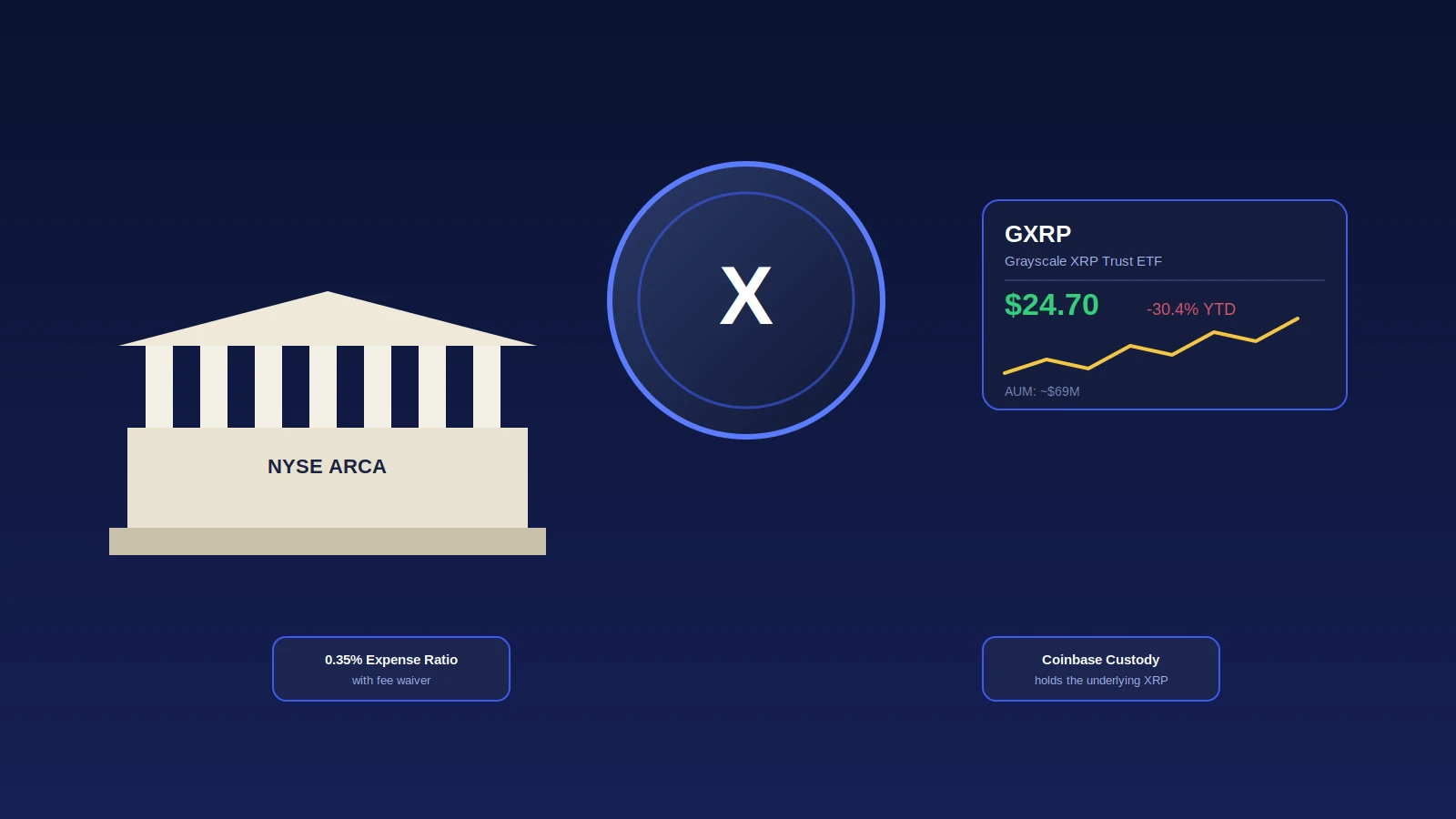
GXRP trades on NYSE Arca and holds nothing but XRP, custodied by Coinbase.
What Is the Grayscale XRP ETF (GXRP)?
The Grayscale XRP ETF (ticker: GXRP) is a spot exchange-traded fund that holds XRP directly and trades on NYSE Arca. Converted from the original Grayscale XRP Trust, it uplisted to ETF status on November 24, 2025, giving everyday investors regulated exposure to XRP’s price through a normal brokerage account, no crypto wallet required.
How the Grayscale XRP ETF Actually Works
Strip away the ticker symbol and GXRP is a Delaware Statutory Trust that does exactly one thing: hold XRP and issue shares that track its value, minus fees. It doesn’t trade options, doesn’t lend out its holdings for yield, and doesn’t touch any other asset. As of its last annual disclosure, the Trust held roughly 0.20% of all circulating XRP, which sounds small until you remember that’s still tens of millions of dollars in a single custodial wallet.
XRP itself runs on the XRP Ledger, a blockchain that settles transactions through a consensus process rather than mining, which is why it clears in a few seconds instead of minutes. GXRP doesn’t touch that network directly, it simply holds the token and tracks its price, so understanding the ledger’s own mechanics is optional background, not something you need to trade the ETF.
From Trust to ETF: The Conversion Story
Grayscale didn’t build GXRP from scratch. The underlying trust was formed back in August 2024 and spent over a year as a closed-end product before NYSE Arca’s application under Rule 19b-4 cleared and the SEC approved generic listing standards for commodity-based crypto ETPs in September 2025. That regulatory green light is what let Grayscale flip the switch on redemptions and list the shares properly, the same playbook that turned GBTC into a spot Bitcoin ETF a couple of years earlier. If you’ve followed Grayscale’s Bitcoin trust conversion, this will feel familiar, and that track record is part of why institutional buyers trust the wrapper even when the underlying asset is volatile.
Who Actually Holds the XRP: Custody and Administration
Coinbase Custody Trust Company holds the fund’s XRP in institutional-grade cold storage, while BNY handles fund administration. This two-party structure, custodian plus administrator, is standard for crypto ETFs and matters more than most retail investors realize: it separates the entity holding your assets from the entity doing the accounting, which is exactly the kind of segregation that got scrutinized hard after prior crypto custody blowups elsewhere in the industry.
Grayscale XRP ETF Fees: What You’re Actually Paying
GXRP carries a 0.35% annual expense ratio, with a temporary fee waiver that applied for the fund’s first three months or until assets under management hit $1 billion, whichever came first. That waiver has since lapsed, so the 0.35% is what current holders are paying. On a $10,000 position, that’s $35 a year, quiet, automatic, deducted from fund assets rather than billed to you directly.
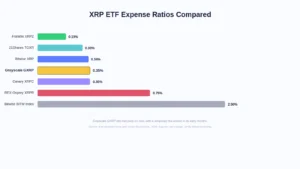
GXRP’s 0.35% fee sits mid-pack among dedicated XRP ETFs as of mid-2026.
How Grayscale’s XRP ETF Fee Compares to Competitors
Six spot and index XRP products are now competing on cost, and the spread is bigger than you’d expect for what are functionally similar products. Franklin Templeton’s XRPZ undercuts everyone at 0.19%. 21Shares TOXR sits at 0.30%. Bitwise’s dedicated XRP ETF comes in at 0.34%, a hair below Grayscale and Canary Capital’s XRPC, both at 0.35%. REX-Osprey’s XRPR runs notably higher at 0.75%, and Bitwise’s broader index product, BITW, charges a steep 2.50% for diversified exposure across multiple tokens rather than XRP alone.
On a $10,000 investment held ten years, that gap between Franklin’s 0.19% and Grayscale’s 0.35% works out to roughly $160 in cumulative fees, real money, but not enough on its own to make or break a decision if brand, liquidity, or an existing brokerage relationship matters more to you.
Grayscale XRP ETF Performance and Why the AUM Keeps Shrinking
Numbers don’t lie here, even when they’re uncomfortable. GXRP’s 52-week range runs from roughly $22 to $46.51, a swing that would be considered extreme for almost any traditional equity ETF but is fairly ordinary for a single crypto asset wrapper. Year-to-date total return has run around negative 30%, and net assets have fallen from a peak to roughly $69 to $71 million as of mid-2026, with quarterly outflows exceeding $160 million at one stretch.
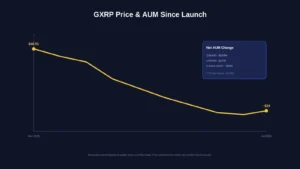
GXRP price and net assets have both trended down since its November 2025 ETF debut.
Why the Grayscale XRP ETF Price Fell From the $40s to the Low $20s
Three things happened at once, and none of them are unique to Grayscale specifically. XRP’s own spot price cooled off after its late-2025 rally lost steam. Competing XRP ETFs launched with lower fees and pulled in fresh allocator dollars that might have otherwise gone to GXRP. And crypto ETF flows broadly got choppier in 2026 as macro uncertainty, government shutdown risk included, pushed some institutional money to the sidelines. None of that means the fund is broken, it means XRP is doing what a volatile digital asset does, and the ETF wrapper was never going to insulate you from that.
Grayscale XRP ETF vs Buying XRP Directly
The honest comparison isn’t GXRP versus other ETFs, it’s GXRP versus just buying XRP on an exchange yourself. The ETF wins on convenience: it fits inside a normal brokerage account, works in an IRA, and skips the private key management entirely. Direct ownership wins on cost and flexibility: no 0.35% annual drag, and you can actually use the XRP on the network, stake-adjacent activity, payments, whatever your reason for holding it, none of which an ETF share lets you do since GXRP is pure price exposure with a single holding and zero utility beyond tracking value.
- Choose GXRP if you want XRP exposure inside a retirement account or standard brokerage without touching a crypto exchange.
- Choose direct XRP ownership if minimizing fees matters more than convenience, or if you actually want to use the token itself.
- Either way, expect the same underlying volatility, the wrapper changes access, not the asset’s price behavior.
Who Should Actually Consider the Grayscale XRP ETF
This fits a narrow but real profile: someone who already wants XRP exposure specifically, not general crypto exposure, who values the brand recognition and regulatory track record Grayscale built through the GBTC and ETHE era, and who’d rather hold it through an existing Fidelity, Schwab, or Robinhood account than open a separate crypto exchange login. It does not fit someone chasing yield, since GXRP pays no dividend and generates no income, or someone uncomfortable with an asset that can lose 30%+ of its value in a matter of months, because that’s exactly what already happened here.
Risks and Limitations of the Grayscale XRP ETF
Every one of these deserves real weight before you commit capital, not a passing mention.
Extreme Price Volatility
A 52-week range from roughly $22 to $46 is not a rounding error, it’s more than a two-to-one swing in twelve months. If that kind of drawdown would force you to sell at the worst time, this product isn’t sized right for your portfolio.
No Income, No Yield
GXRP pays no dividend and generates no yield. Your entire return depends on XRP’s price appreciating faster than the 0.35% fee erodes your position, there’s no income cushion offsetting a flat or declining year.
Single-Asset Concentration
One holding. No diversification. A fund that’s 100% XRP carries all of the concentration risk that comes with betting on a single digital asset’s regulatory and adoption future, risk that a broad-market fund simply doesn’t carry.
Fee Waivers Expire, and Competition Is Fierce
The early fee waiver that made GXRP briefly free is gone. With Franklin, 21Shares, and Bitwise all undercutting Grayscale on cost, expect continued pressure on Grayscale to either cut fees further or lean on brand loyalty to retain assets, and continued AUM volatility either way.
Regulatory and Custody Risk Still Exists
Coinbase Custody’s institutional-grade setup materially reduces, but doesn’t eliminate, custody risk. Regulatory treatment of XRP itself has shifted more than once in recent years, and any future SEC or legislative action specific to XRP could affect the fund faster than it would a diversified product.
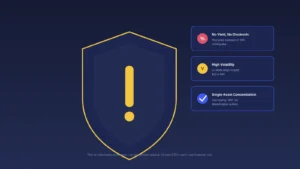
A single-asset crypto ETF concentrates risk that a diversified fund would otherwise spread out.
How to Buy the Grayscale XRP ETF
GXRP trades on NYSE Arca like any other listed ETF. Search the ticker “GXRP” in Fidelity, Schwab, Robinhood, or any standard US brokerage, place a normal market or limit order, and it settles the same way a stock trade would. No crypto wallet, no exchange account, no seed phrase to lose. It’s also eligible for IRAs and other retirement accounts at brokers that support it, which is the single biggest practical advantage over holding XRP directly.
Grayscale XRP ETF: Frequently Asked Questions
What does the Grayscale XRP ETF actually hold?
It holds XRP and only XRP, custodied by Coinbase Custody Trust Company. There are no other assets, no derivatives, and no leverage in the fund’s structure, its share price is designed to track XRP’s market value minus fees.
What is the Grayscale XRP ETF expense ratio?
0.35% annually, following the expiration of an early fee waiver that applied for the fund’s first three months or until it reached $1 billion in assets, whichever came first. That places it roughly mid-pack among the six dedicated XRP ETFs currently trading.
Is the Grayscale XRP ETF a good investment?
That depends entirely on your risk tolerance and reason for wanting XRP exposure. It’s convenient and regulated, but it carries the full volatility of a single crypto asset, no yield, and a fee that’s no longer waived. It suits investors who specifically want XRP exposure inside a normal brokerage account, not investors looking for stability or income.
How has GXRP performed since launch?
Since its November 2025 ETF debut, GXRP has fallen from a 52-week high near $46.51 to trading in the mid-twenties by mid-2026, a year-to-date total return of roughly negative 30%, alongside meaningful outflows from the fund.
Can I hold the Grayscale XRP ETF in an IRA?
Yes, at brokers that support it. Because GXRP trades as a standard NYSE Arca-listed ETF rather than requiring direct crypto custody, it’s eligible for IRAs and other tax-advantaged retirement accounts the same way any other ETF would be.
Which XRP ETF has the lowest fees?
Franklin Templeton’s XRPZ currently has the lowest expense ratio among dedicated XRP ETFs at 0.19%, roughly half of Grayscale GXRP’s 0.35%. 21Shares TOXR and Bitwise’s XRP ETF also undercut Grayscale slightly, at 0.30% and 0.34% respectively.
Final Take: Does the Grayscale XRP ETF Earn Its Fee?
Grayscale’s name still carries weight built over a decade of GBTC and ETHE history, and that brand recognition is worth something to institutional allocators who value a track record over a few basis points of fee savings. But the numbers here are what they are: a fund down roughly 30% since launch, bleeding assets to cheaper competitors, charging a fee that’s no longer waived. If you want XRP exposure specifically and value convenience over shaving fractions of a percent off your costs, GXRP does the job it’s built for. If cost is your primary filter, Franklin’s XRPZ is doing the same job for nearly half the price.