


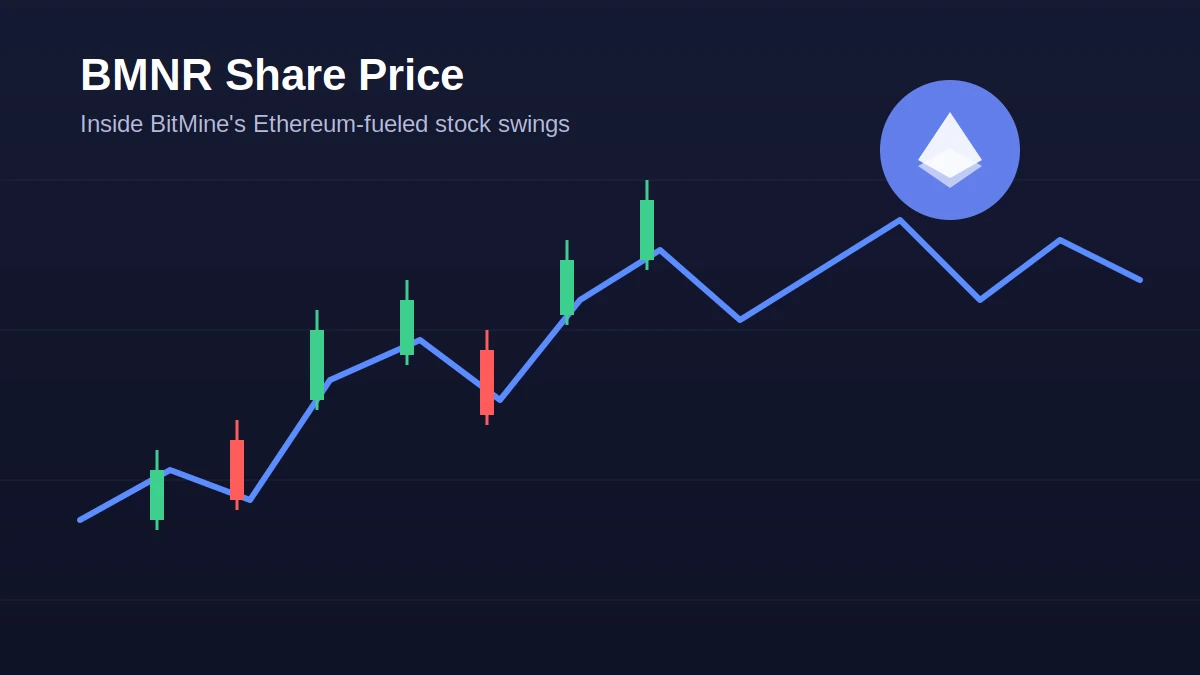
If you’ve typed bmnr share price into Google more than once this month, you’re not being paranoid, you’re just watching a genuinely volatile stock. BitMine Immersion Technologies trades under the ticker BMNR on the NYSE, and right now shares sit in the $15 to $16 range, down sharply from a 52-week high above $134. That’s not a typo. This stock has been on one of the wildest rides in the crypto-equity space this year, and most of the explanations floating around online only tell half the story.
Here’s the full picture: what BMNR actually is, why its share price moves the way it does, what’s driving the recent swings, and the specific numbers worth checking before you decide whether the current price is a bargain or a warning sign.
What Is BMNR Stock, Exactly?
BitMine Immersion Technologies started life as a Bitcoin mining and immersion-cooling hardware company. That’s not what it is anymore, at least not primarily. Under chairman Tom Lee, the company pivoted hard into becoming a corporate Ethereum treasury vehicle, meaning its main business now is accumulating and holding ETH on its balance sheet, similar in spirit to how Strategy built its identity around holding Bitcoin.
BitMine currently holds roughly 5.74 million ETH, close to 4.8% of Ethereum’s entire circulating supply, making it one of the largest corporate holders of the asset anywhere in the world. Nearly all of that ETH, about 4.88 million tokens, is actively staked through the company’s own MAVAN platform, generating recurring yield instead of just sitting idle in a wallet.
Why the BMNR Share Price Tracks Ethereum So Closely
This is the part most surface-level explainers skip. BMNR isn’t valued like a traditional software or mining company where investors model revenue growth and margins. It trades much closer to a leveraged proxy for Ethereum itself. When ETH rallies, BMNR often rallies harder. When ETH slides, BMNR tends to fall faster than the token it’s holding. Analysts commonly describe it as trading against its net asset value, meaning the market price of BMNR shares gets compared to the dollar value of the ETH stack backing each share.
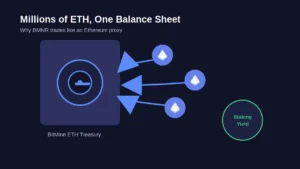
BitMine’s business model now centers on accumulating and staking Ethereum rather than mining Bitcoin.
BMNR Share Price Today: The Current Numbers
As of the most recent trading sessions in July 2026, BMNR has been changing hands in the $14 to $16 range, with a market capitalization sitting around $8.8 to $8.9 billion. The stock’s 52-week range stretches from a low of $12.80 up to a high of $134.48, which tells you almost everything you need to know about how much this thing moves. Shares are down roughly 48% year-to-date and well over 85% from their peak.
Trading volume has stayed heavy, often north of 30 to 40 million shares a day, which is unusually high for a company of this size and points to a stock that’s popular with both short-term traders and long-term believers in the Ethereum treasury thesis. Wall Street analyst price targets currently average around $30 to $34, with a top estimate near $40, though it’s worth remembering that only a small handful of analysts formally cover the stock.
Why Did BMNR Share Price Crash From Its Highs?
The drop from above $130 to the mid-teens wasn’t caused by one single event, it’s the result of several forces compounding. Ethereum itself pulled back sharply from its own highs, dragging BMNR down given how tightly the two are linked. On top of that, BitMine has diluted shareholders significantly to fund its ETH purchases, growing its share count from roughly 234 million to somewhere in the 490 to 570 million range over the past year depending on the source and cutoff date used. More shares outstanding for a similar pool of assets naturally puts downward pressure on a per-share basis, even if the company’s total ETH holdings keep climbing.
There’s also a sentiment layer here. Crypto treasury stocks as a category, not just BMNR, went through a rough stretch as investors questioned whether these companies deserve to trade at a premium to the raw value of the assets they hold, or whether a discount is more appropriate given dilution risk and operating costs.
Dilution and Net Asset Value: The Numbers That Actually Matter
If you only look at the headline share price, you’re missing the more useful comparison. What matters for a company like BitMine is ETH held per share, not just the stock price in isolation. A rising share count that grows slower than the ETH treasury still benefits existing shareholders. A share count that grows faster than the treasury dilutes them, even if the total dollar value of ETH on the balance sheet is going up.
BitMine has also issued preferred stock, including a 9.50% Series A Perpetual Preferred offering that raised $280 million. That preferred stock sits ahead of common shareholders in the capital structure and comes with real dividend obligations, which is a detail that gets buried in most short news hits about the company but genuinely matters if you’re evaluating risk. Simply Wall St’s analysis has pointed to BMNR trading close to its adjusted net asset value recently, meaning the market wasn’t pricing in much extra optimism about ETH upside or staking growth at that level.
BMNR Staking Revenue: An Often Overlooked Piece
One thing that separates BitMine’s strategy from a simple buy-and-hold approach is staking. With roughly 4.88 million ETH staked, the company has cited projected annualized staking revenue north of $200 million, figures that have been updated as the treasury has grown throughout the year. That’s real recurring income layered on top of the raw asset appreciation story, and it’s a meaningful differentiator from companies that just sit on crypto without generating any yield from it.

Share count growth and staking yield matter as much as the raw ETH balance when judging BMNR’s real value.
BMNR Stock vs Other Crypto Treasury Companies
BitMine isn’t alone in this space. Strategy pioneered the corporate Bitcoin treasury model years ago, and a handful of other companies have tried to replicate that playbook with Ethereum, Solana, and other tokens. What sets BMNR apart is scale and speed: BitMine built one of the largest ETH treasuries in the world in a relatively short window, and its recent inclusion in the Russell 1000 Index has given it more visibility among institutional and passive index investors than most of its smaller peers get.
That said, being the biggest doesn’t automatically mean the safest. A larger treasury means more exposure if Ethereum has an extended down cycle, and it means the company’s fortunes are essentially tied to a single asset’s price action rather than a diversified business model.
Is BMNR Share Price a Buy Right Now?
This isn’t investment advice, and anyone telling you with total certainty whether BMNR is a buy at current levels is overstating what anyone can actually know. What’s fair to say is this: the stock is trading well below its highs, close to or slightly below some analysts’ estimates of its net asset value, while the company continues both to grow its ETH treasury and generate staking income from it. That combination is genuinely attractive to investors who believe in Ethereum’s long-term trajectory and are comfortable with the volatility that comes with a leveraged, single-asset bet.
On the other hand, continued dilution, a heavy reliance on Ethereum’s price specifically rather than crypto broadly, and preferred stock dividend obligations are real risks that don’t disappear just because the ticker looks cheap relative to last year’s peak. A breakout above the $18 resistance area is the level several technical analysts are watching for signs of renewed momentum, with $24 mentioned as a next target if that holds.
BMNR Share Price Timeline: How We Got Here
Context helps here more than a single snapshot number. BitMine’s stock barely registered on most traders’ radars before mid-2025, back when it was still primarily framed as a Bitcoin mining and immersion-cooling hardware business. The turning point came when Tom Lee took on the chairman role and the company announced its pivot toward becoming a dedicated Ethereum treasury vehicle, buying its first batch of ETH and signaling a completely new identity.
From there, the stock went almost parabolic. Aggressive ETH accumulation, high-profile media coverage, and a wave of enthusiasm around crypto treasury companies pushed BMNR up to its 52-week high above $134 within a matter of months. That kind of move rarely holds, and it didn’t. As Ethereum cooled off from its own highs and BitMine kept issuing new shares to fund further purchases, the stock entered a prolonged slide that took it back down into the mid-teens by mid-2026, a decline of well over 80% from peak to trough even as the underlying ETH treasury kept growing in absolute terms.
The Russell 1000 inclusion in late June 2026 marked a notable milestone in that decline, adding institutional visibility right around the same time the company crossed the 5.7 million ETH mark. Whether that index inclusion translates into steadier demand for the shares going forward is still an open question, but it’s a meaningfully different investor base than the retail-heavy enthusiasm that drove the original spike.
What Analysts and Traders Are Watching Next
A handful of Wall Street analysts currently cover BMNR, and the consensus leans toward a Buy rating, with price targets clustered between $30 and $40. That’s a wide gap above where shares currently trade, but it’s worth treating these targets with some healthy skepticism given how thin analyst coverage is for a stock this unconventional. Traditional valuation models built for software or industrial companies don’t map cleanly onto a business whose main asset is a volatile cryptocurrency held on the balance sheet.
Technically, traders have flagged $18 as a key resistance level. A confirmed break and hold above that mark is the kind of signal chart-focused traders look for before getting more constructive on a move toward the $24 zone. On the downside, the $12.80 low from earlier this year remains the level nobody wants to see tested again, since a break below it would put the stock into uncharted territory since its pivot to an ETH treasury strategy.
Earnings reports matter more for BMNR than for most companies its size, not because of traditional revenue and margin numbers, but because they reveal updated ETH holdings, staking yield performance, and share count changes, the three inputs that actually drive the long-term investment case here.
What is BMNR’s current share price?
BMNR has recently traded in the $14 to $16 range, giving the company a market capitalization of roughly $8.8 to $8.9 billion. The stock remains highly volatile, so checking a live quote before making any decision is essential.
Why did BMNR stock drop so much from its 52-week high?
BMNR fell from a 52-week high of $134.48 mainly due to Ethereum’s own price pullback, significant share dilution used to fund ETH purchases, and a broader repricing of crypto treasury stocks as investors questioned premium valuations across the sector.
Is BMNR the same as Bitcoin Mining stock?
BitMine started as a Bitcoin mining and immersion-cooling company but has shifted its primary strategy to accumulating and staking Ethereum. It still mentions BTC ecosystem services, but ETH treasury operations now define the business.
Does BMNR pay a dividend?
BitMine pays a small annual dividend on common shares, roughly $0.01 per share, though this is minor compared to the company’s overall value. It has also issued preferred stock carrying a 9.50% dividend yield, which is a separate and more significant obligation.
What is BMNR’s relationship to Ethereum’s price?
BMNR share price closely tracks Ethereum because the company’s core asset base is ETH. Analysts often evaluate the stock against its net asset value, comparing the market price of shares to the dollar value of the Ethereum backing each one.
The Bottom Line on BMNR Share Price
BMNR isn’t a stock you can evaluate the way you’d evaluate a typical growth company. It’s essentially a leveraged, staking-enhanced wrapper around Ethereum, and its share price will keep moving in step with ETH, dilution trends, and sentiment toward crypto treasury companies as a category. If you’re tracking crypto-linked equities and broader market volatility, our coverage of the Bitcoin market crash on Crytix10 is a useful companion read since the same macro pressures hitting Bitcoin have been weighing on Ethereum and, by extension, BMNR.
For background on how Ethereum itself works as a network and asset, Wikipedia’s Ethereum entry is a solid, neutral starting point.