


Most people who search BlackRock share price are checking one of two very different things, either they own BLK stock directly, or they’re actually trying to gauge sentiment around IBIT, BlackRock’s Bitcoin ETF, since the two have become surprisingly tangled together over the past two years. Here’s the full picture, the actual numbers, what’s moving them, and why this particular stock matters to crypto investors specifically, not just traditional Wall Street portfolios.
BlackRock Share Price Right Now, By the Numbers
Here’s exactly where BLK stands as of mid-July 2026, pulled from current market data rather than a stale snapshot.
| Metric | Where things stand (mid-July 2026) |
| Current share price | Roughly $1,030 to $1,036 |
| 52-week high | $1,219.94 |
| 52-week low | $917.39 |
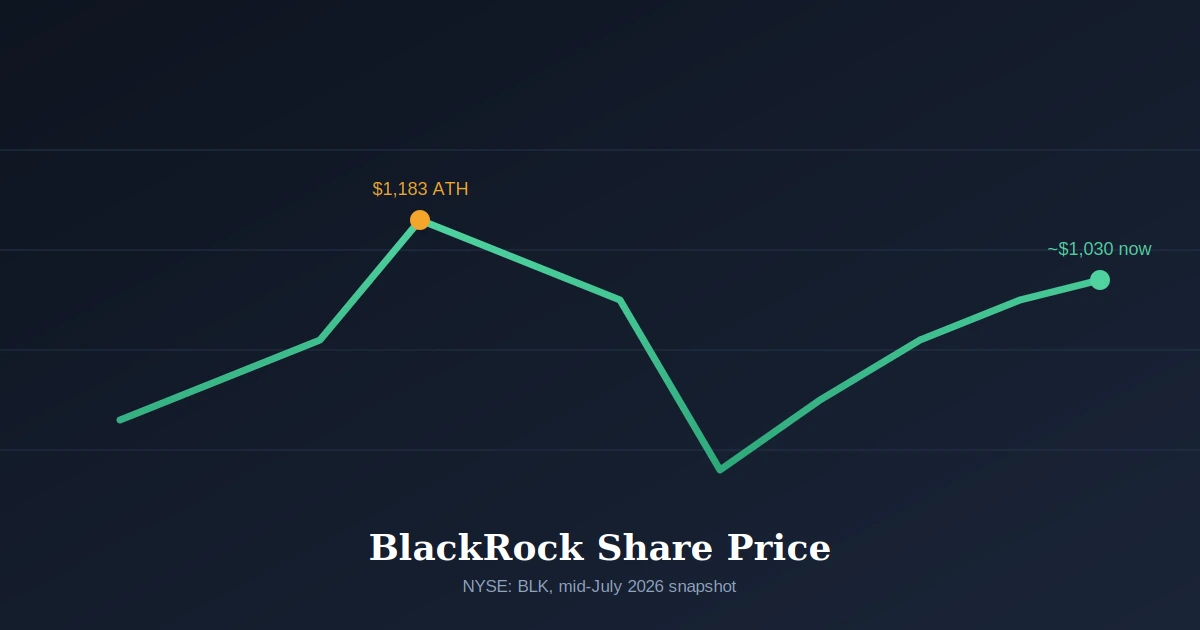
| All-time high | $1,183.47, closed October 15, 2025 |
| Market capitalization | Roughly $167.6 billion |
| P/E ratio | About 25.7x, above the 17.6x peer average |
| Dividend yield | Roughly 2.12% |
| Average analyst 12-month target | Roughly $1,251, implying about 21-25% upside |
| Analyst consensus | Buy, 14 analysts recommending buy, 0 recommending sell |
| Next earnings date | July 15, 2026, before market open |
Why BlackRock Share Price Pulled Back From Its October 2025 High
BLK hit its all-time closing high of $1,183.47 back in October 2025, and it’s spent the months since giving back a meaningful chunk of that gain, dropping as low as $982.40 in late June before recovering toward the $1,030 range. That’s not a crash by any measure, it’s a roughly 13 percent pullback from peak, but it’s worth understanding what’s actually behind it rather than just watching the number move.
Three things have weighed on the stock through this stretch. Valuation concerns are the biggest one, BlackRock’s P/E ratio of roughly 25.7x sits well above the 17.6x average for comparable capital markets companies, and several analysts have flagged the stock as priced for perfection at current levels even as the underlying business keeps performing well. Regulatory and scrutiny pressure around BlackRock’s private credit and alternative investment business has also weighed on sentiment, with the exit of the head of BlackRock’s Private Credit Fund adding to unease in that specific division. And broader market rotation, money moving toward other sectors during a mixed few months for financials generally, has pulled capital away from asset managers as a group, not just BlackRock specifically.
BlackRock Share Price and the Bitcoin ETF Connection
This is the part that makes BLK genuinely relevant to a crypto-focused audience rather than just a traditional finance story. BlackRock runs IBIT, the iShares Bitcoin Trust, which became the largest spot Bitcoin ETF in the US within months of its January 2024 launch and has stayed there since. BlackRock’s own earnings commentary has directly referenced a rebound in crypto ETF inflows as a growth driver, and the firm has continued expanding its digital asset lineup, including a newer Bitcoin income ETF designed to generate yield on top of price exposure rather than simply tracking spot price.
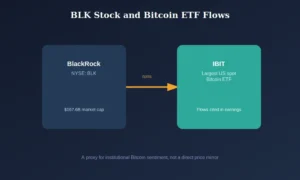
This matters for two reasons if you’re coming at this from a crypto angle rather than a traditional equities one. First, BlackRock’s stock price and ETF flow data have become a genuine proxy for institutional Bitcoin sentiment, when IBIT sees strong inflows, it shows up in BlackRock’s fee revenue and gets called out specifically in earnings calls. Second, BlackRock’s continued build-out into tokenized assets and blockchain-based infrastructure signals where a meaningful chunk of Wall Street’s largest asset manager sees the next decade of growth heading, which is a different kind of institutional validation than a single ETF launch on its own.
What Wall Street Analysts Are Saying About BlackRock Share Price
Analyst sentiment has stayed broadly positive even through the recent pullback, though price targets have moved in both directions recently, reflecting genuine disagreement about how much further BLK can run from here. Read More;
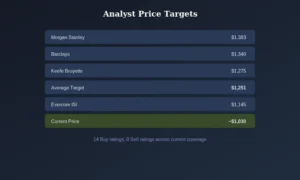
Morgan Stanley trimmed its target to $1,383 from $1,430 while maintaining an Overweight rating, still implying meaningful upside from current levels despite the cut. Evercore ISI raised its target to $1,145 from $1,140, keeping an Outperform rating. Keefe Bruyette raised its target more aggressively, to $1,275 from $1,240, also maintaining Outperform. Barclays raised its own target to $1,340 from $1,310 with an Overweight rating. Across all coverage, the average 12-month price target sits around $1,251, which would represent roughly 21 to 25 percent upside from current trading levels, and the consensus rating remains a clear Buy, with 14 analysts recommending buy and zero recommending sell.
BlackRock’s Q2 2026 Earnings, What to Watch
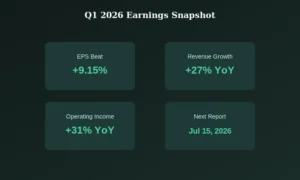
BlackRock reports second-quarter 2026 earnings before market open on July 15, 2026, and this report carries more weight than a typical quarterly check-in given the stock’s recent volatility. The company posted a strong first quarter, EPS of $12.53 beat forecasts by over 9 percent, and revenue rose 27 percent year-over-year to $6.7 billion, with operating income up 31 percent and margin expanding 130 basis points to 44.5 percent. Investors heading into Q2 results will be watching whether that momentum held, particularly around ETF and technology services growth, and whether management’s commentary on crypto ETF inflows shows continued strength or a slowdown from the earlier rebound they’d flagged.
BlackRock’s Dividend, What Income Investors Should Know
Beyond the growth story, BlackRock pays a dividend yielding roughly 2.12% at current share prices, and the company has a long track record of steady dividend increases tied to its consistent fee-based revenue model. For income-focused investors, that yield sits modestly above the broader S&P 500 average, though it’s not the primary reason most investors hold BLK, the stock is generally viewed as a growth-plus-income play rather than a pure high-yield holding. Several of BlackRock’s own iShares ETF products, ironically, offer considerably higher yields than the parent company’s own stock, which is worth knowing if income is your primary goal rather than exposure to BlackRock’s underlying business specifically.
How BlackRock Compares to Its Asset Management Peers
BlackRock trades at a premium to most of its direct competitors, and that premium is really the central debate among analysts covering the stock right now. Its 25.7x P/E ratio sits meaningfully above peers like T. Rowe Price Group and AllianceBernstein Holding, both of which trade at more traditional asset-manager multiples. Part of that premium is justified by BlackRock’s genuinely differentiated position, its Aladdin risk management platform generates recurring technology and subscription revenue that most competitors simply don’t have an equivalent to, and its ETF business, including its crypto ETF lineup, has structural growth tailwinds that legacy active management shops don’t share. The open question analysts keep circling back to is whether that differentiation justifies a 46 percent higher earnings multiple than the peer average, or whether the gap will narrow as competitors like Affiliated Managers Group close the technology and ETF gap over the next few years.
BlackRock’s Broader Crypto and Tokenization Strategy
IBIT gets most of the headlines, but it’s genuinely just the visible piece of a larger strategy. BlackRock has been vocal about tokenized assets, the process of representing traditional securities like money market funds or bonds as blockchain-based tokens, as a major growth area for the next decade of asset management. The firm’s BUIDL tokenized money market fund, launched on Ethereum, was an early and closely watched signal that BlackRock sees blockchain infrastructure as more than just a wrapper for Bitcoin exposure. For crypto-native investors, this broader tokenization push is arguably a more important long-term signal than IBIT’s day-to-day flows, since it points toward BlackRock treating blockchain rails as core financial infrastructure rather than a speculative side bet.
Is BlackRock Stock a Good Buy Right Now
This isn’t financial advice, and nobody should make an investment decision based on a single article. What’s genuinely true here is that BlackRock’s fundamentals remain strong, consistent double-digit revenue growth, an expanding fee base across ETFs and technology services, and a dominant position in both traditional and crypto-adjacent asset management. The tension, and it’s a real one, is that the stock’s current valuation already prices in a lot of that strength, at nearly 26 times earnings against a peer average closer to 18 times, there’s less room for error than the underlying business quality alone would suggest. Some analysis places the stock’s Excess Returns intrinsic value close to fair, meaning the earnings multiple view and the discounted cash flow view are telling somewhat different stories about how much upside is actually left.
For anyone holding BLK primarily as a way to track institutional crypto sentiment rather than a pure financials play, it’s worth remembering that BlackRock’s Bitcoin ETF business is still a relatively small piece of total company revenue next to its core asset management and technology services operations, so BLK share price moves don’t map directly onto Bitcoin price moves, even when the two headlines appear side by side.
Frequently Asked Questions
What is BlackRock’s share price today?
BlackRock (NYSE: BLK) is trading around $1,030 to $1,036 as of mid-July 2026, down from its all-time closing high of $1,183.47 reached in October 2025, but up from its 52-week low of $917.39.
Why has BlackRock’s share price dropped from its all-time high?
BlackRock’s share price has pulled back roughly 13% from its October 2025 peak due to valuation concerns at its current 25.7x P/E ratio, scrutiny around its private credit division, and a broader rotation of capital away from asset management stocks in recent months.
Does BlackRock stock relate to Bitcoin price?
BlackRock runs IBIT, the largest US spot Bitcoin ETF, and has cited crypto ETF inflows as a growth driver in earnings calls. However, BLK’s stock price reflects its entire diversified business, so it does not move in direct lockstep with Bitcoin’s price.
Is BlackRock stock a buy according to analysts?
Analyst consensus on BlackRock remains a Buy, with 14 analysts recommending buy and none recommending sell as of mid-2026. The average 12-month price target sits around $1,251, implying roughly 21 to 25% upside from current levels.
When does BlackRock report its next earnings?
BlackRock is scheduled to report second-quarter 2026 earnings before the market opens on July 15, 2026, following a strong first quarter that saw EPS beat forecasts by over 9% and revenue grow 27% year-over-year.











Comments 1