

The blockchain industry has grown rapidly over the last few years, with many projects trying to solve problems such as slow transactions, high fees, and limited scalability. Among these projects, Solana (SOL) has become one of the most recognized blockchain networks because of its focus on speed, efficiency, and decentralized applications.
Solana is a high-performance blockchain platform designed to support decentralized applications (dApps), smart contracts, decentralized finance (DeFi), and digital assets. The network uses a unique architecture that combines different technologies to process transactions quickly while maintaining security. Wikipedia
The native cryptocurrency of the Solana ecosystem is SOL, which is used for transaction fees, network participation, and supporting applications built on the blockchain.
In this complete guide, we will explain:
- What Solana (SOL) is
- How Solana blockchain works
- What makes Solana different
- SOL token utility
- Solana ecosystem
- Advantages and challenges
- Solana vs Ethereum comparison
- Frequently asked questions
What Is Solana (SOL)?
Solana (SOL) is a decentralized blockchain platform created to support fast and scalable applications. Unlike traditional blockchain networks that may struggle with transaction speed during high usage periods, Solana focuses on improving blockchain performance.
The Solana network was designed for developers who want to build:
- Decentralized applications (dApps)
- DeFi platforms
- NFT marketplaces
- Blockchain games
- Web3 applications
The native cryptocurrency of the network is called SOL.
Users can use SOL for:
- Paying transaction fees
- Staking to support network security
- Interacting with applications built on Solana
How Does Solana Blockchain Work?
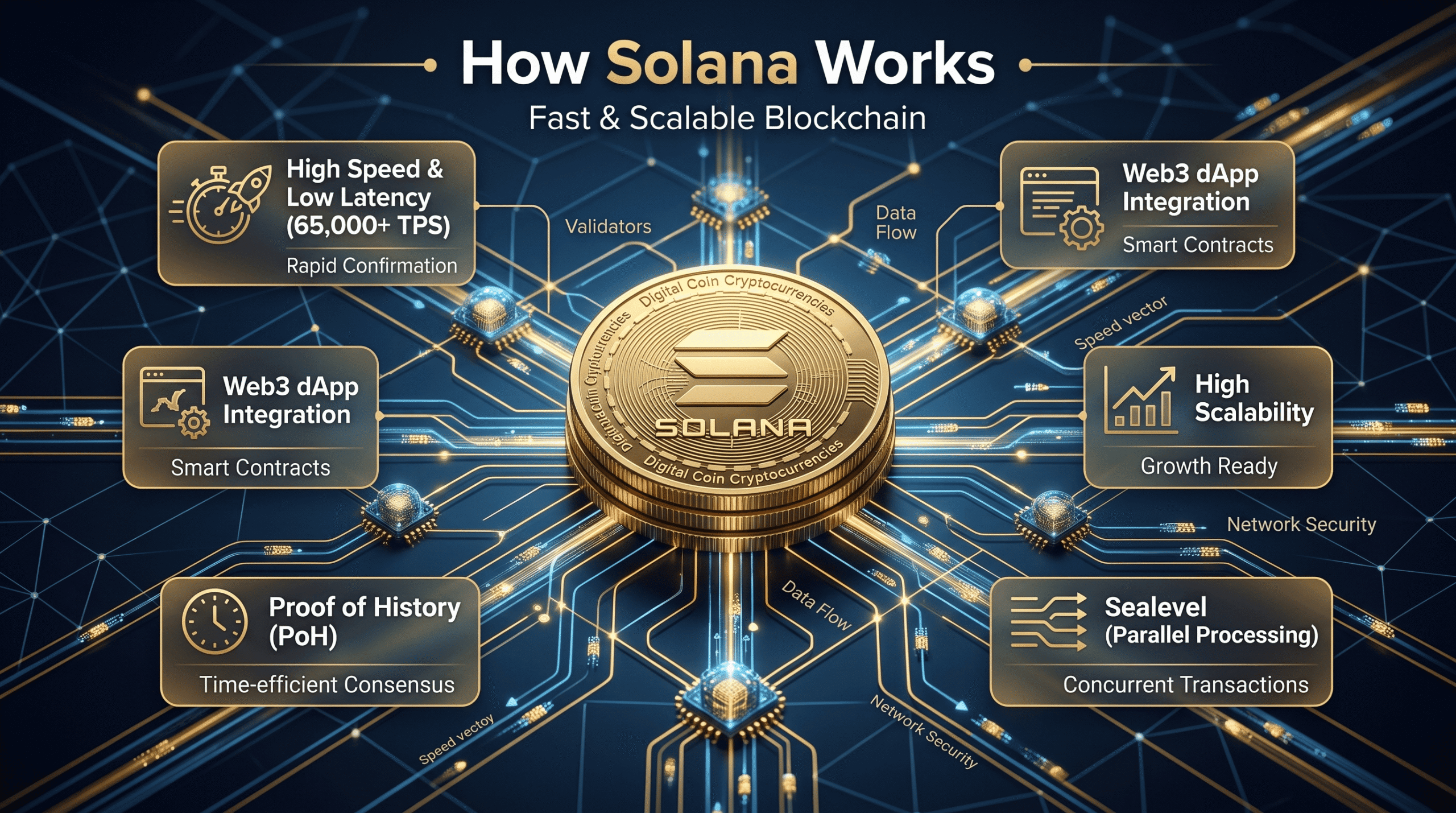
Solana uses a combination of technologies to improve transaction processing and network efficiency.
Two important components of Solana are:
1. Proof of History (PoH)
One of Solana’s unique technologies is Proof of History.
Proof of History helps create a historical record of events on the blockchain by providing a way to verify the order of transactions.
This allows the network to process information more efficiently.
2. Proof of Stake (PoS)
Solana also uses a Proof of Stake mechanism.
Validators help maintain the network by:
- Confirming transactions
- Securing the blockchain
- Participating in consensus
Users can delegate their SOL tokens to validators and participate in network security.
Why Is Solana Different From Other Blockchains?
Solana gained popularity because it focuses on solving some common blockchain challenges.
1. High Transaction Speed
Traditional blockchains can experience delays when network activity increases.
Solana was designed to handle a high number of transactions, making it attractive for applications requiring fast processing.
2. Lower Transaction Costs
Transaction fees are an important factor for blockchain users.
Solana aims to provide low-cost transactions compared with many older blockchain networks.
This makes it suitable for:
- Frequent transactions
- Gaming applications
- DeFi platforms
3. Developer-Friendly Ecosystem
Solana provides tools and infrastructure for developers building Web3 applications.
The ecosystem includes:
- DeFi projects
- NFT platforms
- Gaming applications
- Digital marketplaces
What Is SOL Token Used For?
SOL is the native cryptocurrency of the Solana network.
Main Uses of SOL:
Transaction Fees
Users pay network fees using SOL when interacting with applications or transferring assets.
Staking
SOL holders can participate in network security by staking their tokens with validators.
Ecosystem Participation
SOL is used throughout Solana-based applications, including decentralized exchanges, NFT platforms, and Web3 projects.
Solana Ecosystem: What Can You Build on Solana?
The Solana ecosystem has expanded beyond a simple cryptocurrency network. Today, developers use Solana to create different types of blockchain-based applications, including decentralized finance platforms, NFT marketplaces, gaming projects, and Web3 applications. Solana
Some major areas of the Solana ecosystem include:
1. Decentralized Finance (DeFi)
Solana supports various DeFi applications that allow users to access financial services without traditional intermediaries.
Examples include:
- Decentralized exchanges (DEXs)
- Lending platforms
- Token swapping services
- Liquidity protocols
The fast transaction speed and lower fees make Solana attractive for applications that require frequent transactions.
2. NFTs and Digital Assets
Solana became popular in the NFT space because of its ability to process transactions quickly with relatively low costs.
Creators and developers use Solana for:
- Digital collectibles
- NFT marketplaces
- Gaming assets
- Digital ownership applications
3. Web3 Applications
Solana provides infrastructure for developers building next-generation internet applications.
These include:
- Blockchain games
- Social platforms
- Payment solutions
- Digital identity applications
Developers can build and deploy applications using Solana’s developer tools and ecosystem resources. Solana
Solana vs Ethereum: What Is the Difference?
Solana and Ethereum are both blockchain platforms that support smart contracts and decentralized applications, but their designs are different.
| Feature | Solana (SOL) | Ethereum (ETH) |
|---|---|---|
| Main Purpose | High-performance blockchain applications | Smart contracts and decentralized applications |
| Transaction Speed | Designed for high-speed processing | Improved through upgrades and Layer 2 solutions |
| Fees | Generally lower transaction costs | Can vary depending on network activity |
| Consensus | Proof of Stake + Proof of History | Proof of Stake |
| Ecosystem | Growing DeFi, NFT, Web3 ecosystem | Largest smart contract ecosystem |
Solana focuses heavily on speed and scalability, while Ethereum has a long-established developer ecosystem and network adoption. VanEck Belgium | ETFs
Advantages of Solana (SOL)
1. Fast Transaction Processing
One of Solana’s biggest advantages is its ability to process transactions quickly.
This makes it suitable for applications where users need fast confirmations.
2. Low Transaction Costs
High transaction fees can make blockchain applications difficult to use.
Solana aims to provide affordable transactions, which can benefit users and developers building applications.
3. Strong Developer Ecosystem
Solana has attracted developers building:
- DeFi platforms
- Gaming applications
- NFT projects
- Financial technology solutions
A strong developer ecosystem can help expand blockchain adoption.
Challenges and Risks of Solana
Although Solana has gained significant attention, it also faces challenges.
1. Network Reliability Concerns
In the past, Solana experienced technical issues and network interruptions during periods of high activity. These events highlighted the importance of improving network stability and reliability. Wikipedia
2. Competition From Other Blockchains
Solana operates in a highly competitive blockchain market.
It competes with:
- Ethereum
- Avalanche
- Cardano
- Polygon
- Other Layer 1 networks
Each project has its own approach to scalability and application development.
3. Market Volatility
Like other cryptocurrencies, SOL price movements can be affected by:
- Market sentiment
- Economic conditions
- Regulatory developments
- Overall crypto trends
Cryptocurrency markets can experience significant price fluctuations.
Solana Future Outlook
The future development of Solana depends on several factors.
Growth Opportunities:
Increasing Blockchain Adoption
As more businesses and developers explore blockchain technology, demand for scalable networks may increase.
Expansion of Web3 Applications
Growth in areas such as:
- Gaming
- Digital payments
- Decentralized finance
could create more use cases for Solana.
Developer Innovation
New applications and improvements from developers can influence the long-term growth of the ecosystem.
Is Solana (SOL) a Good Blockchain Project?
Solana has become one of the most recognized blockchain networks because of its focus on speed, scalability, and application development.
However, understanding any cryptocurrency project requires looking at multiple factors:
- Technology
- Adoption
- Competition
- Security
- Market conditions
A blockchain’s future depends on real-world usage, continued development, and ecosystem growth.
How to Buy Solana (SOL)?
Users can generally acquire SOL through cryptocurrency exchanges that support the token.
Basic steps include:
- Choose a cryptocurrency exchange
- Create and verify an account
- Deposit funds
- Purchase SOL tokens
- Store SOL in a compatible wallet
Always research security practices before using any crypto platform.
Frequently Asked Questions (FAQ)
What is Solana (SOL)?
Solana is a high-performance blockchain platform designed for decentralized applications, smart contracts, payments, and Web3 projects. Its native cryptocurrency is SOL. Solana
What is SOL token used for?
SOL is used for transaction fees, staking, and interacting with applications built on the Solana network.
Why is Solana popular?
Solana became popular because of its focus on fast transactions, lower costs, and support for decentralized applications.
Is Solana better than Ethereum?
Solana and Ethereum have different strengths. Solana focuses on speed and scalability, while Ethereum has a larger established ecosystem. Users and developers evaluate both networks based on their needs.
What makes Solana different?
Solana uses a combination of Proof of History and Proof of Stake technologies to improve transaction processing efficiency.
Conclusion
Solana (SOL) is one of the leading blockchain platforms focused on creating a fast and scalable environment for decentralized applications.
With its unique technology, growing ecosystem, and focus on Web3 development, Solana has become an important project in the cryptocurrency industry.
However, like all blockchain networks, Solana faces challenges including competition, technical risks, and market volatility.
Understanding how Solana works, what problems it solves, and where it fits in the broader blockchain ecosystem can help users better understand its role in the future of decentralized technology.