

I downloaded three different prediction market apps in the same week, funded each one with a small amount, and tried to actually withdraw. One took four days and released the money in chunks. One settled instantly through a regulated exchange rail. One made me verify a wallet address before it would move a cent. Same category of product, three completely different experiences. That gap is exactly what most prediction market app articles skip over, because they’re too busy listing sign-up bonuses to explain how these platforms are actually built underneath.
This guide breaks down how prediction market apps actually work, why some run on blockchain rails and others run through regulated derivatives exchanges, what that difference means for your money, and the legal landscape that’s shifting fast enough to catch users off guard in 2026.
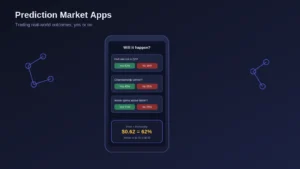
Every prediction market app boils down to the same core mechanic: price reflects probability.
What Is a Prediction Market App?
A prediction market app lets you trade contracts on the outcome of real-world events, elections, sports results, economic data, entertainment milestones, pretty much anything with a defined yes-or-no resolution. You’re not betting against a bookmaker’s odds. You’re trading against other users, and the price of a contract reflects the market’s collective estimate of how likely that outcome is.
Quick snippet answer: A prediction market app is a trading platform where users buy and sell contracts tied to future event outcomes, with contract prices representing the probability of that outcome occurring, settling at $1 if correct and $0 if not.
How Prediction Market Apps Actually Work
Every contract, no matter which app you’re on, follows roughly the same mechanic. If a contract is trading at 62 cents, the market is pricing that outcome at a 62 percent chance of happening. Buy at that price, and if you’re right, the contract settles at a dollar. If you’re wrong, it settles at zero. Simple on paper, but the mechanics behind how that price forms and how your money gets held vary enormously depending on which type of app you’re using.
- Contract price doubles as an implied probability, updating in real time as new information hits the market
- You can typically sell your position before resolution instead of holding to settlement
- Liquidity depth determines how much your own trade will move the price, thin markets can slip badly
- Resolution sources vary, some use manual review, others increasingly lean on automated or AI-driven resolution
Crypto-Native vs Regulated Exchange-Style Prediction Market Apps
This is the distinction almost nobody explains clearly, and it’s the single most important thing to understand before funding any account.
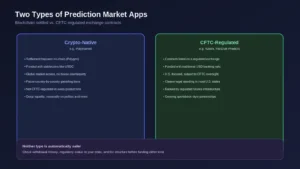
The infrastructure behind a prediction market app changes how your funds move, not just how the app looks.
Crypto-Native Prediction Market Apps
Platforms like Polymarket settle trades on-chain, typically on Polygon, and are funded using stablecoins like USDC rather than a direct bank transfer. This gives them global reach and a level of settlement transparency you can independently verify on a block explorer, but it also means they’ve run into gambling-license disputes in multiple countries, since blockchain-based markets don’t automatically fall under the same licensing frameworks as traditional derivatives exchanges.
CFTC-Regulated Prediction Market Apps
Platforms like Kalshi and FanDuel Predicts list their contracts on a regulated derivatives exchange overseen by the Commodity Futures Trading Commission. FanDuel Predicts, for example, runs through a joint venture with CME Group, meaning contracts are listed on established CME derivatives infrastructure and cleared through a registered futures commission merchant. That regulatory backing generally means clearer legal standing across U.S. states, but it doesn’t automatically mean better pricing or lower fees, those still vary platform to platform.
Sportsbook-Style Hybrids
Apps like ProphetX borrow the visual language of sports betting apps, parlays, live in-game trading, player props, but structure trades as peer-to-peer market contracts rather than house-set odds. The distinction matters for pricing: without a traditional sportsbook margin baked in, prices theoretically reflect user consensus more directly, though liquidity and spread still affect what you actually pay.
Is a Prediction Market App Legal? The Regulatory Patchwork
This is where things get genuinely complicated, and where most competing content gives you an outdated or oversimplified answer.
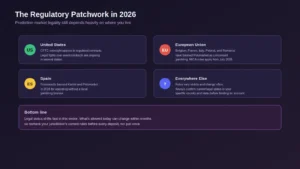
Legal status for prediction market apps depends heavily on your country, and sometimes your state.
In the United States, prediction markets have operated under CFTC oversight since the early 2000s, but political event contracts specifically have gone through years of legal back-and-forth. Kalshi sued the CFTC over political contracts and won a favorable district court ruling in 2024, and the agency’s approach has continued shifting since. Multiple state-level legal challenges are still working their way through courts as of 2026, so U.S. legality can vary by state and by contract type, not just by platform.
Internationally, the picture is more fragmented. Belgium, France, Italy, Poland, and Romania have banned Polymarket outright as an unlicensed gambling platform. Spain issued a temporary ban on both Kalshi and Polymarket in 2026 for operating without a local gambling license. The EU’s MiCA regulation, which took effect in July 2026, adds another compliance layer specifically for prediction markets that touch crypto assets. None of this is static. Treat any legal status you read, including this article, as a snapshot, not a permanent answer, and check current rules for your specific location before funding an account.
Why Blockchain Fits the Prediction Market App Use Case
There’s a real technical reason crypto rails show up so often in this space, beyond just chasing a trend. Prediction markets need transparent, tamper-resistant settlement, since disputes over whether an event resolved correctly are the single biggest trust risk in the category. On-chain settlement gives users a public, independently verifiable record of exactly how and when a contract resolved, which is harder to fake or quietly alter after the fact than an internal database entry on a closed platform. Stablecoin funding also sidesteps some of the cross-border banking friction that made early prediction markets clunky to access outside the U.S. That said, on-chain transparency doesn’t eliminate counterparty and regulatory risk, it just shifts what kind of risk you’re managing.
Red Flags to Check Before You Fund Any Prediction Market App
No sugar coating here. This is still an early, fast-moving product category, and not every app handles user funds the same way.
- Withdrawal speed and consistency, chunked or delayed withdrawals are a recurring complaint across multiple platforms
- Whether the platform is actually regulated in your jurisdiction, or operating in a legal gray zone there
- Market resolution process, manual review versus automated or AI-driven resolution changes dispute risk significantly
- Liquidity depth on the specific market you want to trade, not just the platform’s overall volume
- Fee structure, since contract-based pricing can hide costs that a simple percentage fee would make obvious
If you followed how prediction markets moved during recent political events, our coverage of Polymarket activity around the government shutdown is a good real-world look at how fast liquidity and pricing can shift when a high-attention event is actively unfolding.
How to Choose the Right Prediction Market App
There’s no single best prediction market app for everyone, it depends on what you’re actually trying to do.
- Want the widest range of global political and news markets: crypto-native platforms tend to offer more breadth
- Want the clearest U.S. regulatory footing: CFTC-regulated platforms are generally the more conservative choice
- Want a sportsbook-familiar interface: hybrid apps built around parlays and live sports trading fit that use case best
- Care most about fund transparency: on-chain settlement gives you an independently verifiable resolution trail
Whichever type you pick, start small. This is a product category where the underlying infrastructure, the regulatory status, and even the resolution process can shift with little warning.
A Quick History: Prediction Markets Didn’t Start With an App
The concept is older than the current wave of mobile platforms suggests. HedgeStreet became the first prediction market approved by the CFTC as a designated contract market back in 2004, and it later got acquired and rebranded before eventually landing inside Crypto.com’s portfolio. Long before that, academic researchers ran the Iowa Electronic Markets starting in the early 1990s to study whether market pricing could forecast elections more accurately than polling, and it often did. Corporations picked up on the same idea internally: pharmaceutical company Eli Lilly used internal prediction markets to forecast which drugs in development were most likely to clear clinical trials. The current prediction market app boom didn’t invent this mechanism, it just put a polished mobile interface and blockchain settlement on top of a forecasting tool that’s been quietly proving itself for three decades.
Tax and Record-Keeping Considerations
This is the part almost every prediction market app guide skips entirely, and it matters the moment you actually withdraw a profit. In the U.S., gains from prediction market contracts are generally treated as taxable income, and depending on the platform’s regulatory structure, you may receive different tax documentation, or none at all if you’re trading through a crypto-native platform that doesn’t issue traditional tax forms. Keep your own transaction records regardless of which app you use: entry price, exit price, dates, and contract details. Relying on a platform’s dashboard alone can leave you scrambling at tax time, especially if you’re active across more than one app with different reporting practices. This isn’t tax advice, and rules vary by country, so confirm your specific obligations with a tax professional rather than assuming any platform’s default reporting covers you completely.
Frequently Asked Questions
What is a prediction market app?
A prediction market app is a platform where users trade contracts tied to the outcome of real-world events. Contract prices represent the market’s implied probability of an outcome, and contracts settle at $1 if the outcome occurs or $0 if it doesn’t.
Is a prediction market app the same as gambling?
Not legally, in the U.S. regulated prediction market contracts are overseen by the CFTC as derivatives, distinct from gambling. Several other countries classify platforms like Polymarket as unlicensed gambling, though, so classification depends heavily on jurisdiction.
Which prediction market app is the most trusted?
Trust depends on what you value. Kalshi and FanDuel Predicts offer CFTC-regulated contracts with clearer U.S. legal standing, while Polymarket offers on-chain settlement transparency and broader global market coverage. Neither type is automatically safer than the other.
Can you actually make money on a prediction market app?
Yes, users who accurately price probability relative to the market can profit, but outcomes are genuinely uncertain and losses are just as real. Treat any prediction market activity as speculative trading, not a guaranteed income source.
Is a prediction market app legal in my country?
It depends. The U.S. permits CFTC-regulated contracts, but several EU countries have banned crypto-native platforms as unlicensed gambling, and rules are actively changing under frameworks like MiCA. Always verify current local regulation before funding an account.
Final Take
A prediction market app isn’t one single kind of product, it’s a category split between blockchain-settled platforms chasing global reach and regulated exchanges chasing U.S. legal clarity, with sportsbook-style hybrids trying to bridge the gap. None of that is inherently good or bad, but conflating them, treating Polymarket and Kalshi as interchangeable just because they both show yes and no percentages, is exactly how people end up surprised by a slow withdrawal or an unexpected regulatory freeze. Know which type of app you’re using, check its current legal status where you live, and size your positions like the speculative activity it actually is.