

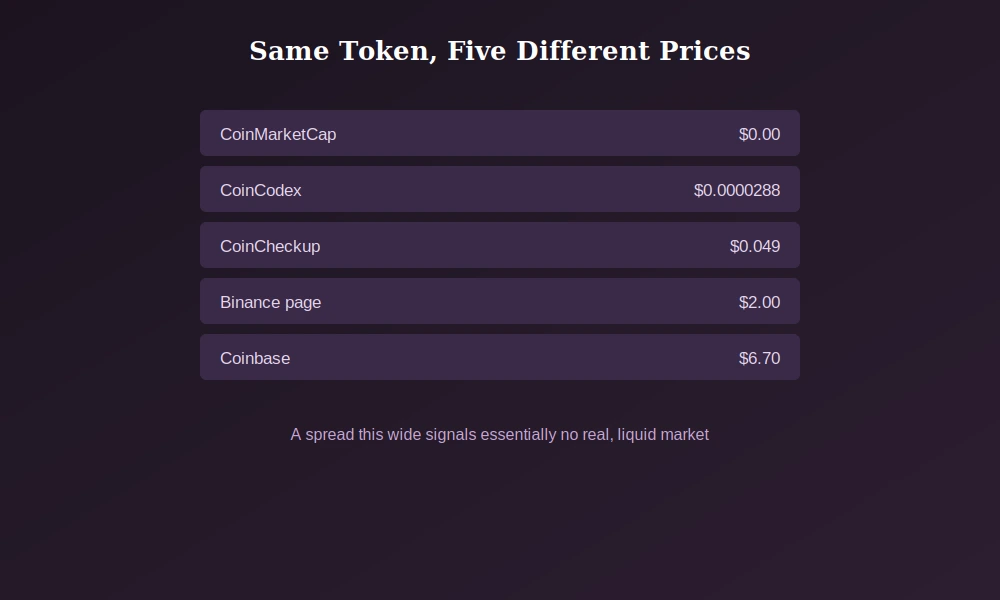
If you searched “CV Token” hoping for a straightforward answer on price, market cap, or whether it’s worth buying, here’s the honest version nobody’s giving you straight. Pull up five different crypto trackers for CV Token right now and you’ll get five different prices, ranging from a fraction of a cent to over six dollars, with a market cap that reads exactly $0 on the platforms that actually matter. That’s not a data glitch worth ignoring. That’s the whole story, and it’s worth understanding properly before you go anywhere near this ticker.
What Is CV Token, Exactly
CV Token, trading under the ticker CVT, launched in 2023 on the BNB Smart Chain as the proposed native currency for a metaverse platform, according to its own whitepaper. The pitch describes CVT as a way to purchase virtual goods, trade virtual real estate, and participate in governance inside a planned virtual world, funded initially through a presale conducted in BEP20 USDT across multiple platforms starting in October 2023.
That’s the pitch. What actually exists today looks considerably thinner than what the whitepaper describes.
The Confusing Part, Multiple Coins Share Similar Names
Before going further, it’s worth clearing up a genuine source of confusion in the search results for this term, because it trips up a lot of people doing casual research.
CV Token (CVT), the BNB Chain Metaverse Presale Coin
This is the token most “cv token” searches are actually looking for, the BNB Smart Chain metaverse project described above.
carVertical (CV), a Different, Established Project Entirely
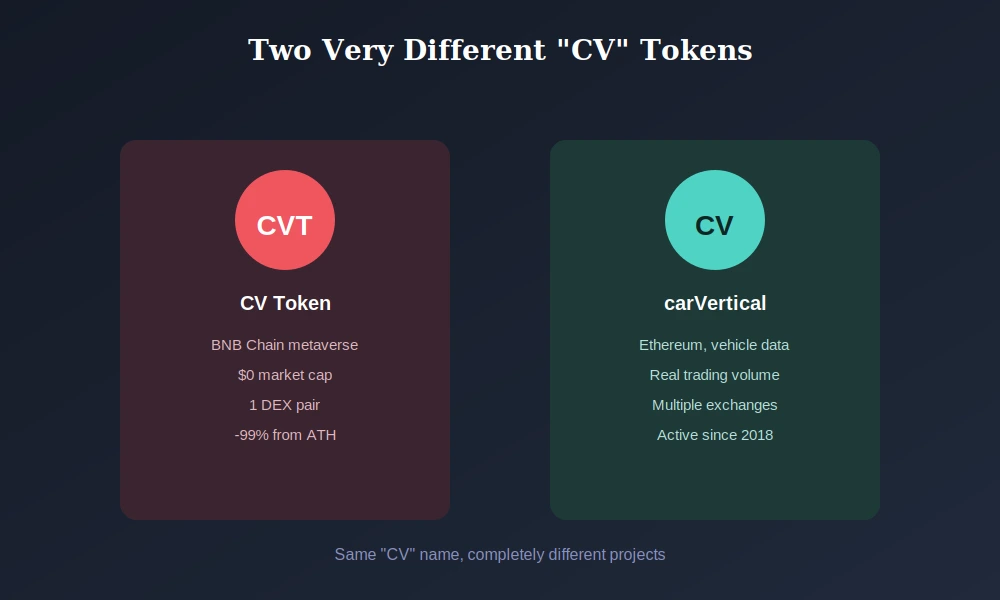
Separately, there’s carVertical, a genuinely different and considerably more established project running on Ethereum since 2018, focused on vehicle history and mileage fraud detection using blockchain records. It has real trading volume, active development, and a completely different use case. If you’re seeing a token called “CV” with billions in supply and actual daily trading activity, that’s almost certainly carVertical, not CV Token. Here’s a side-by-side to keep them straight.
| Detail | CV Token (CVT) | carVertical (CV) |
| Blockchain | BNB Smart Chain (BEP20) | Ethereum |
| Launched | 2023, via presale | 2018, via public ICO |
| Stated purpose | Native currency for a proposed metaverse platform | Vehicle history and mileage fraud detection on-chain |
| Market cap | $0 on major trackers | Actively tracked, real trading volume |
| Exchange listings | 1 DEX pair, negligible volume | Multiple exchanges |
CV Token’s Tokenomics, What the Whitepaper Actually Claims
According to its whitepaper, CV Token was structured with a total supply of 50 million tokens, later cited elsewhere as 42.5 million, an inconsistency worth noting on its own. The project describes a deflationary burning mechanism, with 5 percent of total supply burned monthly, theoretically pushing the internal price upward over time as supply shrinks. Half of presale funds were earmarked for platform development, team recruitment, and system upgrades, with the remainder allocated toward marketing and promotional activity aimed at growing investor awareness.
On paper, a burn mechanism tied to platform revenue isn’t inherently a red flag, plenty of legitimate tokens use similar deflationary designs. The issue isn’t the mechanism, it’s what’s actually observable about the project today versus what the whitepaper promised back in 2023.
Red Flags Worth Taking Seriously Before Going Further
Zero Market Cap Across Every Major Tracker
CoinMarketCap, Coinbase, and Binance’s own pricing pages all list CV Token’s market capitalization as $0, despite showing a circulating supply figure. A market cap of exactly zero on multiple independent, major platforms simultaneously typically means either the circulating supply data is unverified and unreliable, or there’s effectively no functioning market pricing this asset in a way these platforms trust enough to calculate a real number.
Wildly Inconsistent Price Data
This is the detail that should stop anyone doing real due diligence in their tracks. At effectively the same point in time, different trackers have shown CV Token priced anywhere from roughly $0.00002 to over $6.70, a difference of more than five orders of magnitude. Legitimate, actively traded tokens don’t show this kind of variance between data sources, because real trading activity across multiple venues keeps prices roughly aligned. This kind of spread almost always signals extremely thin or effectively nonexistent trading, where a single tiny transaction can swing the “price” a tracker reports by enormous percentages.
Near-Zero Trading Volume and a Single Listing
CV Token trades on exactly one decentralized exchange pair, PancakeSwap V2 on BNB Chain, with 24-hour trading volume reported at times under one dollar. A token with genuine, sustained utility and an active community typically shows liquidity across multiple venues. A single thin trading pair with sub-dollar daily volume is a token that’s either been abandoned by its original team, never gained real traction past its presale, or both.
The Price Chart Tells Its Own Story
CV Token’s all-time high was $18.02, reached in December 2024. By August 2025, it had fallen to $0.02961, a decline of more than 99.8 percent. That specific pattern, a presale-funded token spiking hard shortly after launch before collapsing to near-zero and staying there, is one of the most well-documented patterns in crypto, and it’s worth understanding regardless of whether it applies to any specific project.
This shape of chart shows up often enough in crypto that it has its own name, a pump and dump, where early promotion and presale hype drive a sharp price spike, insiders and early buyers sell into that spike, and the price collapses once buying pressure from new entrants dries up. This isn’t a claim that CV Token was deliberately engineered this way, there’s no way to confirm that from public data alone, but the price pattern itself matches the shape closely enough that it deserves real scrutiny rather than a shrug.
How to Actually Research Any Small Token Before You Touch It
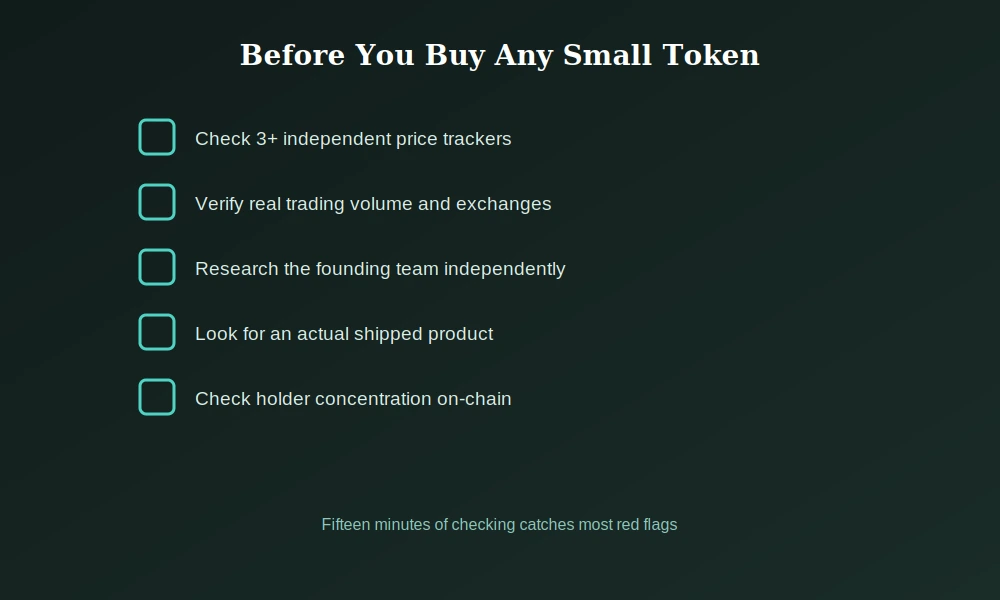
Whatever token you’re looking at, not just this one, a few checks take less than fifteen minutes and catch most obvious problems. Check whether the market cap and price shown are consistent across at least three independent trackers, not just the project’s own website. Look up the actual trading volume and how many exchanges list it, a token on one thin DEX pair carries fundamentally different risk than one listed across major centralized exchanges. Search for the founding team by name outside the project’s own materials, and see whether they have a verifiable history in the space. And check whether the project has published any actual product, not just a roadmap and a whitepaper, more than a year after launch.
It’s also worth checking the token’s contract directly on a block explorer rather than trusting a project’s own dashboard. Look at how concentrated the holder distribution is, if a handful of wallets control the overwhelming majority of supply, that’s a meaningful centralization and dump risk regardless of what the marketing materials say. Community activity is worth a quick look too, not the follower count, which is trivially inflated, but whether there’s genuine back-and-forth discussion happening, questions getting answered, and updates that describe specific, verifiable progress rather than vague future promises.
Why This Kind of Due Diligence Matters More in a Down Market
Low-quality presale tokens tend to multiply during bull runs, when enthusiasm outpaces scrutiny and almost anything with a whitepaper and a countdown timer can raise money. The real test comes later, during quieter or bearish stretches of the market, when hype fades and only projects with genuine usage, active development, and real liquidity keep functioning normally. CV Token’s current state, essentially untraded, inconsistently priced, and far below its earlier high, is a fairly textbook example of what that later stage looks like for a project that didn’t clear that bar. That’s useful context to carry into evaluating any other small-cap token, not just this specific one.
Is CV Token Worth Buying
This isn’t financial advice, and nobody should treat a single article as the basis for a purchase decision. What’s factually true here is that CV Token currently shows no meaningful market cap on major trackers, trades on a single low-liquidity venue, has publicly inconsistent tokenomics figures, and has lost over 99 percent of its value from its all-time high with essentially no recovery. None of that guarantees the project is fraudulent, some presale tokens genuinely do struggle to gain traction without any bad intent involved, but the combination of red flags here is significant enough that anyone considering it should treat it as an extremely high-risk, speculative position at best, and verify every claim independently before committing any money.
What This Case Teaches About Presale and Microcap Tokens Generally
CV Token isn’t a uniquely bad case, it’s a fairly typical example of what happens to a large share of presale-funded tokens that launch during a hype cycle and don’t manage to build a real product or user base afterward. The lesson isn’t that every small-cap or presale token is worthless, some genuinely do build lasting projects. It’s that the burden of proof sits entirely on the token to demonstrate real activity, consistent data, and actual usage, and the moment a project can’t clear that bar cleanly, treating it with real skepticism is the responsible default, not the exception.
Frequently Asked Questions
What is CV Token (CVT)?
CV Token is a cryptocurrency launched in 2023 on the BNB Smart Chain, pitched as the native currency for a proposed metaverse platform. It currently shows a $0 market cap on major trackers and trades with minimal volume on a single decentralized exchange pair.
Is CV Token the same as carVertical?
No. CV Token (CVT) is a separate, much smaller BNB Chain project, while carVertical (CV) is an established Ethereum-based project focused on vehicle history verification, launched in 2018 with active trading volume across multiple exchanges.
Why does CV Token show a $0 market cap?
A $0 market cap on major trackers like CoinMarketCap and Coinbase typically indicates unreliable circulating supply data or effectively no verified, liquid trading market for the token, both of which apply to CV Token based on current public data.
Is CV Token safe to invest in?
This isn’t financial advice, but publicly available data shows significant red flags, including inconsistent pricing across trackers, near-zero trading volume, and a greater than 99% decline from its all-time high, all of which warrant extreme caution and independent verification before any investment.
Where can I buy CV Token?
CV Token is currently traded on PancakeSwap V2 on the BNB Smart Chain, with negligible daily trading volume. It is not listed on major centralized exchanges like Binance or Coinbase for direct purchase.