

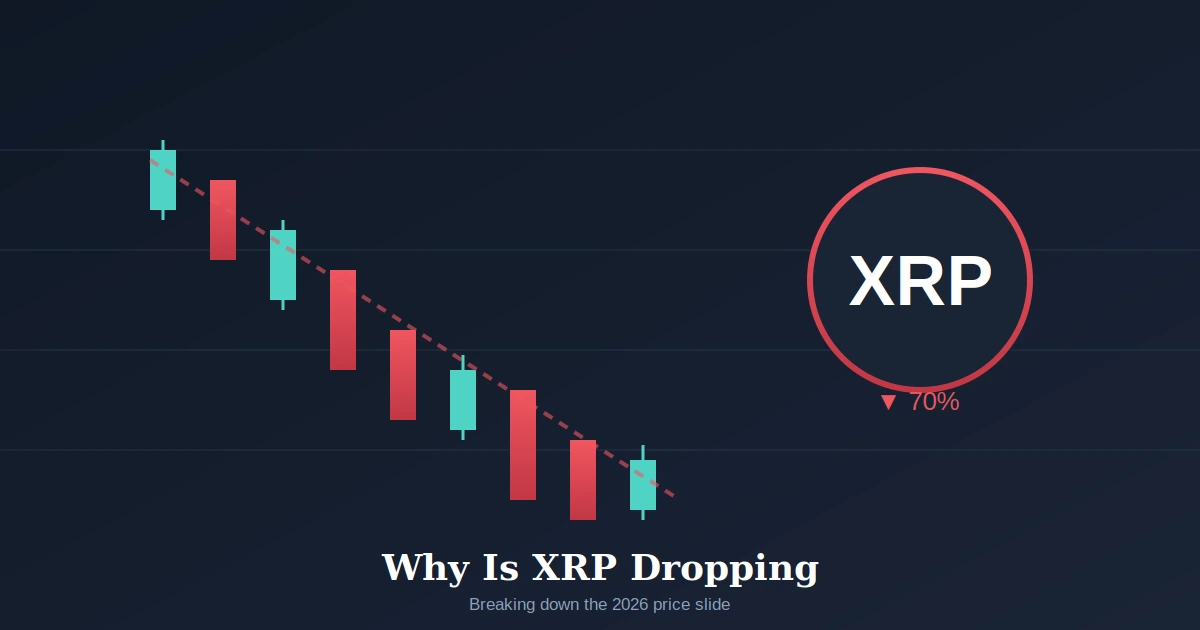
Here’s the part of this story that doesn’t add up at first glance. Ripple won its four-year legal fight with the SEC. A spot XRP ETF actually launched in the US. Institutions are buying more of it than ever. And XRP is still sitting around $1.04, down roughly 70 percent from where it stood a year ago. If good news was supposed to send this thing higher, someone forgot to tell the price chart. Here’s what’s actually driving the drop, without the vague hand-waving most coverage settles for.
Why Is XRP Dropping, the Short Answer
XRP is dropping because of four things happening at once, Ripple’s routine monthly token unlocks adding fresh supply, a broad crypto market sell-off dragging every major coin down together, mounting uncertainty over whether the CLARITY Act will actually pass the Senate this year, and fresh compliance anxiety following California’s new crypto regulation. None of these alone would cause a 70 percent decline. Stacked together, and landing during a broader risk-off mood driven by Federal Reserve rate uncertainty, they’ve been enough to keep XRP pinned near its lowest levels in over a year.
XRP’s Price Right Now, By the Numbers
Before getting into the why, here’s exactly where things stand as of early July 2026.
| Metric | Where things stand (early July 2026) |
| Current price range | Roughly $1.00 to $1.08 |
| Decline from cycle high | About 70% below the $3.66 peak reached in July 2025 |
| Critical support | $1.00, with an air pocket down to $0.80-0.85 if it breaks |
| Key resistance | $1.13 to $1.20, near the 200-day moving average |
| RSI reading | Near 32, in oversold territory |
| Fear and Greed Index | Deep in Extreme Fear territory |
| CLARITY Act passage odds | Roughly 42-50% for 2026, down from over 70% in May |
Reason One, Ripple’s Monthly Escrow Unlocks
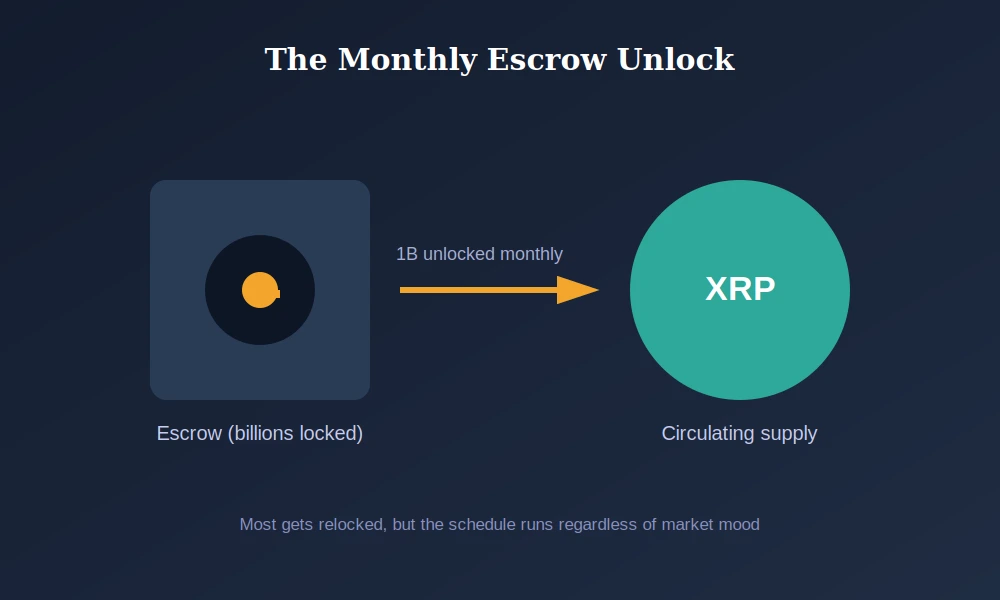
Ripple locked billions of XRP into escrow contracts years ago specifically to prevent dumping the entire supply on the market at once. Each month, up to 1 billion XRP unlocks from escrow. Ripple typically relocks the majority of it into a new escrow contract and only releases a smaller portion into actual circulation, but the release still happens on a fixed schedule regardless of whether the market wants more supply at that moment. Traders watch these unlock dates closely, and even when the actual circulating increase is modest, the psychological effect of “more XRP just hit the market” tends to weigh on short-term sentiment, especially during weeks when the broader market is already nervous.
Reason Two, the Broader Crypto Market Sell-Off
XRP didn’t fall in isolation. Bitcoin dropped below $59,000 to $60,000 during the same stretch, and Ethereum, Solana, and BNB all slid alongside it. When the largest cryptocurrencies fall together like this, it’s a signal the selling is driven by macro fear rather than anything specific to one project. A single wave of forced liquidations wiped out roughly $326 million in leveraged positions on June 29 alone, adding fuel to an already jittery market. XRP has historically moved with a higher beta than Bitcoin, meaning it tends to fall harder during downturns and rally harder during recoveries, which is exactly what’s played out here. A rough month for crypto broadly hits XRP disproportionately, not because anything went wrong at Ripple specifically, but because that’s simply how this asset tends to behave relative to the rest of the market.
Reason Three, the CLARITY Act Keeps Slipping
This is arguably the single biggest swing factor hanging over XRP’s price right now, and it’s worth understanding properly rather than just knowing the name.
What the CLARITY Act Actually Does
The CLARITY Act would permanently classify XRP as a commodity under US federal law, replacing an interpretive joint classification the SEC and CFTC issued back in March 2026, one that a future administration could reverse without needing a single congressional vote. Permanent legal clarity like this removes a meaningful layer of regulatory risk that’s hung over XRP for years.
Why the Senate Timeline Keeps Slipping
The bill has already cleared real hurdles, the House passed its version by a wide 294 to 134 margin back in mid-2025, and the Senate Banking Committee advanced its own version in May 2026 by a 15 to 9 vote, a moment that briefly pushed XRP above $1.50. But getting a full Senate floor vote requires 60 votes to overcome a filibuster, which means roughly seven Democratic senators need to cross the aisle, and that gap hasn’t closed yet. The White House had targeted a July 4 signing, but the Senate left for a holiday recess on June 29 and doesn’t return until July 13, with a defense bill sitting ahead of it in the queue. Market analysts have cut their odds of passage this year from over 70 percent in May down to somewhere between 42 and 50 percent now. Every week that vote gets pushed back adds more uncertainty, and markets generally hate uncertainty more than they hate bad news, since at least bad news is something you can price in.
Reason Four, California’s New Digital Financial Assets Law
California’s Digital Financial Assets Law, known as DFAL, officially took effect on July 1, 2026, introducing stricter compliance rules for crypto companies operating in the state. Since Ripple remains one of the largest blockchain companies headquartered in the US, investors have started worrying about how these new state-level rules might affect its operations, even though the practical impact on Ripple’s day-to-day business remains unclear this early. Markets tend to sell first and ask questions later when new regulation lands, and DFAL’s timing right at the start of July added another layer of anxiety on top of an already fragile week.
The Confusing Part, Why Whales Are Buying While the Price Falls
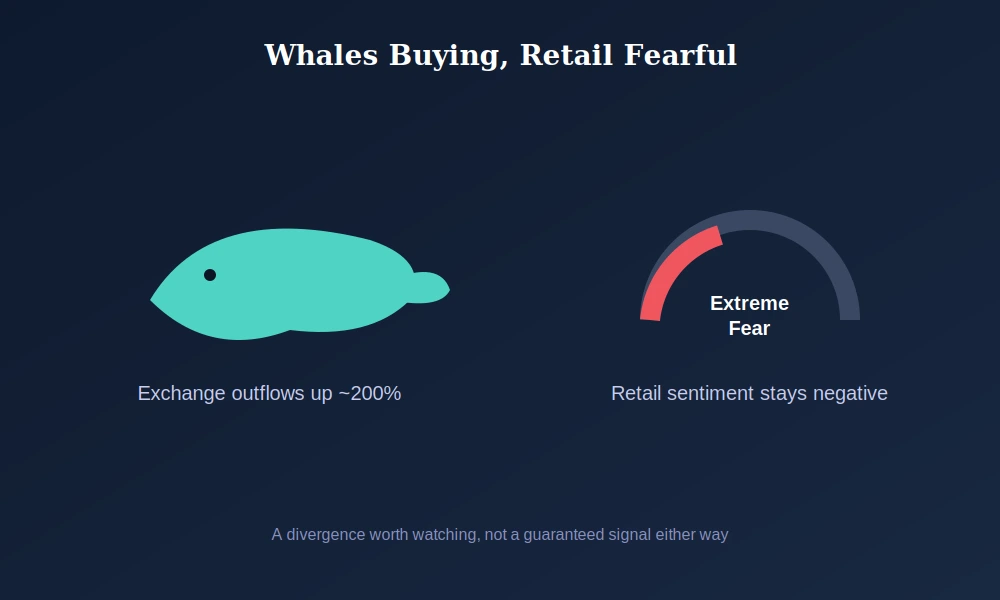
Here’s the detail most casual coverage misses entirely, and it’s genuinely the most interesting part of this whole story. On-chain data shows a sharp increase in XRP leaving exchanges, a metric that typically signals accumulation rather than selling, since coins moved into private wallets usually aren’t about to be sold immediately. That outflow figure jumped roughly 200 percent in a matter of days, from around 40.7 million XRP to about 123 million XRP. At the same time, retail sentiment, measured through social media activity and the broader Fear and Greed Index, remains firmly pessimistic. That split, quiet accumulation beneath the surface while public sentiment stays fearful, is exactly the kind of divergence that shows up before real reversals, though it’s just as capable of being an early move that’s still too soon.
Key Support and Resistance Levels Worth Understanding
If you’re trying to make sense of where XRP goes from here, two numbers matter more than any prediction. The $1.00 level is the psychological and technical floor the entire market is watching, a confirmed break below it opens up an air pocket down to roughly $0.80 to $0.85, where the next real buying interest is expected to show up. On the upside, XRP needs to reclaim and hold the $1.13 to $1.20 zone, where its 200-day moving average sits, to signal the year-long downtrend has actually ended rather than just paused. Until XRP clears that resistance convincingly, most technical analysts continue to describe the broader trend as bearish, regardless of any short-term bounce.
Is Ripple’s Good News Actually Being Ignored
In a strange way, yes. Over the past twelve months, Ripple closed its long-running SEC lawsuit for good, spot XRP ETFs launched in the US, the company won conditional approval for a federal bank charter, and its RLUSD stablecoin passed $1 billion in circulation. Any one of these would normally be considered a major bullish catalyst on its own. Instead, XRP spent that same period falling more than 50 percent. Part of the explanation is simple profit-taking, early holders who’d waited years for the lawsuit to resolve sold into the good news rather than holding for more. Part of it is capital rotation, money moved toward Bitcoin, Ethereum, and faster-moving tech narratives instead of staying in payment-focused tokens like XRP. The fundamentals genuinely improved. The price didn’t follow, at least not yet.
What Would It Take for XRP to Actually Turn Around
Realistically, a combination of things needs to align. Bitcoin needs to stabilize first, since XRP’s fate remains tied to the broader market’s mood regardless of anything specific happening at Ripple. The CLARITY Act passing, even later in the year, would likely trigger a real relief rally, though most analysts caution that a delayed passage would probably produce a shorter bounce rather than a genuine trend reversal on its own. And the Federal Reserve cutting interest rates would loosen the macro conditions that have kept money flowing out of risk assets broadly, crypto included, for most of the year.
Should You Be Worried If You’re Holding XRP
This isn’t financial advice, and nobody should treat a single article as the deciding factor in what to do with money they can’t afford to lose. What’s genuinely true here is that XRP’s decline has tracked a broader, market-wide risk-off period rather than any collapse specific to Ripple’s business, and the underlying fundamentals, ETF approval, legal clarity, growing institutional infrastructure, have continued improving even as the price fell. That doesn’t guarantee a recovery on any particular timeline. It does mean the standard advice applies here as much as anywhere else in crypto, only hold what you can genuinely afford to lose, and make decisions based on your own research and risk tolerance rather than a single price prediction, including this one.
Frequently Asked Questions
Why is XRP price dropping in 2026?
XRP is dropping due to a combination of Ripple’s routine monthly escrow token unlocks, a broad crypto market sell-off tied to Federal Reserve rate uncertainty, delays to the CLARITY Act’s Senate vote, and fresh compliance concerns following California’s new Digital Financial Assets Law.
Will XRP recover in 2026?
Recovery depends heavily on Bitcoin stabilizing, the CLARITY Act passing the Senate, and Federal Reserve rate cuts easing pressure on risk assets broadly. Analyst forecasts for year-end 2026 range widely, from roughly $1.20 in conservative scenarios to $2.80 or higher if multiple catalysts align.
What is the CLARITY Act and how does it affect XRP?
The CLARITY Act is proposed US legislation that would permanently classify XRP as a commodity under federal law. Its passage would remove significant regulatory uncertainty, while continued delays to its Senate vote have added to price pressure throughout mid-2026.
What is Ripple’s escrow release and why does it matter?
Ripple holds billions of XRP in escrow and releases up to 1 billion tokens monthly, typically relocking most of it into a new contract. The scheduled release adds a steady, predictable supply signal that traders watch closely, especially during periods of already weak market sentiment.
Is XRP a good investment right now?
This isn’t financial advice. XRP’s fundamentals, including its ETF launch and resolved SEC lawsuit, have improved even as its price has fallen, but the asset remains volatile and closely tied to broader crypto market sentiment. Any decision should be based on personal research and risk tolerance.