

A private jet. A fleet of Lamborghinis. An $8.5 million mansion in one of Orlando’s most exclusive gated communities. A photograph with the sitting US President. That’s what $328 million in stolen investor money bought Christopher Delgado before federal agents showed up. Goliath Ventures spent years marketing itself as a sophisticated crypto investment firm generating steady, guaranteed returns through liquidity pools. On June 30, 2026, its founder stood in federal court and admitted, under oath, that almost none of it was real.
What Was Goliath Ventures
Goliath Ventures, previously operating under the name Gen-Z Venture Firm, was a cryptocurrency investment company headquartered in Orlando, Florida, with additional offices in Fort Lauderdale and Dubai. Founded and led by Christopher Alexander Delgado, the firm marketed itself as a blockchain-based private venture capital fund focused on crypto liquidity pools, Bitcoin mining infrastructure, and blockchain development projects. Investors were pitched what Delgado called a joint-venture cryptocurrency investment enterprise, with the pitch promising their money would be converted into cryptocurrency and grow through proprietary trading strategies.
The entry point was steep by design, Goliath typically required a minimum initial investment of $100,000, positioning itself as an exclusive opportunity for high-net-worth individuals rather than a retail product. That minimum alone should have been a signal, legitimate crypto funds targeting sophisticated investors don’t usually need to promise guaranteed monthly returns to attract capital, and the ones that do tend not to survive regulatory scrutiny for long.
The Goliath Ventures Pitch, Guaranteed Returns in a Volatile Market
Here’s the detail that should have stopped serious investors cold. Goliath promised guaranteed monthly returns of 3 to 8 percent through cryptocurrency liquidity pools, in an asset class that is, by definition, one of the more volatile in modern finance. No legitimate crypto trading strategy, no matter how sophisticated, can guarantee consistent monthly returns in a market that regularly swings 20 to 50 percent in either direction within weeks. That mismatch between the promise and the underlying asset class is, according to federal prosecutors and multiple securities attorneys now involved in the case, the clearest tell that Goliath was never actually generating returns from trading at all.
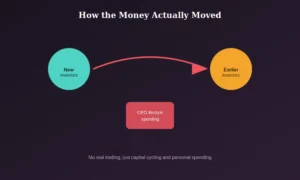
According to the federal criminal complaint and Delgado’s own guilty plea, the majority of investor funds never actually entered any real trading strategy. Instead, the money largely sat as cash in Goliath’s bank accounts and crypto wallets, and was used to pay purported returns to earlier investors, a textbook Ponzi scheme structure where new investor capital funds the appearance of returns for previous investors rather than any genuine underlying business activity.
How the Goliath Ventures Fraud Actually Unfolded
The collapse didn’t happen overnight, and the warning signs were public for months before federal charges finally landed.
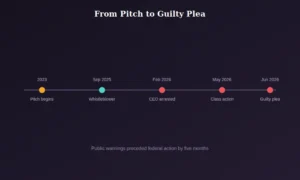
| Date | What happened |
| 2023 | Goliath Ventures, formerly Gen-Z Venture Firm, begins aggressively promoting crypto liquidity pool investments promising 3-8% guaranteed monthly returns |
| September 2025 | Investigative journalist Danny de Hek begins publicly alleging Goliath is a Ponzi scheme; Goliath sues him for defamation |
| February 24, 2026 | DOJ announces the arrest of founder and CEO Christopher Alexander Delgado on wire fraud and money laundering charges |
| Late February 2026 | Goliath drops its defamation lawsuit against de Hek following Delgado’s arrest |
| March 2026 | Court appoints a receiver to take control of all remaining Goliath-linked assets |
| May 6, 2026 | Gibbs Mura and Silver Law Group file a class action against Goliath, Delgado, and third parties including JPMorgan Chase, Coinbase, and law firm Alston & Bird |
| June 30, 2026 | Delgado pleads guilty to conspiracy to commit fraud, wire fraud, and money laundering |
Who Blew the Whistle on Goliath Ventures
New Zealand-based investigative journalist Danny de Hek deserves real credit here. Starting in September 2025, five full months before Delgado’s arrest, de Hek began publishing detailed articles and videos alleging Goliath was a Ponzi scheme, drawing specific parallels to My Liquidity Partner, a separate cryptocurrency scheme that had already collapsed in 2022. De Hek alleged the two operations shared an identical business model and overlapping personnel, including Goliath’s chief operating officer Nick Petrillo.
Goliath’s response wasn’t to address the allegations, it was to sue de Hek for defamation in Orange County Circuit Court. That lawsuit was quietly dropped the moment Delgado was arrested. De Hek also stated he’d been feeding information to Homeland Security Investigations at the same time he was publishing publicly, which suggests federal investigators were already building a case well before the public takedown.
Perhaps the most striking detail in the entire case, on September 21, 2025, de Hek emailed the CEO of the Orlando Economic Partnership directly, copying 37 other staff at the organization, warning them explicitly that Goliath Ventures was a fraud. Nobody responded. Delgado had spent real effort cultivating an image of political and civic legitimacy, including photos that appeared to show him with the FBI director and at a White House bill signing, and that manufactured credibility appears to have been enough to keep institutional gatekeepers from acting on a direct, specific warning.
The Bank and Exchange Accountability Question
The Goliath Ventures case has expanded well beyond just Delgado personally. A federal class action filed in May 2026 by Gibbs Mura and Silver Law Group, together with co-counsel, named JPMorgan Chase, Bank of America, Coinbase, and law firm Alston & Bird as defendants, alleging each played a role in enabling the fraud to continue as long as it did.
The allegations against JPMorgan Chase specifically point to transaction patterns that the complaint describes as widely recognized Ponzi indicators, rapid cycling of funds between investor deposits and outgoing payments, round-number wire transfers, and commingling of investor funds, patterns the lawsuit argues the bank’s own compliance systems should have flagged. Separately, the complaint alleges more than $253 million circulated through a single key Goliath-linked account, with as much as $120 million funneled specifically into Coinbase wallets, raising similar questions about whether a regulated exchange should have caught the pattern sooner.
None of these third-party allegations have been proven in court, and each defendant is entitled to contest them. But the structure of the case reflects a pattern that’s become increasingly common in major crypto fraud litigation, plaintiffs’ attorneys pursuing the banks and exchanges that processed the money, not just the individual who orchestrated the scheme, on the theory that meaningful recovery for victims often depends on reaching institutions with actual assets to pay a judgment.
What Happens to Goliath Ventures Investors Now
A court-appointed receiver took control of all remaining Goliath-linked assets in March 2026, a standard step in large-scale fraud cases meant to preserve whatever value remains for eventual distribution to victims. Realistically, full restitution in cases like this is rare. Delgado’s guilty plea addresses the criminal side of the case, but recovering actual investor losses depends heavily on the separate civil litigation and how much of the original $328 million can actually be traced and clawed back, whether that’s real estate, vehicles, or funds still sitting in linked accounts.
For anyone who invested with Goliath Ventures, securities attorneys handling similar cases consistently recommend the same first steps, preserve every piece of documentation, offering materials, account statements, emails, and wire transfer confirmations, since civil recovery actions typically run on a much longer timeline than the criminal case and depend heavily on a clear paper trail.
The Broader Pattern Behind Crypto Ponzi Schemes Like Goliath Ventures
Sonn Law Group, one of the firms tracking the case closely, put it well, each generation of financial fraud borrows the vocabulary of its moment. In past decades it was offshore hedge funds and oil and gas partnerships. Today it’s liquidity pools, DeFi, and blockchain infrastructure. The terminology changes. The underlying structure doesn’t, a promise of unusually consistent returns, deliberate vagueness about the actual trading strategy, and active resistance to independent verification.
This is the exact same warning sign worth applying to any project, not just Goliath. If you’re evaluating a smaller or newer crypto opportunity and want a framework for the kind of due diligence that would have caught red flags like these early, understanding how to verify a token’s real trading data before investing is a genuinely useful habit to build, since the checks that expose a fabricated project are largely the same whether you’re looking at a $50 microcap token or a $328 million fund promising guaranteed monthly returns.
How to Spot a Goliath Ventures-Style Scheme Before You Invest
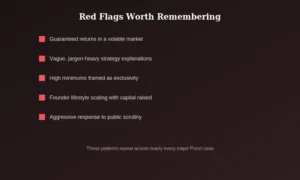
A few consistent patterns showed up across Goliath’s pitch, and they’re worth internalizing as a general checklist. Guaranteed or unusually consistent returns in a genuinely volatile asset class is the single biggest red flag, real crypto trading strategies have real drawdowns, and any firm claiming otherwise is either lying or taking on far more hidden risk than it’s disclosing. Vague, jargon-heavy descriptions of the actual trading strategy, terms like liquidity pools and joint-venture agreements used to sound sophisticated rather than to actually explain the mechanism, deserve real scrutiny rather than automatic trust. High minimum investments framed as exclusivity can also function as a filter that keeps away exactly the kind of sophisticated investors most likely to ask hard questions early. And a founder’s visible lifestyle, private jets, luxury vehicles, aggressive self-promotion around political access, growing in step with investor capital raised is a pattern worth watching rather than admiring.
Frequently Asked Questions
What was Goliath Ventures?
Goliath Ventures was a cryptocurrency investment firm based in Orlando, Florida, that raised approximately $328 million from investors by promising guaranteed monthly returns of 3 to 8 percent through crypto liquidity pools. Federal authorities later confirmed it operated as a Ponzi scheme.
Who was the CEO of Goliath Ventures?
Christopher Alexander Delgado founded and led Goliath Ventures. He was arrested on February 24, 2026, on wire fraud and money laundering charges, and pleaded guilty to conspiracy to commit fraud, wire fraud, and money laundering on June 30, 2026.
How much money did Goliath Ventures steal from investors?
Federal prosecutors alleged initial investor losses of at least $328 million. A related civil class action alleges more than $253 million circulated through a single key Goliath-linked account, with roughly $120 million funneled into Coinbase wallets.
Can Goliath Ventures investors recover their money?
A court-appointed receiver is working to preserve and recover remaining assets, and separate civil litigation against Goliath, Delgado, and third parties including JPMorgan Chase and Coinbase is ongoing. Full restitution in large-scale Ponzi cases is uncommon, and actual recovery amounts depend on how much of the original funds can be traced and reclaimed.
What were the warning signs of the Goliath Ventures fraud?
Key red flags included guaranteed monthly returns in a volatile asset class, vague descriptions of the actual trading strategy, a high $100,000 minimum investment, and a founder whose visible luxury lifestyle grew alongside investor capital raised, all patterns commonly associated with Ponzi schemes.