


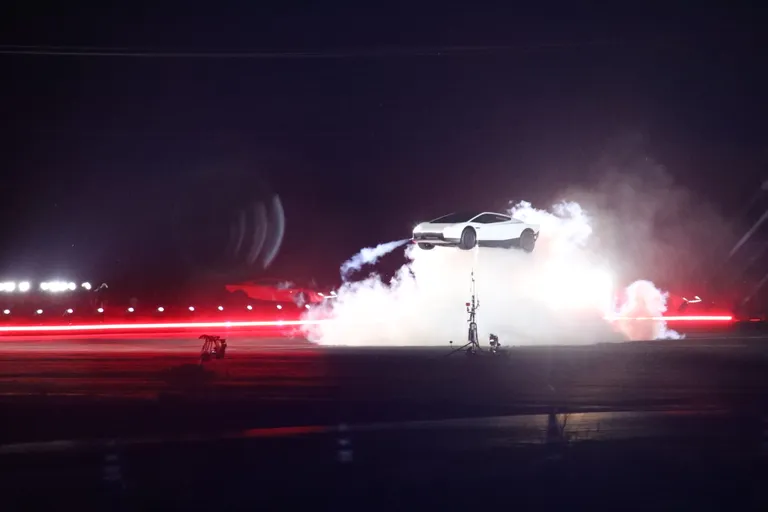
For years, car fans joked about flying cars. At the latest Tesla event, the joke turned into a live demo. The new Tesla Roadster hovered, spun, flipped and even performed barrel rolls in front of the crowd. So how does an electric sports car do something like that?
The answer is a propulsion system borrowed from SpaceX, the rocket company Elon Musk also leads. In this guide, we explain how the Tesla Roadster’s flying system works, its main parts, and what it could mean for the car’s acceleration. No engineering degree needed.
The Short Answer: Compressed Gas, Not Fire
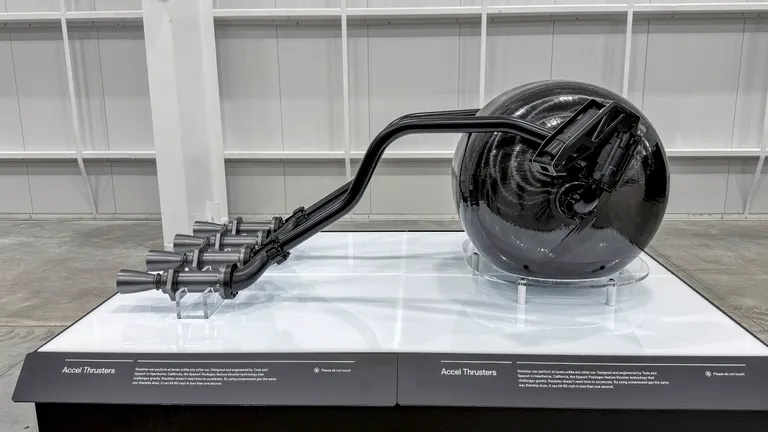
The Roadster does not fly with a jet engine or a rocket burning chemical fuel. It uses cold gas thrusters (CGT), which push the car by releasing high-pressure gas, mostly nitrogen, through special nozzles.
Think of a balloon you let go of without tying it. The air rushes out, and the balloon shoots away. Now imagine the same idea, but with a huge tank of gas at extreme pressure, carefully controlled valves and precisely built nozzles. That is the basic principle behind the Tesla Roadster rocket thrusters.
The system has three main parts:
- A strong storage tank called a COPV
- A set of valves, actuators and pipes that control the gas
- Several nozzles that point the gas where thrust is needed
Let us look at each one.
Part 1: The COPV, the Heart of the System
COPV stands for composite-overwrapped pressure vessel. That sounds complicated, but the idea is simple: it is a very strong gas tank wrapped in layers of strong, lightweight material.
On the Roadster, the COPV is a black sphere that sits behind the two front seats. It is roughly the size of a large gym exercise ball and covered in glossy carbon-fibre weave. Reports suggest it holds about 200 litres of gas, stored at pressures as high as 10,000 psi. That is similar to the pressure inside modern hydrogen fuel-cell cars, and much higher than the tanks used in natural gas or propane vehicles.
Why Wrap the Tank?
Storing gas at such high pressure requires a tank that is both strong and light. A solid steel tank would work, but it would be far too heavy for a sports car that wants to be quick.
That is why engineers use a two-layer design:
- A metal liner inside, which stops gas from slowly seeping through the walls
- A continuous wrap of carbon fibre outside, which provides the strength to hold the pressure
Wrapping the fibres in one continuous piece, rather than sticking on separate strips, gives the highest possible strength. Materials like Kevlar and carbon fibre are popular because they are among the strongest and lightest options available.
This Is Not New Technology
COPVs are not a Tesla invention. Pressurised tanks have been part of rocketry from the start. Early versions were made of steel, then aluminium and titanium. Later, teams working on the NASA Space Shuttle helped pioneer metal-lined tanks wrapped in composites. SpaceX uses several COPVs in its rockets, and earlier this year it bought Hexagon Masterworks, a company that makes them, so it could bring this key technology in-house.
Part 2: Valves, Actuators and Pipes
Holding the gas is only half the job. The car also needs to release it at exactly the right moment and in exactly the right amount.
At each end of the sphere, a large flange is attached with 12 big bolts. It connects to a thick pipe with two piston-style actuators on either side. The heavy build and the many safety-wired nuts show how much pressure is inside. Interestingly, the motors that drive these actuators are said to come from the ankle of Tesla’s Optimus robot.
These actuators open and close valves inside the pipe, controlling how fast the gas leaves the tank. The gas exits at supersonic speed, then travels through two long pipes that split into four nozzles at the rear of the car.
Why Pipe Length Matters
According to Tesla’s vice president of vehicle engineering, Lars Moravy, all the tubes and valves between the tank and the nozzles must be exactly the same length. This works like the equal-length headers in a performance engine’s exhaust.
If one path is longer, gas reaches some nozzles slightly later than others. During forward thrust, that imbalance could twist the car sideways. For example, if the two left nozzles fire first, the car could swing, or “yaw,” to the right. Equal lengths keep the push even and the car straight.
Part 3: The Nozzles (Cold Gas Thrusters)
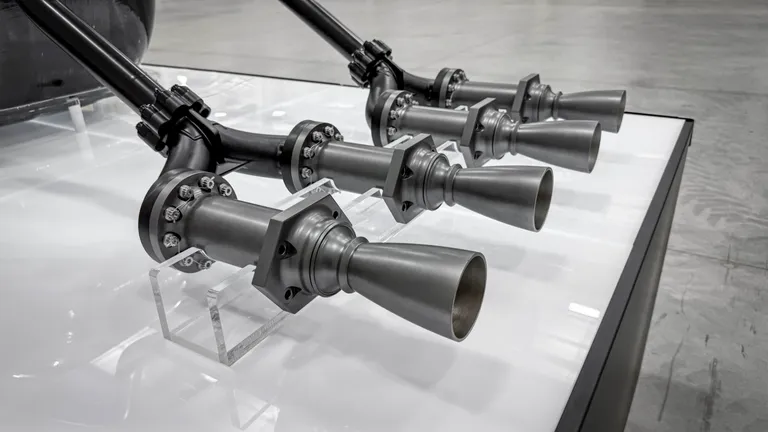
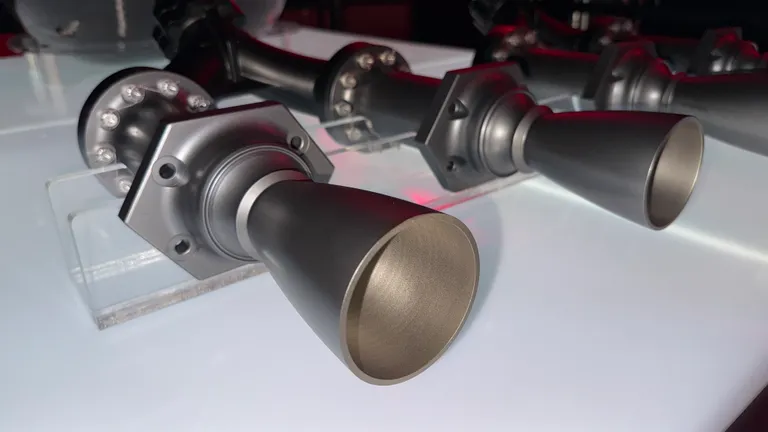
The four metal nozzles above the rear bumper look a lot like the exhaust tips on a supercar, spaced a little wider apart. But this is an EV, so nothing is being burned. These openings release compressed gas, and the force of that gas leaving the car pushes it forward.
Materials Built for Extreme Conditions
Because the system handles very high pressure and the car must stay light, the parts use exotic metals:
- Titanium for the long tubes and thruster nozzles
- Inconel, a heat- and pressure-resistant alloy, for the splitter pipes on each side
Both materials are strong for their weight, which is exactly what a performance car needs.
How the Roadster Actually Flew
The flying demo used more than the basic setup. To lift the car off the ground, Tesla added a second, larger COPV, which tripled the total gas supply to about 600 litres. More gas means thrust can last longer.
It also added six extra nozzles:
- Four pointing downward, placed just behind the wheels, to push the car upward
- Two on the nose, aimed left and right, to control sideways movement and yaw
By firing different nozzles at different times, the car could hover, rotate, flip and roll. It is the same basic control idea that spacecraft use to steer in orbit.
Can the Rocket Thrusters Make the Roadster Faster?
Tesla’s claimed 0 to 60 mph time is 0.8 seconds. That is a huge claim, because normal cars are limited by how much grip their tyres can deliver. Past a certain point, tyres cannot turn more power into faster acceleration.
Thrusters bypass that limit, because they push the car directly instead of relying on tyre grip.
Here is a rough back-of-the-napkin estimate based on the available numbers:
| Item | Estimated Value |
|---|---|
| Rear motor power | 1 MW (about 1,341 hp) |
| Forward force from motors | About 32.3 kN (7,261 lbf) |
| Car weight | About 3,750 lb |
| Extra force needed from thrusters for 0.8 s | About 19.8 kN (4,451 lbf) |
The motors can deliver that much force partly because the car’s ducted fan system presses it to the road with more than 2 g of downforce.
Many details are still unknown, including the shape of the nozzle throats, the car’s drag and its frontal area. So nobody can say exactly how long strong thrust would last. A few seconds seems realistic, and in that time the car could reach at least 135 to 180 mph while the motors keep pulling.
These are estimates, not official figures, so treat them as an informed guess until Tesla shares more data.
Where Does the “Rocket Fuel” Come From?
This is one of the most interesting questions. Since the thrusters use compressed gas instead of chemical fuel, the supply could in theory come from industrial gas companies such as Air Liquide, Airgas or Linde.
On stage, however, Elon Musk described the gas as essentially air and hinted that the car could capture, compress and store it by itself. That idea sounds almost too good to be true, and engineers are understandably cautious. Compressing air to 10,000 psi takes a lot of energy and equipment, so many details need to be explained before this becomes practical.
Is Cold Gas Thrust Powerful?
Compared with solid rocket boosters, cold gas thrusters are quite gentle. Chemical rockets get their power from burning fuel, which releases far more energy. Cold gas systems only release stored pressure.
That is also why they are popular where precision matters more than raw power, such as steering and positioning spacecraft. For a car, they offer a safer and simpler way to add short bursts of extra force without fire, smoke or flammable fuel.
Why Would Anyone Want a Flying Car?
Fair question. Even automotive experts admit it is hard to see the practical use of a car that can levitate, spin and fly short distances. Most owners will never need a barrel roll on the way to the office.
But the demo shows a bigger idea: adding a third dimension to how cars move. Even if full flight stays a showpiece, the acceleration boost from thrusters could be real, and the technology might inspire new ways to control vehicles in the future.
Quick Summary: How the Tesla Roadster Flying System Works
- A carbon-fibre COPV tank stores nitrogen-rich gas at up to 10,000 psi
- Actuators and valves control how the gas is released
- Equal-length pipes keep the thrust balanced
- Titanium and Inconel parts handle the pressure while staying light
- Four rear nozzles push the car forward
- Six extra nozzles and a bigger 600-litre gas supply allow hovering, spinning and flips
Frequently Asked Questions
Does the Tesla Roadster really fly?
In the launch demonstration, it hovered, spun, flipped and performed barrel rolls using cold gas thrusters. This was a short-duration demo, not a normal driving mode.
What are cold gas thrusters?
They are nozzles that release high-pressure gas to create thrust. They do not burn fuel, so there is no flame or exhaust fire.
What gas does the Tesla Roadster use?
It uses high-pressure air, primarily nitrogen, stored in a COPV tank.
How big is the Roadster’s gas tank?
The standard setup is reported to hold about 200 litres of gas. The flying demo version used a larger tank that raised the total to about 600 litres.
Can the thrusters help the Roadster reach 60 mph in 0.8 seconds?
Estimates suggest the motors alone may not be enough, and the thrusters could supply the extra force needed. Tesla has not published full technical data yet.
Who makes the COPV technology?
COPVs are widely used in the space industry. SpaceX recently purchased Hexagon Masterworks, a COPV manufacturer, to bring this technology in-house.
Final Thoughts
The Tesla Roadster flying demo was more than a stunt. It showed how rocket-industry parts, such as carbon-wrapped tanks, titanium nozzles and precision valves, can be applied to a road car. Questions remain about real-world use, refilling the gas and how much faster the thrusters can make the car in everyday conditions.
Even so, one thing is clear: the Roadster is trying to redefine what a sports car can be. Stay tuned to Crytix10 for more updates as Tesla shares further details.