

Type “VDR crypto” into a search bar and you’ll get answers that sound confident and contradict each other within the same page of results. One site tells you VDR is a Solana meme coin parodying Vanguard the asset manager. Another shows you a completely different VDR token built on Ethereum for content creators. A third result is actually about VDOR, a similarly branded “oil reserve” coin that isn’t the same project at all. None of these articles tell you that up front, and that’s the actual problem worth solving here.
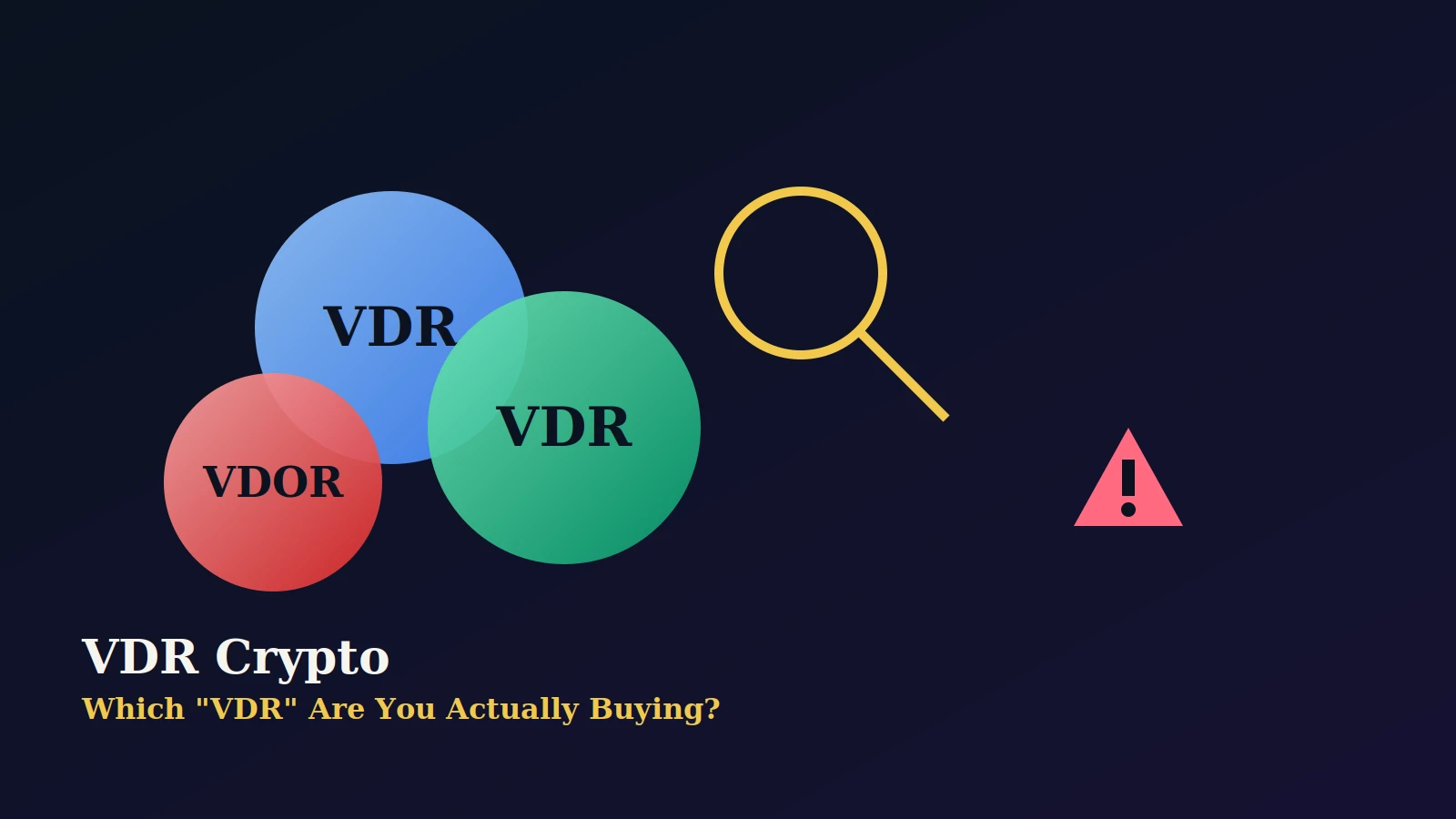
VDR crypto isn’t a single coin. At least three separate tokens use the name or ticker, and they’re easy to mix up.
VDR Crypto Isn’t One Coin, It’s a Naming Collision
Before getting into price charts or buying guides, it’s worth being blunt about something most VDR crypto content glosses over: you cannot assume that a wallet, exchange listing, or article referring to “VDR” is talking about the same token as the last one you read. This happens more than people realize in crypto, tickers aren’t trademarked, and popular naming conventions get copied constantly. VDR is a textbook case.
At minimum, three distinct projects are circulating under this name or a close variant right now: Vanguard Digital Reserve on Solana, Vodra on Ethereum, and VDOR (Vanguard Digital Oil Reserve), also on Solana. They have nothing to do with each other beyond sharing a naming pattern, and mixing them up isn’t a small mistake, it’s the difference between researching the wrong project entirely and buying a token you never meant to touch.
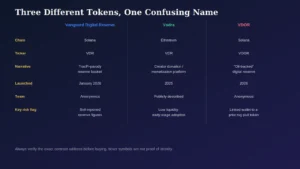
Three tokens, one confusing family of names. Always check the contract address, not just the ticker.
Vanguard Digital Reserve (VDR): The Solana TradFi Meme Coin
This is the token most people mean when they search “vdr crypto” today. Vanguard Digital Reserve launched in late January 2026 on Solana, introducing itself through a series of tongue-in-cheek, patriotic-toned posts from its official account, with lines like “America’s Reserve for the Digital Age is here.” It has zero affiliation with the actual Vanguard Group, the trillion-dollar asset manager, despite borrowing its name and aesthetic.
What makes VDR different from a typical dog-themed meme coin is the language it wraps around itself. The project describes holding VDR as exposure to a “reserve basket,” talks about “collateral design” and “settlement rails,” and frames itself as an on-chain reserve index rather than a joke token. It’s a clever positioning move, institutional vocabulary layered over what is, underneath, a narrative-driven Solana SPL token with no audited backing.
Is VDR Crypto (Vanguard Digital Reserve) Legit?
Short answer for the featured snippet crowd: Vanguard Digital Reserve shows no confirmed signs of being an outright scam, but it’s also not a regulated or institutionally backed product. The founding team is fully anonymous, there’s no published whitepaper naming real individuals, and any reserve figures the project shares are self-reported rather than independently audited. Treat it as a high-risk, narrative-driven token, not a reserve asset in the traditional sense.
There’s a roadmap element worth knowing about too. VDR has floated a “Rare Metals” phase, positioning the token as a future utility layer for tokenized physical commodities. As of now, that’s a stated ambition, not a live feature, and pricing has been extremely volatile and thin on liquidity, some tracking sites show 24-hour trading volume near zero on certain days, which tells you how easily price can swing on small trades.
Vodra: The Other VDR Crypto Token
Separately, and confusingly under the same VDR ticker, Vodra runs on Ethereum with an entirely different purpose. Vodra positions itself as a decentralized donation and monetization platform for content creators, streamers, musicians, and educators who don’t have traditional sponsorship deals. The pitch is that creators keep more of their earnings by cutting out algorithm-driven ad revenue splits and platform fees.
The VDR token here has a defined utility loop: holders can stake it for rewards, the project allocates a slice of ad campaign revenue, reportedly 2 to 5 percent, toward token buybacks meant to reduce circulating supply, and larger holders get perks like event access. Vodra reports having attracted over 2,000 livestream creators since launch. Trading volume remains modest, in the range of a few hundred to a few thousand dollars a day across its markets, which puts it firmly in early-stage, illiquid territory even if the underlying idea has more real-world grounding than a pure meme coin.
If you’re checking a price chart and the numbers look wildly different from what another VDR article quoted, this is very likely why. Two entirely separate tokens, same three letters, different chains, different supply caps, different everything that actually matters.
VDOR: A Similarly Named Token With Real Red Flags
Then there’s VDOR, short for Vanguard Digital Oil Reserve, which deliberately echoes the Vanguard Digital Reserve branding while claiming something far bigger: that it represents a tokenized digital oil reserve backed by trillions of dollars in crude oil, refined products, and futures contracts stored across a network of facilities.
This is the one worth being genuinely cautious about. Security researchers examining VDOR’s on-chain activity identified that its liquidity-funding wallet appears connected to the team behind a prior token called UGOR (United Global Oil Reserve), which pumped to a $23 million market cap before its team executed a sharp sell-off that crashed the price more than 80 percent, a textbook rug-pull pattern. There’s no independent audit, custody verification, or on-chain mechanism tying VDOR’s price to any actual barrel of oil. Analysts across multiple platforms have described it consistently as a high-risk, narrative-driven asset rather than a legitimate commodity-backed token.
This matters for VDR crypto searches specifically because VDOR shows up in the same search results, sometimes in the same comparison articles, and the branding similarity is clearly intentional. If you’re only skimming, it’s easy to walk away thinking VDR and VDOR are the same reserve project at different stages. They are not, and the risk profile between them is not remotely comparable.
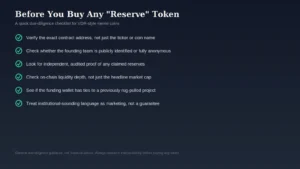
A short due-diligence checklist worth running through before buying any reserve-branded meme coin.
How to Tell Which VDR Crypto Token You’re Looking At
A few quick checks settle the confusion in under a minute:
Check the blockchain first
Vanguard Digital Reserve and VDOR both run on Solana. Vodra runs on Ethereum. If a wallet or exchange shows you a chain that doesn’t match what you expected, you’re likely looking at the wrong project.
Match the contract address, not the name
Ticker symbols and project names are not unique identifiers on-chain, contract addresses are. Before buying, copy the exact contract address from the project’s official social account or website and confirm it matches what your exchange or wallet is showing. This single step prevents the overwhelming majority of naming-collision mistakes.
Read the narrative, not just the branding
Reserve baskets, collateral design, oil backing, creator monetization, these are different stories with different claims. If an article’s description doesn’t match what you thought you were researching, stop and re-verify before transacting.
Frequently Asked Questions
Is VDR crypto the same as Vodra?
No. VDR (Vanguard Digital Reserve) is a Solana-based meme coin with a TradFi-parody reserve theme launched in January 2026. Vodra is a separate Ethereum-based token, also trading under the VDR ticker, built around a content-creator monetization platform. They share a ticker but nothing else.
What is Vanguard Digital Reserve (VDR)?
Vanguard Digital Reserve is a Solana SPL token that markets itself as giving holders exposure to a “reserve basket” using institutional-sounding language. It has no affiliation with the Vanguard Group, no audited reserves, and an anonymous team, making it a high-risk, narrative-driven asset rather than a regulated financial product.
Is VDOR a scam?
VDOR shows several documented red flags: an anonymous team, no independent audit or proof of the oil reserves it claims to represent, and an on-chain link between its funding wallet and a previous token that carried out an apparent rug pull. It hasn’t been formally labeled fraudulent by regulators, but the risk indicators are serious enough that extreme caution is warranted.
Where can I buy VDR crypto?
Vanguard Digital Reserve trades primarily on Solana decentralized exchanges like Raydium and Jupiter, with some availability on centralized platforms. Vodra trades on Ethereum-based markets. Because multiple tokens share the VDR name, always confirm the exact contract address before purchasing on any platform.
Why do so many crypto tokens use similar ‘reserve’ branding?
Reserve-themed branding borrows credibility from traditional finance language, terms like collateral, reserve basket, and settlement rails sound institutional even when nothing regulated backs them. It’s a low-cost way for anonymous teams to make a speculative token feel more serious than it is, and it’s part of why naming collisions like the VDR situation keep happening.
The Bottom Line on VDR Crypto
If you searched “vdr crypto” hoping for a straightforward answer, here it is: there isn’t one token to research, there are at least three, and they don’t share a team, a chain, or a risk profile. Vanguard Digital Reserve is a volatile, anonymous-team meme coin dressed in TradFi language. Vodra is a smaller, Ethereum-based creator-economy project with more defined utility but thin liquidity. VDOR carries the most serious red flags of the three, including a funding-wallet connection to a token that already crashed in an apparent rug pull.
None of that makes any of these a guaranteed bad investment, plenty of narrative-driven tokens survive and some even build real communities. But going in without knowing which VDR you’re actually buying is how people end up holding something they never meant to research in the first place. Match the contract address, read past the branding, and treat reserve claims as marketing until proven otherwise.
Related reading: for another case of copycat crypto branding causing real confusion, see our breakdown of the unofficial tokens trading on Elon Musk’s and MrBeast’s names on Crytix10.
Also see: our investor-protection breakdown of CV token’s documented red flags for a similar due-diligence framework applied to a different project.
External reference: Meme coin — Wikipedia for background on how narrative-driven tokens like these are generally categorized.