

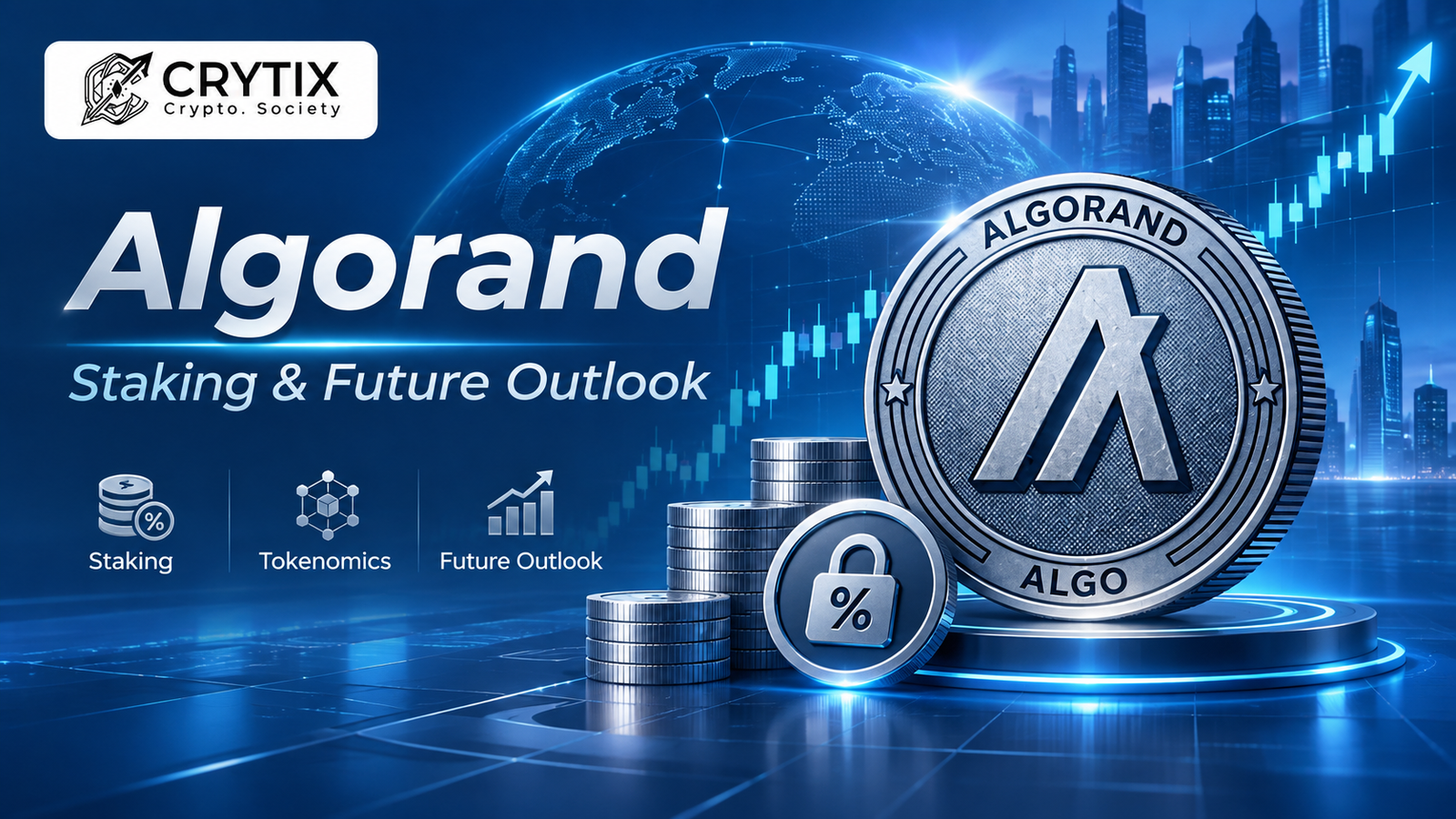
Algorand (ALGO) is a Layer 1 blockchain designed to support fast digital payments, decentralized applications, tokenized assets, and secure financial transactions. Unlike traditional blockchain networks that rely on energy-intensive mining, Algorand uses a Pure Proof-of-Stake consensus mechanism to validate transactions and maintain network security. Founded on research led by computer scientist Silvio Micali, Algorand was developed to address important challenges involving blockchain scalability, decentralization, and transaction finality. Its infrastructure is designed to help developers and organizations create financial applications without depending entirely on centralized systems.
In 2026, Algorand continues evolving through improvements in staking incentives, developer tools, blockchain economics, and post-quantum security. Its native cryptocurrency, ALGO, supports transaction fees, network participation, and decentralized applications. However, understanding Algorand requires more than following cryptocurrency market prices. This guide examines how its blockchain works, why Pure Proof-of-Stake matters, how staking rewards operate, and which technological developments and investment risks could influence its future.
What Is Algorand (ALGO)?
Algorand is an open-source blockchain platform that enables users and developers to transfer digital assets, execute smart contracts, and build decentralized services. The network operates through distributed computers that follow common protocol rules to maintain a shared transaction ledger. Applications can use Algorand for digital payments, financial instruments, asset ownership records, decentralized exchanges, and other activities requiring programmable blockchain infrastructure.
ALGO is the native cryptocurrency of the network. Users pay transaction fees in ALGO, and eligible holders can participate in consensus through supported staking arrangements. Algorand differs from cryptocurrencies operating as tokens on another blockchain because its native asset exists on an independent Layer 1 network. The platform also provides built-in functionality for creating Algorand Standard Assets, allowing developers to issue digital tokens without necessarily developing a separate token smart contract.
The History and Founder of Algorand
Algorand was founded by Silvio Micali, a Massachusetts Institute of Technology professor and recipient of the Turing Award for his contributions to cryptography and theoretical computer science. His research helped establish the mathematical foundations behind technologies used in secure digital communication. Algorand’s development began with the objective of creating a decentralized blockchain that could achieve fast consensus without the computational demands associated with conventional Proof-of-Work mining.
The Algorand mainnet launched in June 2019. During its early development, the project concentrated on consensus security, efficient transactions, and infrastructure for programmable digital assets. Over time, the ecosystem expanded to include smart contract development tools, decentralized finance applications, governance mechanisms, and solutions for financial organizations. By 2026, the network had introduced direct staking rewards and post-quantum security improvements, reflecting a shift toward stronger validator incentives and longer-term infrastructure resilience.
How Does Algorand Blockchain Technology Work?
Algorand operates using a decentralized consensus system known as Pure Proof-of-Stake, or PPoS. Instead of selecting block producers through computational mining competitions, the protocol uses cryptographic randomness and participating ALGO stake to select accounts that propose and vote on blocks. Eligible participants operate nodes that communicate with other network participants and verify whether proposed transactions follow the protocol’s rules.
A central feature of Algorand is its use of a Verifiable Random Function, commonly abbreviated as VRF. This cryptographic mechanism allows participants to determine whether they have been selected for a consensus role while producing evidence that others can verify. Because committee selection is unpredictable in advance, the protocol is designed to make targeted interference more difficult. Once the appropriate voting process confirms a block, transactions achieve finality without the conventional probability of chain reorganizations found in some other blockchain designs. Reliable finality is particularly important for payments and applications that need confidence that confirmed transactions will not be reversed by normal chain competition.
What Is Pure Proof-of-Stake?
Pure Proof-of-Stake is Algorand’s distinctive approach to blockchain consensus. Its objective is to enable secure agreement through stake-weighted participation without requiring users to compete through energy-intensive mining. Accounts participating in consensus can be selected to propose blocks and join voting committees, with selection probabilities influenced by their online stake. This allows the network to coordinate block production through cryptographic procedures rather than continuous computational competition.
Algorand’s security depends on a supermajority of participating stake behaving honestly under its consensus assumptions. Although its design reduces certain attacks associated with predictable validator selection, no distributed network is completely immune to operational problems or hostile behavior. Network decentralization, participation incentives, software reliability, and responsible private-key management all remain important. PPoS should therefore be understood as a specific consensus design with identifiable advantages and security assumptions rather than an absolute guarantee against every possible threat.
Algorand Transaction Speed and Finality
Algorand is designed to process transactions efficiently, with blocks typically finalized within a few seconds. The network’s architecture provides immediate transaction finality once a block has been certified, which is valuable for digital payments, asset transfers, and applications requiring predictable settlement. Unlike blockchain systems where recipients may wait for several additional blocks to reduce reorganization risk, Algorand’s consensus process is designed to avoid ordinary blockchain forks after finalization.
However, actual application performance depends on network conditions, transaction complexity, node availability, and supporting infrastructure. A simple ALGO transfer may require fewer resources than a complex smart contract interaction. Developers should distinguish between block finality, transaction submission time, wallet display updates, and the time required by third-party financial services to credit funds. Fast protocol finality is useful, but it does not automatically eliminate exchange delays, application failures, or financial fraud.
Algorand Smart Contracts and Developer Technology
Algorand supports smart contracts that allow developers to create programmable financial services, digital asset systems, and decentralized applications. Smart contracts execute defined rules on the blockchain, enabling services such as asset transfers, lending arrangements, application permissions, and digital marketplaces. The Algorand Virtual Machine provides the execution environment for supported smart contract operations, while developer tools simplify implementation and testing.
The ecosystem includes tools that support languages such as Python and TypeScript through compatible development frameworks. This can make blockchain development more approachable for programmers already familiar with conventional application development. Nevertheless, smart contract security requires careful engineering. Logical errors, incorrect permissions, poorly designed financial incentives, and compromised external dependencies can create risks even when the underlying blockchain functions correctly. Developers should use appropriate testing, security reviews, and monitoring before deploying applications that manage valuable digital assets.
What Are Algorand Standard Assets?
Algorand Standard Assets, or ASAs, are digital assets created through built-in blockchain functionality. They can represent fungible tokens, collectibles, loyalty points, stablecoins, or other digital instruments. Unlike some blockchain environments where every token requires a separate smart contract, Algorand allows developers to create and manage many asset types using standardized protocol features.
This functionality can simplify asset issuance while supporting permissions such as freezing, clawback, and administrative controls when configured. However, these controls have important implications for users because some assets can be managed or restricted by designated authorities. Anyone acquiring an unfamiliar ASA should verify its asset identifier, issuer, permissions, and supporting documentation. The ability to create a token easily does not establish its legitimacy, economic value, or legal enforceability.
ALGO Tokenomics and Maximum Supply
Algorand has a maximum token supply of 10 billion ALGO. All 10 billion tokens were originally created at launch, with their distribution scheduled over time through ecosystem allocations, Foundation programs, and other mechanisms. Unlike cryptocurrencies with uncapped mining issuance, ALGO’s maximum supply is defined, although the amount available in general circulation changes as previously allocated tokens enter the market.
According to Algorand Foundation’s August 2026 network report, approximately 9.04 billion ALGO were circulating at the end of that month, representing about 90.4% of the maximum supply. This historical figure should not be confused with a live circulating supply measurement. Investors evaluating tokenomics should distinguish maximum supply, circulating supply, Foundation holdings, and tokens available through trading markets. A capped supply provides a defined monetary limit, but it does not guarantee future price appreciation. Actual market outcomes depend on demand, liquidity, ecosystem activity, and investor expectations.
Algorand Transaction Fees and Network Economics
Algorand has historically offered low transaction fees, with basic transfers commonly beginning at 0.001 ALGO. Affordable fees can make small digital payments and frequent blockchain interactions more practical, especially when compared with networks where congestion can create substantial transaction costs. Users must still maintain sufficient ALGO to meet account and transaction requirements, including minimum balances associated with certain assets and applications.
Protocol changes in 2026 expanded the use of resource-based fees, allowing more demanding transactions to be charged according to their computational and data requirements. This approach aims to maintain affordable ordinary transfers while better reflecting the cost of resource-intensive operations. Transaction fees also contribute to the network’s economic infrastructure and staking reward arrangements. Users should confirm current charges through reliable wallets or network documentation rather than assuming that every transaction always costs the same amount.
How Does Algorand Staking Work?
Algorand introduced direct staking rewards in January 2025 to encourage active participation in securing the blockchain. The system provides incentives to accounts that contribute to consensus through supported participation nodes. Under the documented rules, an independently participating account generally requires at least 30,000 ALGO committed to online consensus to qualify for direct rewards. Holders with smaller amounts may explore supported staking pools or delegated services, although eligibility and arrangements differ by provider.
Algorand staking has distinctive characteristics compared with some other Proof-of-Stake networks. Native participation does not require users to surrender custody of their ALGO, and the protocol does not use token slashing as a penalty for validator misconduct. Underperforming nodes may instead miss rewards or be removed from participation. These characteristics reduce certain staking risks, but users still face cryptocurrency price volatility, node operating responsibilities, and potential third-party risks when using external staking services.
ALGO Staking Rewards in 2026
Algorand staking rewards are designed to compensate eligible participation accounts for helping maintain consensus. The initial reward system combines a portion of transaction fees with supplementary bonuses funded through the Algorand Foundation. Official documentation states that 50% of relevant transaction fees are allocated toward block rewards, alongside a Foundation-funded bonus that began at 10 ALGO per block and gradually declines by 1% every million blocks. The supplementary incentive program is scheduled to continue until January 2028.
Rewards depend on active network participation and block proposal outcomes rather than representing fixed guaranteed interest. Foundation reports show that millions of ALGO were distributed to eligible participants during 2026, but historical reward totals do not guarantee future individual earnings. Users considering staking should evaluate hardware requirements, validator performance, pool fees, custody arrangements, and the possibility that market losses could exceed earned rewards.
Algorand and Decentralized Finance (DeFi)
Decentralized finance applications use blockchain technology to provide financial services such as token swaps, lending, liquidity provision, and asset management through smart contracts. Algorand supports these activities through programmable contracts, standardized assets, and relatively efficient transaction settlement. Developers can create applications that allow supported tokens to move between users and protocols according to predefined rules.
However, decentralized finance introduces risks beyond those associated with holding ALGO. Smart contract vulnerabilities, liquidity shortages, oracle problems, unstable token prices, and fraudulent projects can cause financial losses. Low transaction fees and fast settlement improve technical usability but do not guarantee that an application is financially sound. Users should evaluate each protocol’s security, asset custody, liquidity structure, and operating history before participating.
Real-World Applications of Algorand
Algorand’s infrastructure can support digital payments, tokenized assets, identity-related services, loyalty systems, and financial settlement applications. Its low-fee transactions and deterministic finality may appeal to organizations that need predictable digital transfers. Asset tokenization is another potential area of use because blockchain records can represent interests in financial products, property-related assets, or other instruments, subject to relevant legal arrangements.
The network has also supported payment and humanitarian technology initiatives. Examples include financial access services and digital payment programs built around Algorand infrastructure. Such initiatives demonstrate possible use cases, although pilot projects, announced integrations, and sustained commercial deployments should be distinguished. Long-term blockchain adoption depends on regulatory compliance, user experience, dependable infrastructure, and economic advantages over existing systems.
Algorand’s Post-Quantum Security Developments in 2026
Post-quantum cryptography has become an increasingly important research area because sufficiently powerful future quantum computers could threaten some cryptographic methods used by modern digital systems. In June 2026, the Algorand Foundation published a roadmap targeting broad quantum resilience across wallets, developer tools, and consensus-related infrastructure by the end of 2027.
The Algorand v5.0.0 upgrade introduced native support for quantum-resilient accounts using Falcon-based cryptographic technology. The Foundation reported that quantum-resilient accounts and transactions became available on mainnet in August 2026. These developments represent progress toward stronger long-term security, but they do not mean that every Algorand account, application, or underlying protocol component is already fully protected against all future quantum threats. Users should follow official migration guidance and understand that comprehensive post-quantum readiness remains an ongoing process.
Algorand vs Ethereum and Solana
Algorand, Ethereum, and Solana are Layer 1 blockchain platforms, but their architectures and development ecosystems differ. Algorand emphasizes Pure Proof-of-Stake consensus, fast finality, and protocol-level digital asset functionality. Ethereum offers a large smart contract ecosystem supported by extensive Layer 2 infrastructure, while Solana emphasizes high-performance execution and a broad range of decentralized financial applications.
The differences matter because developers and users have different requirements. Algorand may appeal to applications prioritizing predictable settlement and standardized assets, while Ethereum offers extensive developer tooling and liquidity. Solana provides its own performance-oriented model and established application ecosystem. No blockchain is automatically superior for every use case. Security, decentralization, liquidity, costs, compatibility, and developer adoption should all influence technical decisions.
Is Algorand (ALGO) a Good Investment in 2026?
Algorand may interest investors researching blockchain payment infrastructure, decentralized finance, asset tokenization, and advanced cryptographic security. Its fixed maximum supply, Pure Proof-of-Stake design, direct staking incentives, and continuing development provide identifiable areas for investment analysis. However, useful technology does not guarantee positive investment returns, and ALGO remains exposed to cryptocurrency market volatility.
An informed assessment should examine network transaction activity, fee generation, validator participation, ecosystem adoption, circulating supply, and the relationship between usage and demand for ALGO. Investors should also consider competition from other networks and the sustainability of staking incentives after supplementary rewards decline. No specific ALGO price target for 2026 or later years can be guaranteed. Financial decisions should reflect personal circumstances, appropriate risk management, and the possibility of losing invested capital.
Major Risks of Investing in ALGO
Market volatility is one of the principal risks associated with Algorand. Cryptocurrency prices can change rapidly because of liquidity conditions, market sentiment, economic developments, and regulatory announcements. Competition may also affect Algorand’s ability to attract developers and meaningful transaction activity, while technical improvements do not automatically result in increased token demand.
Security considerations include compromised wallets, phishing, malicious applications, smart contract exploits, and third-party service failures. Although native Algorand staking does not involve protocol-level slashing, users relying on custodial platforms or staking pools may face additional risks. Investors should distinguish the security of the underlying blockchain from the safety of individual services built on it.
How to Buy and Store Algorand (ALGO) Safely
People interested in acquiring ALGO should research cryptocurrency exchanges that legally operate in their country and support the native Algorand blockchain. Important factors include trading fees, exchange liquidity, withdrawal costs, security practices, and supported payment methods. Before transferring funds, users should verify that the receiving wallet supports native ALGO rather than a wrapped or unrelated representation on another network.
Self-custody wallets allow users to control their own credentials, while custodial platforms manage private keys on behalf of customers. Users should protect recovery phrases, enable strong authentication where available, and verify transaction addresses carefully. Testing unfamiliar transfer routes with smaller amounts can help reduce the impact of preventable errors. Anyone participating in staking should also understand whether assets remain under their direct control.
The Future of Algorand in 2026 and Beyond
Algorand’s future will depend on its ability to support reliable blockchain applications, attract developers, expand economic activity, and maintain strong security. Its roadmap includes improvements in developer experience, staking incentives, user-friendly wallets, tokenized financial products, and post-quantum cryptography. These developments may create opportunities for applications involving payments, digital ownership, automated commerce, and financial infrastructure.
Nevertheless, technological progress should be evaluated alongside measurable adoption. Transaction counts, active users, sustainable fees, application quality, and decentralization are important indicators of network health. For ALGO holders, long-term outcomes will depend on how demand develops relative to available supply and market conditions. Algorand remains a relevant blockchain project to research, but future price performance is uncertain.
FAQ,s
1. What is Algorand (ALGO)?
Algorand is a Layer 1 blockchain designed for decentralized applications, digital payments, and tokenized assets. ALGO is its native cryptocurrency.
2. Who founded Algorand?
Algorand was founded by Silvio Micali, a Turing Award-winning cryptographer and MIT professor. Its mainnet launched in June 2019.
3. What is Pure Proof-of-Stake?
Pure Proof-of-Stake is Algorand’s consensus mechanism, which uses cryptographic randomness and stake-weighted participation to select block proposers and voting committees.
4. What is the maximum supply of ALGO?
Algorand has a fixed maximum supply of 10 billion ALGO. Circulating supply increases as previously allocated tokens are distributed.
5. Can I stake Algorand with 1 ALGO?
Accounts with small balances can participate in securing consensus, but direct independent staking rewards require at least 30,000 ALGO. Some third-party staking pools may support smaller amounts.
6. Does Algorand staking involve slashing?
Native Algorand staking does not use protocol-level token slashing. Participants may lose reward opportunities if they fail to meet participation requirements.
7. Is Algorand faster than Ethereum?
Algorand provides fast transaction finality, but performance comparisons depend on the specific network, transaction type, and Ethereum scaling solution involved.
8. Is Algorand quantum-resistant?
Algorand introduced native quantum-resilient account capabilities in 2026, but its broader post-quantum security roadmap remains in progress.
9. Can ALGO reach $1?
ALGO could theoretically trade at $1 if sufficient market demand supported that price, but there is no guarantee. Supply, liquidity, adoption, and market conditions are important.
10. Is Algorand a good long-term investment?
Algorand offers established blockchain technology, but ALGO remains a speculative asset. Investors should evaluate network adoption, tokenomics, competition, and financial risks before investing.
Conclusion
Algorand (ALGO) is a blockchain platform designed to combine efficient transaction processing, Pure Proof-of-Stake consensus, and programmable digital asset infrastructure. Its technology supports payments, smart contracts, staking, tokenization, and other decentralized applications. Developments in 2026, including post-quantum security features and evolving network economics, demonstrate continued efforts to strengthen the ecosystem.
For readers researching Algorand, understanding both its advantages and limitations is essential. Fast transaction finality and secure consensus provide useful technical characteristics, but they do not eliminate investment volatility, application vulnerabilities, or competition. Algorand’s long-term prospects will depend on measurable adoption, sustainable economic activity, and continued technical reliability rather than speculative price predictions.
Disclaimer: This article is intended for general educational and informational purposes only. It does not constitute financial, investment, legal, or tax advice. Cryptocurrency investments involve substantial risk, including the possibility of losing invested capital.