

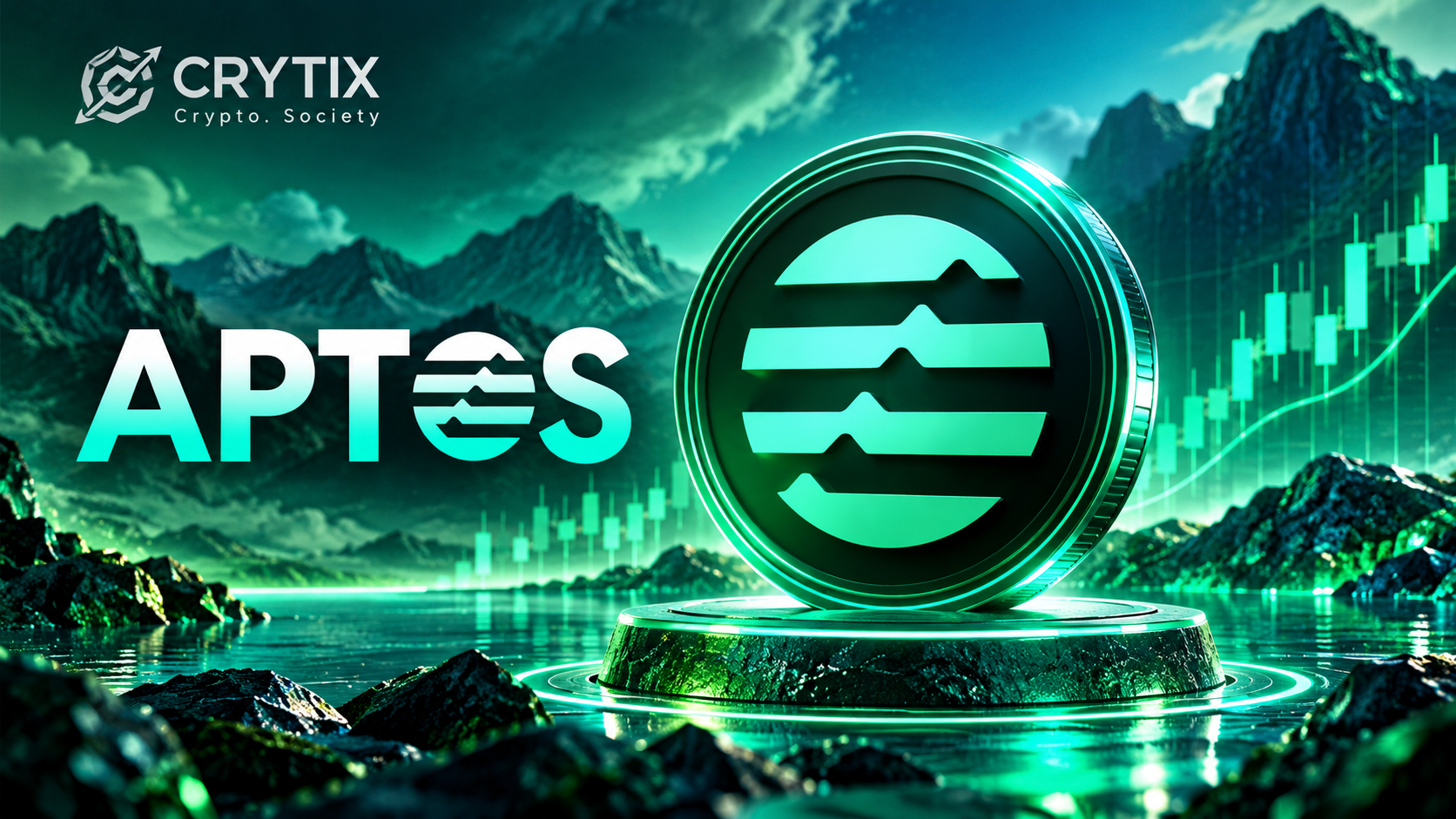
Aptos (APT) is a Layer 1 blockchain platform designed to support decentralized applications, digital payments, financial services, and scalable Web3 technology. Since launching its mainnet in October 2022, Aptos has attracted attention for its high-performance blockchain architecture, Move programming language, and innovative parallel transaction execution system. While many blockchain networks struggle to balance transaction processing capacity, security, and user accessibility, Aptos approaches these challenges through a modular infrastructure designed to improve efficiency without requiring developers to sacrifice important security principles. Its technology has become relevant to discussions surrounding decentralized finance, stablecoin payments, tokenized assets, blockchain gaming, and the development of financial applications capable of handling substantial transaction activity.
As the cryptocurrency industry evolves in 2026, Aptos continues developing its infrastructure while adjusting its token economics and encouraging applications that require efficient blockchain transactions. APT, the network’s native cryptocurrency, plays an important role in transaction fees, validator staking, and ecosystem operations. However, understanding Aptos requires more than tracking cryptocurrency prices or comparing theoretical transaction speeds. Its long-term relevance depends on developer adoption, real-world applications, network reliability, sustainable economic activity, and competition from other blockchain platforms. This comprehensive guide explores what Aptos is, how its technology works, why Move and Block-STM matter, how APT staking operates, and which opportunities and risks investors should evaluate.
What Is Aptos (APT)?
Aptos is an open-source, Proof-of-Stake blockchain designed to provide infrastructure for smart contracts, digital assets, and decentralized applications. It enables developers to create blockchain-based services that operate through distributed validators rather than relying entirely on centralized database systems. Users can transfer APT, interact with supported financial applications, manage digital assets, and participate in network activities using compatible cryptocurrency wallets.
The Aptos blockchain was developed by Aptos Labs, a company established by former contributors to Meta’s blockchain initiatives. Its technology emphasizes the secure management of digital assets, efficient transaction execution, and an upgradeable network architecture. Unlike a cryptocurrency created exclusively for payments, Aptos provides a programmable environment in which developers can build complex applications using the Move programming language.
APT is the native utility token of this ecosystem. It is used to pay transaction fees, support network security through staking, and participate in protocol-related operations. The token has also become relevant to decentralized applications and financial markets operating within the Aptos ecosystem.
The History and Development of Aptos Blockchain
Aptos was founded by Mo Shaikh and Avery Ching, who previously worked on blockchain-related projects at Meta. The network’s technological background is connected to research and development associated with the Diem blockchain initiative, formerly known as Libra. Although Meta eventually discontinued its original blockchain plans, several technologies and engineering ideas continued influencing new projects developed by former contributors.
Aptos Labs was established in 2022 with a focus on creating an accessible and scalable blockchain infrastructure. Following development and testing, Aptos launched its mainnet in October 2022. The launch introduced a blockchain built around Move smart contracts, Byzantine fault-tolerant consensus, and parallel transaction execution.
Since then, the Aptos ecosystem has expanded into decentralized finance, digital asset infrastructure, gaming, and blockchain-based payment services. Developers have introduced applications designed to take advantage of the network’s transaction processing model, while protocol upgrades have sought to improve usability, security, and operational efficiency. In 2026, Aptos also introduced governance discussions and approvals concerning token issuance, transaction economics, and long-term sustainability, highlighting the network’s evolution beyond its initial development phase.
How Does Aptos Blockchain Technology Work?
Aptos operates through a distributed network of validators responsible for processing transactions, agreeing on blockchain state, and maintaining the integrity of the ledger. When a user submits a transaction, the request enters the network and undergoes validation before being included in the blockchain. Validators use consensus mechanisms to agree on the ordering and results of transactions, helping ensure that participating nodes maintain consistent records.
Aptos combines Byzantine fault-tolerant consensus with a modular transaction processing architecture. Instead of treating transaction processing as one sequential operation, the network separates several responsibilities, including transaction dissemination, consensus, execution, and storage. This approach allows different processing stages to operate efficiently and helps the blockchain make better use of available computing resources.
One of its distinctive technologies is Block-STM, a parallel execution engine designed to process multiple transactions concurrently when possible. The network also uses Move smart contracts to manage digital assets and application logic. Together, these components aim to improve throughput while maintaining predictable transaction results and strong security properties.
What Is the Move Programming Language?
Move is a programming language designed for secure digital asset management and blockchain application development. Originally created during Meta’s blockchain research, Move introduces resource-oriented programming concepts intended to make the creation, ownership, and transfer of digital assets safer and more predictable.
Traditional programming languages may allow developers to copy or accidentally duplicate certain forms of data. Move provides specialized resource management principles that help developers establish rules for assets that should not be duplicated or destroyed unintentionally. These capabilities are particularly relevant to cryptocurrencies, digital collectibles, financial positions, and other blockchain assets requiring carefully controlled ownership.
Aptos uses its own implementation of Move, supported by developer tools, frameworks, and formal verification capabilities. Developers can build smart contracts that define how assets move between accounts, how applications manage permissions, and how transactions interact with blockchain resources.
Although Move is designed to prevent certain classes of programming errors, it cannot eliminate every vulnerability. Developers still need to consider access control, economic attacks, incorrect application logic, compromised dependencies, and other security risks.
What Is Block-STM and Why Is It Important?
Block-STM is one of the technological features that distinguishes Aptos from many conventional blockchain execution systems. It uses optimistic concurrency control to process transactions in parallel while detecting conflicts between operations that access shared information.
In a traditional sequential execution model, transactions may be processed one after another even when they do not depend on each other. This arrangement can limit throughput because independent operations must wait for earlier transactions to finish. Block-STM instead allows compatible transactions to execute concurrently, increasing the opportunity to use available computing resources efficiently.
When conflicts occur, the system identifies the affected operations and can re-execute transactions as necessary to preserve the correct results. This allows Aptos to support parallel execution without requiring developers to declare every resource a transaction will access in advance.
The actual performance benefits depend on the nature of the workload. Applications involving independent accounts or resources can benefit from concurrency, while operations competing to modify the same shared information may experience more contention. Consequently, Block-STM improves execution opportunities but does not guarantee unlimited transaction processing capacity.
Aptos Consensus Mechanism and Network Security
Aptos relies on a Byzantine fault-tolerant consensus system supported by staked validators. This approach allows distributed participants to agree on transaction ordering and blockchain state even when some network participants experience failures or behave incorrectly within the protocol’s fault assumptions.
Validators operate blockchain infrastructure and participate in processing transactions, maintaining ledger consistency, and securing the network. Their participation is linked to staking, which creates economic incentives for supporting reliable operations.
The network also includes fullnodes that help distribute blockchain information and maintain access to network data. Fullnodes perform important functions, but they are distinct from validators responsible for consensus decisions.
Network security depends on multiple factors, including validator participation, software reliability, distributed infrastructure, protocol design, and the concentration of staking influence. A fast blockchain should not automatically be considered more secure than a slower one, because transaction speed and security measure different properties.
How Fast Is the Aptos Blockchain?
Aptos is designed to support low-latency blockchain transactions and substantial throughput through its modular execution architecture. Technologies such as Block-STM and pipelined processing contribute to its performance-oriented design.
However, blockchain speed should be evaluated carefully. Block production time, transaction confirmation, finality, and application response time are separate measurements. A wallet may display a submitted transaction quickly, but financial applications should rely on appropriate confirmation and finality information before treating a payment as complete.
Aptos documentation describes transaction processing that can achieve sub-second end-to-end performance for certain operations, depending on network conditions and implementation. Actual results vary according to transaction complexity, demand, validator infrastructure, and other factors.
For developers, reliable performance is more meaningful than promotional transaction-per-second estimates. The ability to maintain predictable fees, stable execution, and secure operations during periods of high activity is particularly important for financial applications.
What Is APT Cryptocurrency Used For?
APT serves several essential functions within the Aptos ecosystem. Its primary use is paying blockchain transaction fees. Users generally need APT to transfer assets, execute smart contracts, and interact with decentralized applications unless a supported service sponsors transaction fees on their behalf.
APT is also used for staking, which supports the validator network and helps maintain blockchain security. Eligible holders can participate through supported staking mechanisms and potentially receive rewards under the network’s current economic rules.
The cryptocurrency also plays a role in ecosystem governance and can be used within supported decentralized financial applications, including exchanges and liquidity markets.
However, increasing blockchain activity does not automatically guarantee increasing APT prices. The economic relationship depends on transaction fee levels, token supply, staking demand, application usage, and broader cryptocurrency market conditions.
Aptos Tokenomics and APT Supply in 2026
Aptos originally launched with an initial supply of one billion APT tokens. These tokens were allocated among community initiatives, core contributors, the Aptos Foundation, and investors. The original allocation included approximately 51.02% for the community, 19% for core contributors, 16.50% for the Foundation, and 13.48% for investors.
The network originally followed a model in which additional APT could be created through staking rewards without a permanent hard maximum supply. This monetary structure became a focus of governance discussions as the ecosystem matured.
In March 2026, Aptos governance approved a proposal establishing a hard supply cap of 2.1 billion APT. The proposal formed part of a broader economic reform initiative, AIP-140, designed to reduce dependence on early-stage token subsidies and link network economics more closely to real usage.
The governance record specified that code implementation would follow approval. Consequently, readers should distinguish between an approved policy and confirmation that every associated protocol change has been activated on mainnet.
Other reform proposals included reduced staking emissions, changes to transaction economics, and measures intended to encourage sustainable token demand. These developments may affect future supply dynamics, but a supply ceiling alone does not guarantee positive investment returns. Current circulating supply, scheduled releases, staking rewards, and actual network usage all remain important considerations.
Aptos Gas Fees and Transaction Costs
Aptos charges transaction fees to compensate for computational processing and blockchain storage requirements. Its fee structure accounts for execution and input/output operations as well as persistent storage costs.
The execution-related portion of transaction fees is burned under the documented network model, removing those tokens from circulation. Storage fees reflect the resources needed to maintain blockchain data and may qualify for refunds when previously allocated storage is deleted.
Transaction costs depend on factors such as computational complexity, transaction payloads, storage requirements, and current gas pricing. A straightforward APT transfer generally requires fewer resources than a complex decentralized financial operation involving several smart contracts.
Low transaction fees can improve accessibility, particularly for applications involving frequent transfers or smaller payments. However, transaction fees can change through governance decisions or changing network conditions. Developers should calculate actual transaction costs rather than assuming that historical fee estimates will remain unchanged indefinitely.
How Does Aptos Staking Work?
Aptos uses a Proof-of-Stake-based validation system in which eligible participants commit APT to help secure the blockchain. Validators operate the infrastructure required for consensus and transaction processing, while other token holders can participate through supported delegation arrangements.
Delegated staking allows multiple participants to contribute funds to a pool associated with validator operations. This enables holders who do not operate their own validator infrastructure to participate in network staking.
Rewards depend on protocol parameters, validator performance, applicable commission rates, and the amount of eligible stake. They should not be treated as fixed interest payments or guaranteed returns.
Aptos staking also involves lockup conditions. Users can request to unlock delegated assets, but withdrawals may remain unavailable until the relevant pool’s lockup period expires. Anyone considering staking should review these conditions and understand that the market value of APT can decline even when staking rewards are earned.
How to Stake APT Cryptocurrency
Users interested in staking APT can begin by selecting a compatible wallet or staking interface that supports Aptos delegation. They should confirm the authenticity of the platform and review its available validators or delegation pools.
Before participating, users should investigate validator performance, commissions, staking requirements, withdrawal periods, and the risk of technical or operational failures. After selecting an eligible pool, they can follow the wallet’s instructions to delegate an appropriate amount of APT.
Delegation pools generally require sufficient combined stake to participate in the active validator set. Individual participation requirements depend on the staking mechanism and interface, making it important to consult current documentation rather than relying on outdated minimum figures.
Users should avoid platforms promising unusually high guaranteed returns. Staking is a blockchain participation mechanism, not a risk-free savings account.
Aptos Blockchain and Decentralized Finance (DeFi)
Decentralized finance is an important application category within the Aptos ecosystem. Developers can build decentralized exchanges, lending protocols, liquidity markets, stablecoin services, and other financial applications using Move smart contracts.
Aptos’s performance-oriented infrastructure can be useful for applications requiring frequent transactions and efficient settlement. Financial applications may also benefit from sponsored transactions, flexible account management, and programmable asset standards.
The ecosystem’s emphasis on high-throughput financial applications has attracted interest in trading infrastructure and blockchain-based financial services. However, technical capability alone does not guarantee commercial success.
DeFi participation involves risks including smart contract vulnerabilities, liquidity shortages, liquidation events, oracle failures, and rapidly changing asset prices. Users should evaluate the security and financial design of individual applications rather than assuming every platform operating on Aptos offers the same protection.
Real-World Applications of Aptos Blockchain
Aptos can support applications extending beyond speculative cryptocurrency trading. Payment services may use blockchain transactions to transfer digital assets, while businesses can investigate programmable settlement and asset management systems.
Tokenized real-world assets represent another potential application. Financial instruments and other assets may be represented through blockchain-based tokens, allowing certain transfers and operations to follow programmable rules. However, legal ownership, custody, compliance, and redemption rights remain dependent on the structures supporting each product.
Gaming developers can also use Aptos to manage digital collectibles, transferable items, and application-specific assets. Additional opportunities include digital identity services, loyalty systems, and infrastructure supporting decentralized applications.
These use cases demonstrate the versatility of programmable blockchain technology, but their success depends on adoption, security, regulatory compliance, and whether they provide benefits over existing centralized systems.
Aptos vs Sui: What Is the Difference?
Aptos and Sui share historical connections to Meta’s blockchain research and both use variations of the Move programming language. However, they have developed different approaches to transaction processing and blockchain architecture.
Aptos uses Block-STM to enable optimistic parallel execution of transactions, detecting and resolving conflicts during processing. Sui emphasizes an object-centric architecture that organizes digital assets around ownership and shared-object access patterns.
Both approaches seek to improve blockchain performance while supporting programmable applications. Their differences influence developer workflows, execution requirements, transaction behavior, and ecosystem compatibility.
Neither Aptos nor Sui is universally better. Developers should examine the requirements of their applications, available tools, security assumptions, network reliability, and economic costs before selecting a platform.
Aptos vs Ethereum and Solana
Aptos also competes with established blockchain ecosystems such as Ethereum and Solana. Ethereum offers extensive developer infrastructure, established decentralized financial services, and a significant Layer 2 ecosystem. Solana emphasizes efficient execution and an integrated high-performance network architecture.
Aptos differentiates itself through Move smart contracts, Block-STM parallel execution, and an upgradeable transaction processing model.
For developers, blockchain selection requires balancing scalability, liquidity, compatibility, tooling, decentralization, and security. For investors, technology comparisons should also consider the relationship between actual network demand and token economics.
A faster execution engine does not automatically produce greater adoption or superior cryptocurrency investment performance.
Is Aptos (APT) a Good Investment in 2026?
Aptos may interest investors who believe that high-performance blockchain infrastructure, decentralized finance, digital payments, and tokenized assets will remain important areas of technological development.
Its native token supports network fees and staking, while its Move-based architecture offers differentiated capabilities. The network’s evolving monetary policy also provides an important area for investment research.
Nevertheless, technological development does not guarantee positive financial returns. APT remains exposed to cryptocurrency volatility, changing liquidity, token distribution, competition, and broader economic conditions.
Investors should examine measurable indicators such as network activity, transaction fees, developer participation, validator distribution, application usage, and current token supply. Announced partnerships and technical demonstrations should be distinguished from sustained commercial activity.
No particular APT price target for 2026 or future years can be guaranteed. Investment decisions should reflect personal financial circumstances, risk tolerance, and the possibility of substantial losses.
Major Risks of Investing in Aptos
Market volatility is one of the most significant risks associated with APT. The cryptocurrency’s price can change rapidly as investor expectations, trading activity, token availability, and market conditions evolve.
Token unlocks and distribution concentration may also influence liquidity and market behavior. Even when a project continues developing useful technology, its native cryptocurrency may experience substantial price declines.
Technical risks include vulnerabilities in smart contracts, wallet compromises, phishing attacks, application failures, and infrastructure disruptions. Blockchain systems also depend on reliable validator participation and correct protocol implementations.
Regulatory changes and competition from other Layer 1 networks could influence future adoption. Investors should avoid relying entirely on optimistic price forecasts or promotional claims when evaluating cryptocurrency opportunities.
How to Buy and Store Aptos (APT) Safely
People interested in buying APT should begin by researching cryptocurrency exchanges that legally operate in their jurisdiction and support the native Aptos network. Important considerations include platform security, trading fees, liquidity, withdrawal costs, and supported payment methods.
After purchasing APT, users can hold the cryptocurrency through a custodial service or transfer it to a compatible self-custody wallet. Custodial platforms manage private keys on behalf of customers, while self-custody provides direct control alongside greater responsibility for protecting recovery information.
Before making transfers, users should verify wallet addresses, supported blockchain networks, and transaction details. A small test transaction can be helpful when using an unfamiliar withdrawal route.
Strong authentication, official wallet software, secure recovery backups, and careful review of transaction permissions are important security practices.
The Future of Aptos Blockchain in 2026 and Beyond
The future of Aptos will depend on its ability to attract useful applications, maintain secure and reliable infrastructure, and develop sustainable economic activity. Its Move programming environment and parallel execution architecture provide technical capabilities that may be valuable for applications requiring efficient transaction processing.
Potential growth areas include decentralized exchanges, payments, tokenized financial assets, digital commerce, and other programmable services. Continued improvements to developer tools, governance, and validator infrastructure may also influence adoption.
However, Aptos faces significant competition from established and emerging blockchain ecosystems. Achieving sustainable growth will require practical advantages that developers, businesses, and users can recognize.
For APT holders, the implementation of approved tokenomics reforms, fee burning, staking incentives, circulating supply, and measurable network activity will remain important considerations. Technological potential should be evaluated alongside actual usage rather than treated as evidence of guaranteed future price appreciation.
FAQs
1. What is Aptos (APT) cryptocurrency?
Aptos is a Layer 1 blockchain designed for decentralized applications, digital assets, and efficient transaction processing. APT is its native cryptocurrency used for fees, staking, and network-related activities.
2. Who founded Aptos blockchain?
Aptos was founded by Mo Shaikh and Avery Ching, who previously worked on blockchain initiatives associated with Meta.
3. When was Aptos launched?
The Aptos mainnet launched in October 2022, introducing a blockchain built around Move smart contracts and parallel execution technology.
4. What is the maximum supply of APT?
In March 2026, Aptos governance approved a proposal to establish a hard supply cap of 2.1 billion APT. The activation status of the technical implementation should be verified separately.
5. What is Block-STM?
Block-STM is Aptos’s parallel transaction execution engine. It allows compatible transactions to execute concurrently while identifying and resolving conflicts.
6. Can I stake APT cryptocurrency?
Yes. Aptos supports staking through validators and delegation pools. Rewards and withdrawal conditions depend on the applicable protocol and staking arrangement.
7. Is Aptos better than Sui?
Aptos and Sui use different blockchain architectures. Aptos emphasizes Block-STM parallel execution, while Sui uses an object-centric approach. The better choice depends on specific application requirements.
8. Can Aptos reach $20?
APT could theoretically trade at $20 under sufficiently strong demand, but no price target is guaranteed. Investors should consider token supply, market capitalization, liquidity, and overall market conditions.
9. Is Aptos safe for beginners?
Aptos uses established cryptographic and blockchain security mechanisms, but users remain exposed to wallet attacks, scams, smart contract vulnerabilities, and cryptocurrency volatility.
10. What is the future of Aptos in 2026?
Aptos’s future depends on network adoption, financial applications, developer activity, tokenomics implementation, infrastructure reliability, and competition from other blockchain ecosystems.
Conclusion
Aptos (APT) is a Layer 1 blockchain project that combines Move programming, Block-STM parallel execution, and Proof-of-Stake security to support decentralized applications and digital financial services. Since its 2022 launch, the network has developed infrastructure intended to improve transaction efficiency, application security, and blockchain accessibility.
Its evolving tokenomics framework and growing emphasis on practical financial applications make Aptos an important project to follow in 2026. However, blockchain innovation does not eliminate market volatility, technical risks, or uncertainty surrounding future adoption.
Anyone researching Aptos should evaluate its technology, current economic policies, actual usage, and competitive position before forming investment conclusions. Reliable sources and careful risk assessment are more valuable than unrealistic cryptocurrency price predictions.
Disclaimer: This article is intended for general educational and informational purposes only. It does not constitute financial, investment, legal, or tax advice. Cryptocurrency investments involve substantial risk, including the possible loss of invested capital.