


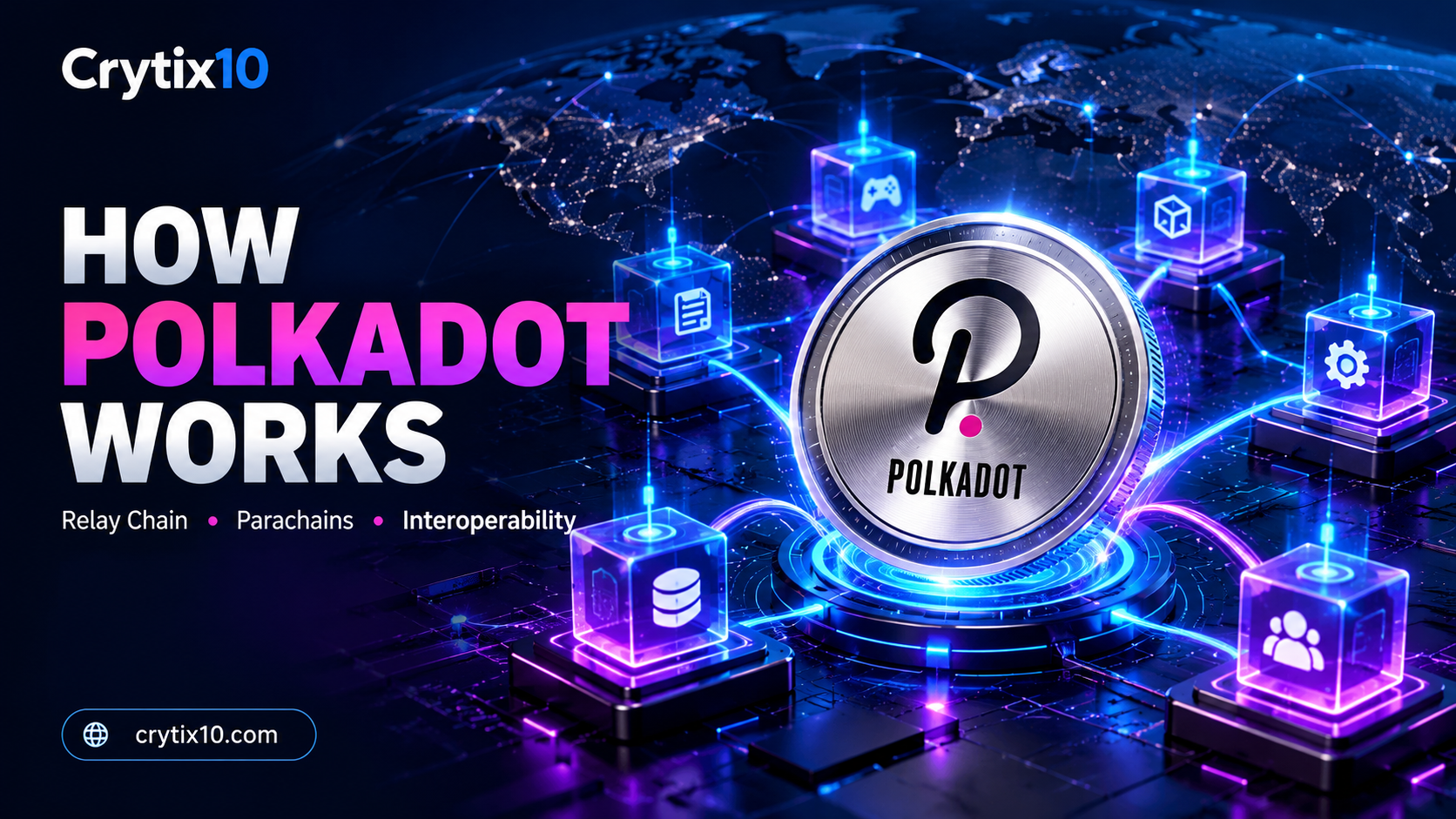
Polkadot (DOT) is an innovative blockchain network designed to connect different blockchain systems, support decentralized applications, and provide shared security for specialized blockchain networks. As the cryptocurrency industry continues to evolve in 2026, Polkadot remains an important project in discussions about blockchain interoperability, scalability, decentralized governance, and Web3 infrastructure. Unlike conventional blockchain networks that primarily operate as isolated ecosystems, Polkadot was created to support multiple blockchains working together within a coordinated environment. This approach allows developers to create specialized blockchain applications while benefiting from common infrastructure, security mechanisms, and communication capabilities. Its native cryptocurrency, DOT, is used for staking, governance, and purchasing computational resources within the ecosystem.
Polkadot is more than another cryptocurrency designed for everyday transactions. It is an infrastructure project that seeks to address important limitations in blockchain technology, particularly the difficulty of connecting independent networks and efficiently allocating computational resources. The ecosystem has undergone significant technical and economic changes, including improvements to parachain infrastructure, flexible coretime purchasing, and a revised DOT supply model. This comprehensive guide explains what Polkadot is, how its technology works, why the DOT token matters, how staking functions, and which opportunities and challenges could influence the network’s long-term development.

What Is Polkadot (DOT)?
Polkadot is an open-source, decentralized blockchain protocol that enables multiple specialized blockchains to operate within a shared security framework. Instead of requiring every decentralized application to build an entirely independent security network, Polkadot provides infrastructure through which connected chains can access validator-backed security and coordinate the exchange of information. These specialized chains can be developed for different purposes, including digital finance, gaming, identity services, enterprise applications, and decentralized infrastructure.
DOT is the native token of the Polkadot ecosystem and supports several essential network functions. Users can stake DOT to help secure the network, participate in governance decisions, and use the token in activities related to obtaining blockchain computational resources. Polkadot’s architecture is especially relevant to developers because it allows different applications to use blockchain environments designed around their individual requirements rather than relying exclusively on a single general-purpose execution layer.
The History and Development of Polkadot
Polkadot was co-founded by Dr. Gavin Wood, Robert Habermeier, and Peter Czaban. Gavin Wood is also known for his earlier involvement in Ethereum and for creating the Solidity programming language. Polkadot was developed with support from Web3 Foundation and Parity Technologies, with the objective of creating a more connected and adaptable blockchain ecosystem. The project’s original technical vision focused on enabling independent blockchain systems to communicate while maintaining strong security and decentralized governance.
Polkadot launched its initial network in May 2020 and subsequently introduced additional functionality through staged development. One major milestone involved the introduction of parachains, which enabled specialized blockchains to operate within Polkadot’s shared security architecture. Since then, the network has moved toward more flexible allocation of execution resources, reducing dependence on earlier approaches that required projects to obtain long-term parachain slots through auctions. Developments such as Agile Coretime and elastic scaling reflect Polkadot’s ongoing transition toward a more adaptable infrastructure model in which blockchain applications can acquire computing capacity according to their needs.
How Does Polkadot Blockchain Technology Work?
Polkadot uses a layered blockchain architecture centered around coordination, security, and specialized execution environments. The Relay Chain provides important consensus and security functions, while connected parachains perform application-specific operations. Validators participate in securing the network through a Proof-of-Stake-based mechanism, checking the validity of blockchain activity and helping maintain agreement across the ecosystem. This shared security model is an important part of Polkadot’s design because connected parachains can benefit from a common validator security framework rather than individually establishing equivalent security arrangements.
Polkadot also uses protocols for communication between connected systems. Its Cross-Consensus Messaging format, commonly known as XCM, allows compatible blockchain environments and consensus systems to express instructions for communication. This can support asset transfers, application coordination, and other interactions when appropriate execution and security mechanisms are available. However, cross-chain communication is not automatically risk-free. Applications still depend on correctly implemented messaging systems, trustworthy execution environments, and secure handling of assets.
Understanding the Polkadot Relay Chain
The Relay Chain is a central component of Polkadot’s architecture. Its main responsibilities include coordinating consensus, validating the work of connected parachains, and supporting network security. Instead of executing every application-level transaction directly, the Relay Chain focuses on responsibilities associated with maintaining the overall blockchain ecosystem. This structure allows connected chains to perform specialized activities while operating under coordinated security assumptions.
Validators play a critical role in this arrangement because they help ensure the validity of parachain blocks and participate in consensus. The system is designed to coordinate multiple parallel workloads while maintaining the network’s security framework. Although the Relay Chain provides shared security to connected parachains, each application must still address smart contract vulnerabilities, operational mistakes, and other risks that can occur at the application level.
What Are Polkadot Parachains?
Parachains are specialized blockchains connected to the Polkadot ecosystem. They can be configured to support particular applications, transaction models, or technical requirements. For example, one parachain might focus on decentralized finance, while another might support gaming, digital identity, or enterprise services. Because parachains do not all need to perform identical functions, developers can optimize their blockchain environments for specific workloads instead of depending on one execution system.
Polkadot’s parachain architecture also provides opportunities for communication between connected networks. This capability is particularly useful for applications that need information or assets to move between different blockchain environments. The design differs from simply creating numerous unrelated blockchains because connected parachains can participate in a coordinated security and interoperability framework. However, connectivity depends on compatible implementations and does not remove the need for careful security analysis.
What Is Agile Coretime in Polkadot?
Agile Coretime is a resource allocation system that allows projects to access the computing capacity required to operate parachains. Under earlier parachain allocation models, projects competed for longer-term execution resources through slot auctions. Agile Coretime introduced a more flexible approach in which projects can obtain processing resources through bulk purchasing or on-demand allocation. This helps developers better match infrastructure spending with their application requirements.
For example, an application expecting steady transaction activity may benefit from reserved bulk coretime, while a project with irregular demand might prefer more flexible resource allocation. This system can reduce the need for projects to commit substantial resources before establishing whether their applications will attract users. It also introduces a direct economic role for DOT because coretime purchasing forms part of Polkadot’s resource market. The effectiveness of this model depends on practical demand, allocation efficiency, and the continued development of supporting infrastructure.
Elastic Scaling and the Future of Polkadot Performance
Elastic scaling is another important element of Polkadot’s technical development. It allows parachains to use multiple processing cores when additional computational capacity is required. Instead of limiting a parachain to a fixed amount of execution capacity, elastic scaling can help applications process more work in parallel and respond more effectively to changes in transaction demand.
This approach is particularly relevant for blockchain applications that experience unpredictable activity, including decentralized exchanges, gaming platforms, and other high-volume services. However, actual performance depends on application design, resource availability, node infrastructure, and correct implementation. Technical throughput estimates should not be confused with guaranteed real-world performance for every blockchain application. Elastic scaling is best understood as an infrastructure capability that can support greater flexibility rather than as a promise of unlimited transaction processing.
Polkadot Tokenomics and DOT Supply in 2026
Polkadot’s tokenomics underwent a major change through its community governance process. Earlier descriptions of DOT commonly referred to an inflationary model without a fixed maximum supply. However, the network approved a revised monetary policy establishing a maximum supply of 2.1 billion DOT. The new issuance schedule was implemented through governance changes in January 2026, with a major issuance adjustment beginning on March 14, 2026.
Under the revised monetary policy, additional DOT issuance follows a stepped schedule that reduces the remaining distance toward the maximum supply over time. This represents a significant change to the ecosystem’s long-term monetary framework. New tokens continue to be relevant to staking rewards and network economics, but the issuance mechanism now operates within a capped supply model. Investors should distinguish between maximum supply, total supply, and circulating supply because these metrics measure different aspects of token availability. A supply cap does not guarantee that DOT will appreciate in value, since market demand, liquidity, network adoption, and investor expectations remain essential factors.
What Is DOT Used For?
DOT serves multiple functions within the Polkadot ecosystem. One of its primary uses is staking, which helps secure the network by supporting validators who participate in consensus. DOT holders may also participate in governance activities, including decisions about protocol upgrades, treasury funding, and network policies. These functions distinguish DOT from cryptocurrencies whose principal role is limited to transferring value between users.
DOT is also used in Polkadot’s coretime market, where computational resources can be acquired for blockchain operations. This creates an economic connection between network infrastructure and the native token. Nevertheless, the relationship between ecosystem growth and token price is complex. More development activity does not automatically guarantee higher token demand or higher market valuations. Investors should assess whether actual network use is generating sustainable economic activity rather than relying solely on announcements about new partnerships or technical features.
How Does Polkadot Staking Work?
Polkadot uses a staking model commonly described as Nominated Proof-of-Stake, or NPoS. In this system, validators operate infrastructure and help secure the network, while nominators support validators by staking DOT. Eligible participants may receive staking rewards when protocol conditions are satisfied. However, staking also carries risks, including potential slashing when validators violate certain network rules. Rewards can vary depending on validator performance, staking conditions, commissions, and other network factors.
Polkadot supports both direct nomination and nomination pools. Under the documented 2026 requirements, submitting an intention to nominate directly requires at least 250 DOT, while nomination pools allow participation starting from 1 DOT. Importantly, the minimum amount required for active direct nomination rewards is dynamic, so holding the nomination-intent minimum does not automatically guarantee rewards. Nomination pools offer an accessible alternative for users with smaller holdings, although members still need to evaluate pool management, fees, validator selection, and staking risks.
Staking also introduces liquidity considerations because bonded tokens may not be immediately transferable. Withdrawal and unbonding rules can change through governance and network upgrades, so users should confirm the current requirements before committing funds. Anyone interested in staking should rely on the official Polkadot Staking Dashboard and current protocol documentation rather than assuming that advertised annual percentage yields are fixed or guaranteed.
Polkadot OpenGov and Decentralized Governance
OpenGov is Polkadot’s on-chain governance system, allowing eligible DOT holders to participate in decisions affecting the network. Governance activities can include protocol upgrades, treasury spending proposals, economic parameter changes, and other matters involving ecosystem development. Instead of depending entirely on a central organization to determine the network’s direction, Polkadot provides mechanisms through which stakeholders can submit proposals and participate in voting.
This governance structure gives DOT an important role beyond market speculation. Holders may influence the network’s future by participating in decisions about technology, funding, and resource allocation. However, decentralized governance also introduces challenges. Complex proposals can be difficult for ordinary users to evaluate, voting participation may be uneven, and large token holders can potentially exercise significant influence. Effective governance therefore depends not only on technical voting systems but also on transparency, responsible participation, and informed decision-making.
Real-World Use Cases of Polkadot
Polkadot’s infrastructure supports the development of blockchain-based applications in several sectors. Decentralized finance projects can use connected chains to build financial services, while gaming applications may benefit from specialized execution environments. Digital identity systems, tokenization platforms, decentralized infrastructure, and interoperability services are other areas where customizable blockchain technology may provide practical advantages.
One of Polkadot’s central potential benefits is reducing the isolation of blockchain ecosystems. Applications operating on connected chains may be able to coordinate activities and exchange supported assets through compatible communication mechanisms. Nevertheless, technical interoperability does not automatically create commercial success. Blockchain applications must still provide convenient user experiences, competitive costs, reliable infrastructure, and meaningful advantages over existing technologies. Sustainable adoption depends on whether developers can convert these capabilities into products that users genuinely need.
Polkadot vs Ethereum: What Is the Difference?
Polkadot and Ethereum are both important blockchain ecosystems, but their architectural priorities differ. Ethereum provides a widely used smart contract platform with an extensive ecosystem of decentralized applications and Layer 2 networks. Polkadot focuses on coordinated blockchain infrastructure, shared security, parachain execution, and communication between specialized blockchain environments. These different approaches reflect distinct strategies for improving scalability, developer flexibility, and decentralized application infrastructure.
Ethereum’s ecosystem benefits from broad adoption, established financial applications, and significant developer activity. Polkadot offers specialized blockchain development capabilities and a shared security model intended to support connected networks. Neither platform is automatically better for every application. Developers should consider technical requirements, ecosystem maturity, interoperability, cost, security, and application-specific needs when deciding which infrastructure to use.
Polkadot vs Solana and Avalanche
Polkadot also competes with other blockchain platforms, including Solana and Avalanche. Solana emphasizes high-performance execution within an integrated blockchain environment, while Avalanche supports customizable Layer 1 networks alongside its Primary Network. Polkadot distinguishes itself through its coordinated parachain architecture, shared security, governance mechanisms, and flexible computational resource allocation.
These differences matter because blockchain scalability can be approached in several ways. Some networks prioritize execution performance, while others emphasize specialized chains, independent validator models, or modular infrastructure. The best technical design depends on the intended application and the security assumptions involved. Investors should avoid treating marketing claims about transaction speed as the only meaningful measure of blockchain quality.
Is Polkadot (DOT) a Good Investment in 2026?
Polkadot may interest investors who believe that blockchain interoperability, shared security, and specialized execution environments will remain relevant to the future of decentralized technology. Its technical infrastructure, governance system, staking economy, and capped supply model provide identifiable characteristics for investment research. However, a technically sophisticated project is not automatically a profitable investment. The market value of DOT can be influenced by cryptocurrency liquidity, speculative trading, overall economic conditions, token issuance, competitive developments, and actual demand for network services.
An informed investment analysis should consider Polkadot’s ecosystem activity, active developers, parachain usage, coretime demand, validator participation, treasury spending, and real-world adoption. It should also examine the relationship between the network’s economic activity and demand for DOT. A supply cap may change the long-term monetary framework, but it does not establish a guaranteed minimum price or future appreciation. Investors should compare the potential rewards with the risk of significant financial losses before deciding whether DOT is appropriate for their circumstances.
Major Risks of Investing in Polkadot
Polkadot carries many of the risks associated with cryptocurrency investments. Its token price can experience substantial volatility, and market trends may change rapidly without corresponding changes to the underlying technology. Competition from Ethereum, Solana, Avalanche, and other blockchain ecosystems could affect demand for Polkadot-based infrastructure. The network must continue attracting developers and users while maintaining reliable services and an economically sustainable ecosystem.
Technical risks include software vulnerabilities, smart contract exploits, interoperability failures, validator misconduct, and security weaknesses in applications built on connected chains. Staking participants may also face slashing, reward uncertainty, and liquidity restrictions. Governance decisions can change important economic and operational parameters, making it essential for users to stay informed about protocol developments. Investors should avoid relying on guaranteed-return promotions and should never commit funds they cannot afford to lose.
How to Buy and Store Polkadot (DOT) Safely
Users interested in purchasing DOT should research cryptocurrency exchanges that support Polkadot and operate legally within their jurisdiction. Important considerations include trading fees, exchange security, withdrawal costs, liquidity, and supported payment methods. Before purchasing, users should understand whether they plan to trade DOT, hold it for longer periods, use it for governance, or participate in staking.
For storage, users may choose compatible self-custody wallets or custodial exchange accounts. Self-custody offers direct control over cryptographic credentials but requires careful backup and recovery practices. Users should confirm that their wallet supports the relevant Polkadot network and verify all addresses before transferring funds. Hardware wallets may provide additional protection for larger holdings when properly configured. Recovery phrases should never be shared with anyone, including people claiming to represent wallet support services.
Polkadot’s Future: Web3, JAM and Blockchain Interoperability
Polkadot’s long-term development includes work on greater scalability, flexible computation, and improvements to its underlying architecture. One significant research direction is the Join-Accumulate Machine, commonly known as JAM. This proposed architecture aims to extend Polkadot’s computational flexibility while preserving important security properties. JAM represents a future-oriented technological direction rather than a feature that should be assumed to be fully deployed on the live network.
Polkadot’s broader future depends on developer adoption, useful applications, economic sustainability, governance quality, and its ability to compete with alternative blockchain infrastructure. Agile Coretime and elastic scaling may help developers build more flexible systems, while cross-chain communication could support applications requiring cooperation between multiple networks. For DOT holders, the most important indicators will be measurable network usage and economic demand rather than speculative headlines or unrealistic price predictions.
FAQs
1. What is Polkadot (DOT) cryptocurrency?
Polkadot is a blockchain ecosystem designed to connect specialized blockchains through shared security and communication infrastructure. DOT is its native cryptocurrency, used for staking, governance, and purchasing computational resources.
2. Who founded Polkadot?
Polkadot was co-founded by Gavin Wood, Robert Habermeier, and Peter Czaban. Its development has been associated with Web3 Foundation and Parity Technologies.
3. Does Polkadot have a maximum supply?
Yes. Following its 2026 monetary policy changes, Polkadot has a maximum supply cap of 2.1 billion DOT.
4. Can I stake Polkadot with 1 DOT?
Yes. Polkadot nomination pools support participation starting from 1 DOT. Direct nomination has higher minimum requirements, and staking rewards are not guaranteed.
5. What are Polkadot parachains?
Parachains are specialized blockchain networks that connect to Polkadot’s infrastructure and can benefit from coordinated security and interoperability mechanisms.
6. What is the difference between Polkadot and Ethereum?
Polkadot focuses on connected blockchain infrastructure and shared security, while Ethereum provides a major smart contract settlement network with a broad ecosystem of Layer 2 applications.
7. Is Polkadot a good long-term investment?
Polkadot has notable blockchain technology and an established ecosystem, but its future token performance is uncertain. Investors should assess adoption, competition, tokenomics, and personal financial risk before investing.
8. Can Polkadot reach $100?
A $100 DOT price is theoretically possible under sufficiently strong market demand, but there is no guarantee this price will be reached. Market capitalization, token supply, liquidity, and broader economic conditions must all be considered.
9. What is Polkadot OpenGov?
OpenGov is Polkadot’s on-chain governance system. It allows eligible token holders to participate in proposals and votes concerning network upgrades, treasury spending, and protocol policies.
10. What is the future of Polkadot in 2026 and beyond?
Polkadot’s future depends on its ability to support useful blockchain applications, attract developers, scale efficiently, and maintain secure infrastructure. Improvements such as Agile Coretime, elastic scaling, and future architectural research may influence its development.
Conclusion
Polkadot (DOT) is a blockchain infrastructure project designed to support interoperability, decentralized security, specialized blockchain development, and community governance. Its architecture combines coordinated validation with flexible execution environments, allowing developers to build blockchain applications that can interact within a broader network. Developments involving Agile Coretime, elastic scaling, and a revised token supply model demonstrate the project’s continuing technical and economic evolution.
For anyone researching Polkadot in 2026, it is important to understand both the platform’s technological potential and the uncertainty surrounding cryptocurrency investments. DOT provides utility through staking, governance, and network resource purchasing, but future market performance will depend on adoption, economic demand, competition, and broader financial conditions. Readers should rely on verified documentation, evaluate risks carefully, and avoid treating speculative price forecasts as guaranteed investment outcomes.
Disclaimer: This article is intended for educational and informational purposes only. It does not constitute financial, investment, legal, or tax advice. Cryptocurrency investments involve substantial risk, including the possible loss of invested capital.