

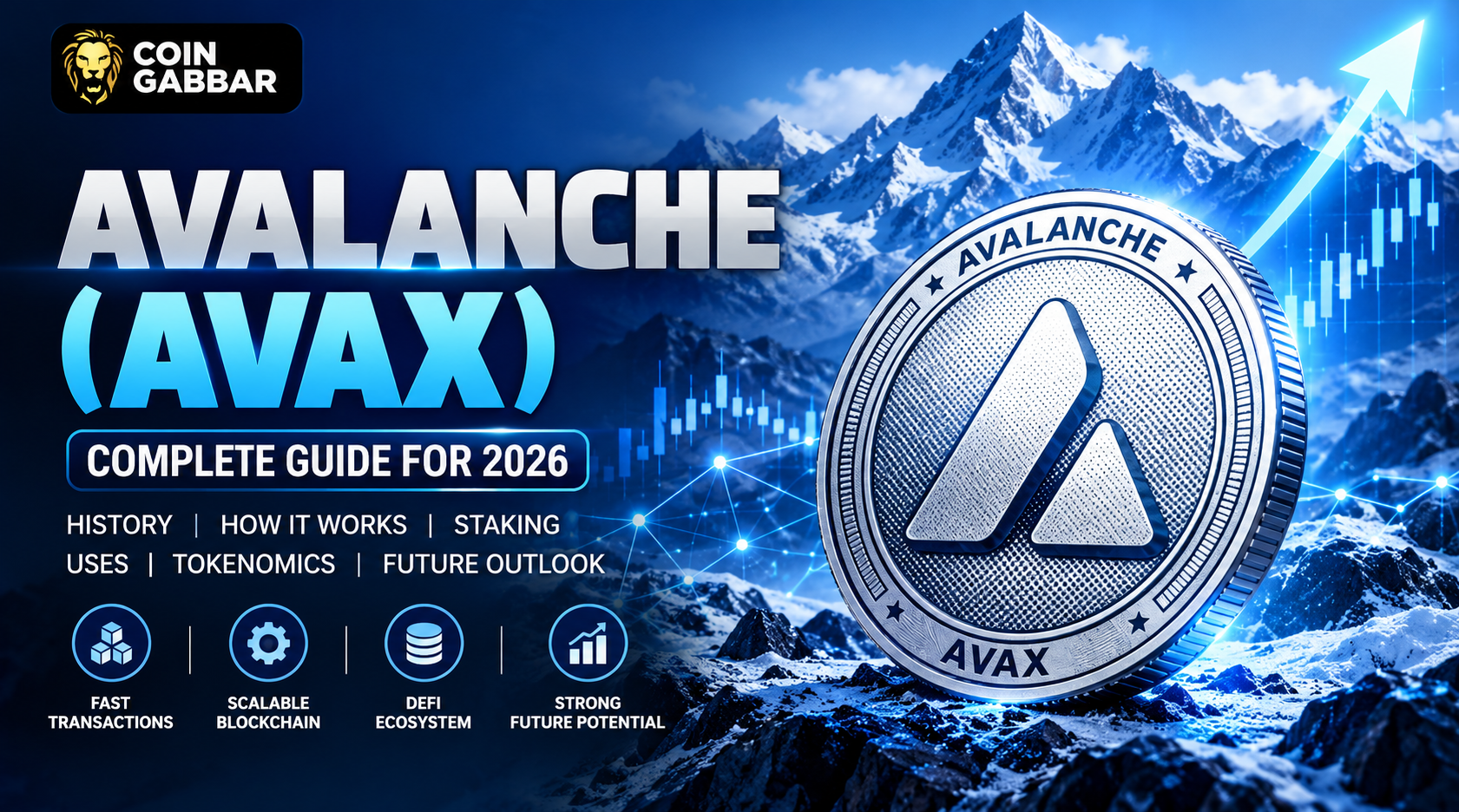
Avalanche (AVAX) is a blockchain ecosystem designed to support decentralized applications, digital assets, financial services, and customizable blockchain networks. As cryptocurrency technology continues evolving in 2026, Avalanche remains an important platform for developers and organizations interested in building applications that require fast transaction processing, flexible network architecture, and compatibility with established smart contract development tools. Unlike blockchain systems that depend entirely on one shared execution environment, Avalanche allows developers to build independent Layer 1 blockchains with their own operational requirements while remaining part of the broader Avalanche ecosystem. This architectural approach has attracted attention from decentralized finance developers, gaming projects, enterprises, and infrastructure providers exploring blockchain-based solutions.
AVAX is the native cryptocurrency of the Avalanche Primary Network and plays an essential role in transaction fees, staking, and network security. However, understanding Avalanche requires more than following the market price of its token. The platform combines specialized blockchains, Proof-of-Stake security, and consensus protocols intended to provide efficient transaction finality. This complete guide explains how Avalanche works, what makes its blockchain architecture different, how AVAX staking operates, why tokenomics matter, and which benefits and risks investors should examine before participating in the ecosystem.
What Is Avalanche (AVAX)?
Avalanche is an open-source blockchain platform that supports smart contracts, digital asset transactions, and the creation of independent application-specific blockchain networks. Developed by Ava Labs and supported by a broader community of contributors and validators, Avalanche launched its mainnet in September 2020. Its primary objective is to provide infrastructure that developers can use for decentralized applications without relying on a single execution environment for every project. The network supports applications involving decentralized exchanges, lending services, blockchain gaming, tokenization, digital collectibles, and other uses of programmable blockchain technology.
The Avalanche ecosystem consists of a Primary Network and additional Avalanche Layer 1 blockchains, previously referred to as Subnets. Its Primary Network contains three specialized chains, each responsible for different functions. The Contract Chain supports Ethereum-compatible smart contracts, the Platform Chain manages important network coordination and staking operations, and the Exchange Chain handles native asset activities. This division allows Avalanche to organize blockchain operations across multiple components instead of placing every responsibility on one chain. AVAX connects important parts of this infrastructure by supporting transaction processing and participation in network security.
The History and Development of Avalanche
Avalanche emerged from research into a family of consensus protocols that use repeated sampling among validators to establish agreement efficiently. The platform’s development is closely associated with computer scientist Emin Gün Sirer and researchers Kevin Sekniqi and Maofan “Ted” Yin. Ava Labs helped develop the technology and build the supporting ecosystem, while the Avalanche mainnet officially launched in September 2020. The project entered a competitive blockchain landscape where Ethereum had established itself as a major smart contract platform, but transaction congestion and scalability limitations were encouraging developers to explore alternative network designs.
Since its launch, Avalanche has expanded beyond its original blockchain architecture through upgrades, additional development tools, and support for application-specific networks. Its approach to independent blockchain deployments has become increasingly important as projects seek customized infrastructure for gaming, financial applications, institutional experimentation, and other specialized workloads. The Avalanche9000 initiative and Etna upgrade helped reshape the economics and deployment model for custom Avalanche Layer 1 networks. Later developments, including the Helicon upgrade activated in September 2026, introduced further changes to network execution and staking parameters. These developments reflect an ongoing effort to improve usability, infrastructure efficiency, and blockchain customization, although their long-term success depends on adoption and reliable operation.
How Does Avalanche Blockchain Technology Work?
Avalanche uses a Proof-of-Stake system in which validators participate in network security and transaction agreement. Instead of relying on energy-intensive mining equipment, validators commit AVAX and operate nodes that communicate with other network participants. Avalanche’s consensus design uses repeated sampling, meaning validators query subsets of other validators and update their preferences until the network reaches agreement. This approach differs from traditional Proof-of-Work mining and from some classical Byzantine fault-tolerant systems that require more extensive communication among participating nodes.
The platform’s Snowman consensus protocol supports ordered sequences of blocks and is used across its Primary Network chains. Snowman builds on concepts from the Avalanche consensus family to enable efficient agreement while retaining distributed validation. Avalanche is designed to achieve fast transaction finality, but actual performance depends on network conditions, application requirements, transaction complexity, and the particular blockchain involved. Fast finality should not be interpreted as a guarantee that every application will deliver identical speeds or that transactions are automatically protected from application-level vulnerabilities. Reliable operation still depends on validator participation, correct software, secure smart contracts, and appropriate network configuration.
Understanding Avalanche’s Three Primary Blockchains
1. Contract Chain (C-Chain)
The Contract Chain, commonly called the C-Chain, is Avalanche’s Ethereum-compatible smart contract environment. It supports the Ethereum Virtual Machine, allowing developers to deploy and operate smart contracts using familiar technologies such as Solidity and commonly used Ethereum development tools. This compatibility makes Avalanche accessible to teams already experienced with Ethereum-based applications, reducing the need to learn an entirely different programming model before creating decentralized exchanges, lending protocols, token contracts, or other blockchain services.
The C-Chain is also important for everyday users because many Avalanche-based decentralized applications and compatible wallets operate through it. Transactions on the C-Chain generally require AVAX for gas fees. Users moving tokens between platforms must carefully verify the selected network because Avalanche C-Chain addresses and asset representations can resemble those on other EVM-compatible blockchains, even though the underlying networks are separate.
2. Platform Chain (P-Chain)
The Platform Chain, known as the P-Chain, coordinates essential platform-level functions, including Primary Network staking and validator-related operations. It also supports the infrastructure used to organize Avalanche Layer 1 blockchain deployments. The P-Chain contributes to the network’s operational structure by recording validator participation and handling activities associated with securing the Primary Network.
For investors who want to participate in native AVAX staking, the P-Chain is particularly important. Validator and delegation operations involve protocol requirements that differ from ordinary C-Chain transfers. Users should understand which chain their wallet or staking interface uses before transferring assets, because sending tokens through the wrong network can create unnecessary complications.
3. Exchange Chain (X-Chain)
The Exchange Chain, or X-Chain, is designed for native Avalanche asset creation and exchange-related operations. It uses a transaction model suited to handling digital assets and transfers, while the C-Chain focuses on programmable smart contract execution. The presence of separate chains reflects Avalanche’s design philosophy of organizing different workloads according to their requirements rather than forcing every application to share one environment.
Although these three chains perform different responsibilities, they operate within the Primary Network’s broader infrastructure. Users and developers should distinguish between them when choosing wallet tools, implementing transfers, or integrating services because compatibility and transaction handling depend on the chain being used.
What Are Avalanche Layer 1 Blockchains?
Avalanche Layer 1 blockchains are customizable networks that developers can deploy for applications with particular operational, technical, or organizational needs. Previously known as Avalanche Subnets, these networks can use independent validator arrangements and specialized configurations. For example, a blockchain game may benefit from infrastructure tailored to frequent in-game transactions, while an enterprise application may require particular validator membership or compliance-related controls. Rather than requiring every project to compete for the same execution resources, independent Avalanche L1s can process their own workloads.
This design provides flexibility, but it also introduces trade-offs. Independent blockchain environments must establish appropriate security, validator participation, interoperability mechanisms, and operational reliability. The security characteristics of a custom L1 should not automatically be considered identical to those of Avalanche’s Primary Network. Developers must evaluate their selected validator model and application architecture carefully. The ecosystem’s ability to connect specialized blockchains is an important potential advantage, but moving information or assets between networks requires compatible infrastructure and security-conscious implementation.
What Is AVAX and How Is It Used?
AVAX is the native utility token of Avalanche’s Primary Network. Its most established roles include paying transaction fees, securing the Primary Network through staking, and supporting operations within the Avalanche ecosystem. When users interact with smart contracts on the C-Chain, they typically pay gas fees in AVAX. Validators stake AVAX to participate in securing the network, while eligible delegators can assign their stake to validators according to protocol rules.
AVAX is also relevant to broader ecosystem economics, although not every Avalanche L1 must use AVAX as its transaction fee token. Custom Layer 1 networks may employ different economic structures and fee assets depending on their design. Consequently, an increase in the number of Avalanche-based blockchains does not necessarily produce a proportional increase in direct demand for AVAX. Investors should examine how a particular application uses the native token rather than assuming every activity across the ecosystem creates identical token demand.
Avalanche Tokenomics: Supply, Fees and Burning
Avalanche has a protocol-defined AVAX supply cap of 720 million tokens. At the network’s launch, 360 million AVAX were minted as part of the genesis allocations, while additional tokens have been issued through staking rewards. The actual available supply changes over time as rewards are created, tokens become available, and transaction fees are permanently removed from circulation through burning. This supply structure differs from cryptocurrencies with unlimited issuance because AVAX has a defined upper limit on minting.
Avalanche’s transaction fee burning mechanism is another important feature of its tokenomics. Fees paid for qualifying activities on the Primary Network are destroyed instead of being distributed directly to validators as transaction fee income. Eligible validators receive newly minted staking rewards under the protocol’s reward rules. These processes operate independently, meaning supply issuance and fee burning can occur simultaneously. Although burning reduces the number of existing tokens, it does not guarantee price appreciation, since market value also depends on demand, liquidity, trading conditions, token distribution, and overall investor sentiment.
How Does Avalanche Staking Work?
Avalanche staking allows eligible AVAX holders to participate in securing the Primary Network through validation or delegation. A validator operates the required infrastructure and commits a minimum of 2,000 AVAX to join the Primary Network validator set. Validators are responsible for maintaining node availability, following consensus rules, and participating correctly in network operations. Those who satisfy the required performance conditions may receive staking rewards after completing their staking periods.
Delegation provides an alternative for users who do not want to operate validator infrastructure. The minimum native delegation amount is 25 AVAX, allowing eligible holders to delegate tokens to a selected validator while participating in the network’s staking system. Delegators must consider validator reliability, delegation fees, expected rewards, and staking duration. Rewards are not guaranteed because validator performance and protocol conditions affect eligibility. Native staking also involves defined commitment periods, and users generally cannot withdraw their staked AVAX early once the operation has been accepted.
In 2026, staking parameters have evolved alongside Avalanche network upgrades. The Helicon upgrade reduced the minimum Primary Network validator staking period to 48 hours, while native delegation generally retains a two-week minimum. Reward calculations depend on factors including staking duration, current supply, protocol parameters, and validator performance. Users should rely on the latest official Avalanche documentation rather than outdated guides or promotional reward estimates.
Avalanche and Decentralized Finance (DeFi)
Decentralized finance is an important application category within the Avalanche ecosystem. DeFi protocols use smart contracts to support activities such as token swaps, borrowing, lending, liquidity provision, and other blockchain-based financial operations. Avalanche’s EVM-compatible C-Chain provides developers with a familiar environment for building these applications, while its independent Layer 1 architecture offers additional options for projects with specialized performance or infrastructure requirements.
DeFi participation creates opportunities for users to interact with financial applications without relying entirely on traditional intermediaries, but it also introduces significant risks. Smart contract vulnerabilities, oracle failures, liquidity shortages, governance decisions, and unstable token prices can result in substantial losses. Some protocols also use bridges or wrapped assets that introduce additional dependencies and security concerns. Users should research the underlying protocol, verify contract addresses, understand liquidation rules where applicable, and avoid assuming that a high advertised yield indicates a safe or sustainable opportunity.
Real-World Applications of Avalanche
Avalanche can support applications extending beyond cryptocurrency trading. Its programmable infrastructure allows developers to explore digital asset tokenization, gaming economies, enterprise blockchain systems, identity-related applications, and settlement services. Tokenization involves representing rights or interests in assets through digital tokens, potentially allowing automated transfers, programmable restrictions, or more transparent records. However, the legal enforceability of tokenized ownership depends on the jurisdiction, the asset structure, and the organizations involved.
Gaming applications may use blockchain infrastructure to manage transferable items, ownership records, or digital currencies, while enterprises may investigate specialized blockchain networks with configurable validator participation. These applications remain subject to practical challenges involving regulation, user experience, integration costs, privacy, and technical security. Avalanche’s flexibility makes it a candidate for such deployments, but the existence of blockchain infrastructure does not by itself prove commercial viability or meaningful adoption.
Avalanche vs Ethereum: Key Differences
Avalanche and Ethereum both support smart contracts and decentralized applications, but their architectures differ considerably. Ethereum operates around a primary settlement network with a broader ecosystem of Layer 2 scaling solutions, while Avalanche combines its Primary Network with customizable Layer 1 blockchains. Avalanche’s C-Chain provides EVM compatibility, allowing many Ethereum-oriented development techniques to be adapted for Avalanche applications.
Both ecosystems use Proof-of-Stake-based security, but they employ different consensus mechanisms, validator structures, and scaling approaches. Ethereum has an extensive developer ecosystem and established application infrastructure, while Avalanche emphasizes independent blockchain customization and a different approach to transaction execution. Neither system should be considered universally superior. Developers must evaluate security assumptions, transaction requirements, ecosystem maturity, liquidity, interoperability, and operating costs before choosing a blockchain platform.
Is Avalanche (AVAX) a Good Investment in 2026?
Avalanche may attract investors interested in smart contract platforms, blockchain infrastructure, and decentralized application adoption. Its established token utility, capped issuance framework, staking system, and customizable network architecture provide measurable characteristics that investors can examine. However, identifying useful technology does not automatically establish that its native cryptocurrency is undervalued or that future returns will be positive. Cryptocurrency valuations can be strongly influenced by general market liquidity, speculative trading activity, economic conditions, regulatory developments, and changing expectations about future adoption.
A responsible investment assessment should consider Avalanche’s actual network usage, transaction activity, fee generation, token supply changes, validator participation, developer engagement, and competition from other blockchain networks. Investors should also examine whether ecosystem growth creates direct economic demand for AVAX and how that demand compares with new issuance and available market supply. Short-term price movements can be unpredictable, and long-term investment outcomes remain uncertain even when a project continues developing its technology. No specific AVAX price target for 2026 or beyond should be treated as guaranteed.
Major Risks of Avalanche Cryptocurrency
Market volatility is one of the main risks associated with AVAX. Like other cryptocurrencies, its price can experience sharp movements driven by changes in investor confidence, liquidity, regulatory announcements, security events, or broader market trends. Competition also matters because Avalanche operates in a sector where numerous blockchain platforms are developing scaling solutions, customizable networks, and efficient smart contract environments. Sustained technological innovation does not guarantee that one network will capture a particular share of users or economic activity.
Technical and operational risks include smart contract exploits, wallet compromise, bridge vulnerabilities, network outages, and weaknesses in independently configured Avalanche L1 environments. Investors who stake AVAX must also consider lock-up periods, validator performance, and changing protocol parameters. Custodial exchanges introduce counterparty risks, while self-custody requires careful private key management. Evaluating these issues before acquiring AVAX can help users distinguish between the platform’s potential benefits and the actual risks involved in holding or using its token.
How to Buy and Store Avalanche (AVAX)
Users interested in purchasing AVAX should begin by researching cryptocurrency exchanges that legally operate in their country and support the appropriate Avalanche network. Exchange selection should consider security history, fees, liquidity, account verification requirements, and supported deposit and withdrawal methods. After purchasing AVAX, holders can choose between custodial exchange storage and compatible self-custody wallets according to their individual preferences and security capabilities.
The Avalanche Core wallet is one option designed for interacting with Avalanche ecosystem features, including supported staking operations. Other wallets may support the C-Chain or specific Avalanche assets, but users must confirm exactly which networks and token standards are available. Before transferring AVAX, it is important to verify the receiving address, destination chain, and withdrawal network. Keeping recovery phrases offline, enabling two-factor authentication where available, and testing unfamiliar transfer routes with small amounts can reduce avoidable security risks.
The Future of Avalanche Blockchain
Avalanche’s future will depend on its ability to attract developers, support reliable blockchain operations, and provide tangible benefits to organizations and users. Continued improvements to infrastructure, validator participation, interoperability, and development tools may help expand the ecosystem. Custom Avalanche Layer 1 networks offer possibilities for applications requiring specialized configurations, but adoption will ultimately depend on whether these networks solve real problems more effectively than competing technologies.
For AVAX holders, the distinction between ecosystem expansion and token value remains especially important. Network adoption may create transaction activity and demand for certain services, but individual L1s can use different fee structures and economic models. Long-term outcomes will therefore depend on multiple factors, including native staking demand, fee burning, technological relevance, market conditions, and actual usage of the Primary Network. Avalanche represents an important approach to blockchain infrastructure, but its future market performance remains uncertain.
FAQs
1. What is Avalanche (AVAX) cryptocurrency?
Avalanche is a blockchain platform designed for smart contracts, decentralized applications, and customizable Layer 1 networks. AVAX is its native utility cryptocurrency, used for transaction fees and Primary Network staking.
2. Who founded Avalanche?
Avalanche technology is associated with Emin Gün Sirer, Kevin Sekniqi, and Maofan “Ted” Yin. Ava Labs contributed to building the platform, which launched its mainnet in September 2020.
3. What is the maximum supply of AVAX?
Avalanche has a protocol-defined maximum minting supply of 720 million AVAX. Transaction fee burning permanently removes tokens, so the effective available maximum can be lower.
4. Can I stake Avalanche (AVAX)?
Yes. Eligible users can participate through native validation or delegation. The mainnet minimums are 2,000 AVAX for Primary Network validators and 25 AVAX for delegators.
5. Is Avalanche better than Ethereum?
Avalanche and Ethereum use different architectures and scaling approaches. Avalanche provides customizable L1 networks, while Ethereum has a larger established ecosystem of Layer 2 solutions and applications. The better choice depends on specific needs.
6. What are Avalanche L1s?
Avalanche L1s, formerly called Subnets, are customizable blockchain networks with their own validation arrangements and operating configurations. They can support applications that need specialized infrastructure.
7. Can Avalanche reach $100?
A price of $100 is theoretically possible if market demand supported the corresponding valuation, but there is no reliable guarantee that AVAX will reach this level. Investors should evaluate supply, market capitalization, liquidity, and economic conditions.
8. Is Avalanche safe for beginners?
Avalanche is an established blockchain ecosystem, but using AVAX involves cryptocurrency market volatility, wallet security requirements, and application-level risks. Beginners should research transactions and storage practices carefully before committing funds.
9. Does Avalanche burn transaction fees?
Yes. Qualifying transaction fees paid in AVAX on the Primary Network are burned. This removes the paid tokens from circulation, while eligible staking rewards are minted separately.
10. What is the future of Avalanche in 2026 and beyond?
Avalanche’s future depends on development activity, ecosystem adoption, network security, interoperability, and competition. Its architecture offers potential applications, but future growth and AVAX price performance cannot be guaranteed.
Conclusion
Avalanche (AVAX) is a blockchain ecosystem that combines smart contract functionality, Proof-of-Stake security, specialized Primary Network chains, and customizable Layer 1 blockchain infrastructure. Its architecture aims to provide developers with flexibility while supporting decentralized finance, digital assets, enterprise applications, and other uses of blockchain technology. AVAX plays a central role in Primary Network transaction fees and staking, while its capped supply and fee-burning mechanism distinguish its economic design from some other cryptocurrencies.
For readers exploring Avalanche in 2026, the most important consideration is understanding both the technology and its limitations. Fast transaction processing, configurable blockchain networks, and an active development ecosystem may support future adoption, but they do not eliminate investment volatility, security threats, or competition. Whether evaluating Avalanche as a developer, everyday user, or potential investor, decisions should be guided by verified technical information, practical use cases, current market conditions, and an awareness of financial risk rather than unrealistic price predictions.
Disclaimer: This article is intended for educational and informational purposes only and does not constitute financial, investment, tax, or legal advice. Cryptocurrency markets are volatile, and readers should conduct independent research before making investment decisions.