

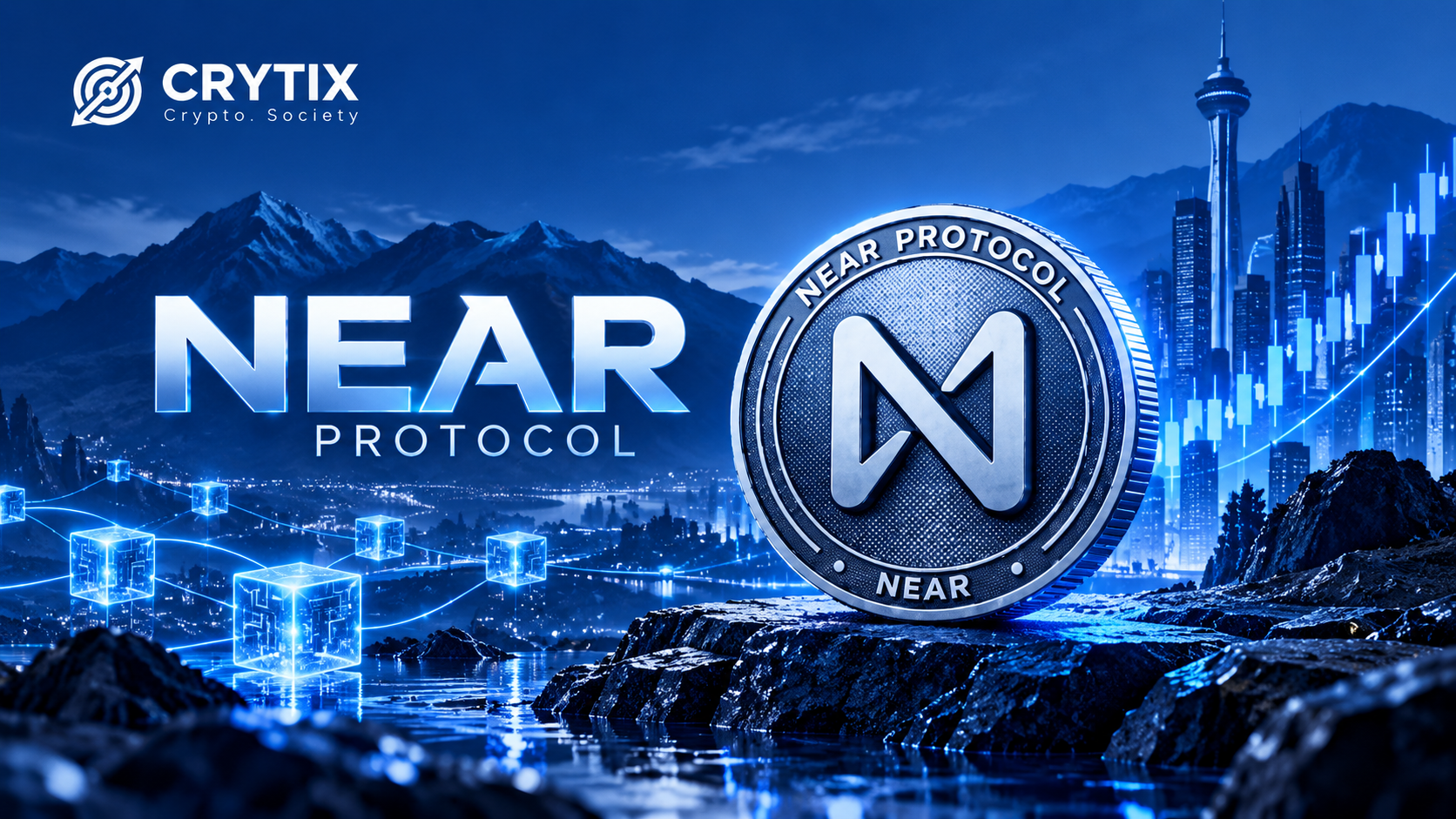
NEAR Protocol (NEAR) is a Layer 1 blockchain platform designed to support decentralized applications, digital payments, scalable smart contracts, and user-friendly Web3 experiences. Since its mainnet launch in 2020, NEAR has developed from a blockchain scalability project into a broader ecosystem focused on cross-chain interoperability, artificial intelligence, and decentralized financial infrastructure. Unlike traditional blockchain networks that depend entirely on a single processing environment, NEAR uses an advanced sharding architecture known as Nightshade to distribute transaction processing across multiple sections of the network. This approach aims to provide efficient performance while supporting applications that require accessible blockchain technology.
In 2026, NEAR Protocol has attracted additional attention through developments involving NEAR Intents, Chain Signatures, AI agents, and improvements to its tokenomics. These technologies seek to simplify cryptocurrency transactions across different blockchains and support applications in which artificial intelligence systems can interact with digital assets. The NEAR token plays an important role in transaction fees, staking, and network security. However, understanding NEAR requires examining its actual technology and economic design rather than focusing exclusively on market prices. This comprehensive guide explores how NEAR works, its advantages, limitations, staking opportunities, token supply, investment risks, and long-term potential.
What Is NEAR Protocol (NEAR)?
NEAR Protocol is an open-source, Proof-of-Stake blockchain that enables developers to build decentralized applications and smart contracts. Its infrastructure supports blockchain-based payments, digital asset management, decentralized finance, gaming applications, and services that connect multiple cryptocurrency networks. The platform emphasizes accessibility by providing features such as readable account names, flexible account permissions, and development tools designed to reduce the complexity of creating and using decentralized applications.
The native cryptocurrency, NEAR, is used to pay transaction fees, secure the blockchain through staking, and support various network activities. Unlike projects built entirely on Ethereum, NEAR operates its own independent blockchain with a separate validator network and consensus infrastructure. Developers can create smart contracts using supported technologies, including Rust-based development tools, while users interact through compatible wallets. The platform also supports WebAssembly-based smart contract execution, helping developers build applications that can operate within its blockchain environment.
The History and Founders of NEAR Protocol
NEAR Protocol was co-founded by Illia Polosukhin and Alexander Skidanov in 2018. Polosukhin previously worked as a machine learning researcher at Google and was a co-author of the influential research paper “Attention Is All You Need,” which helped establish the transformer architecture used in modern artificial intelligence systems. Skidanov brought experience in distributed databases and large-scale software infrastructure. Their technical backgrounds influenced NEAR’s original focus on making decentralized applications more scalable and accessible.
The network reached its mainnet genesis on April 22, 2020, initially operating under a controlled launch model. Later that year, NEAR progressed toward decentralized validator participation, with the network becoming community-operated in September 2020. Since its early development, NEAR has introduced improvements involving blockchain sharding, stateless validation, cross-chain communication, and user-friendly wallet infrastructure. Its evolving roadmap demonstrates a shift from focusing primarily on blockchain throughput toward supporting an ecosystem in which applications, users, and autonomous software can interact across multiple networks.
How Does NEAR Protocol Blockchain Technology Work?
NEAR operates through a Proof-of-Stake consensus system in which validators help secure the blockchain, process transactions, and maintain agreement about network state. Users submit transactions through wallets or applications, after which the network verifies their validity and records the resulting changes. Smart contracts execute programmed instructions, allowing developers to create applications that manage digital assets, financial interactions, and other decentralized services.
One of NEAR’s central architectural features is its ability to divide blockchain processing across multiple shards. Instead of requiring every participating node to execute every application operation, the network distributes responsibilities among validators and processing groups. This improves its ability to accommodate different workloads without forcing all transactions through a single execution environment. NEAR also uses transaction finality mechanisms designed to help participants determine when transactions have been securely accepted. However, real-world performance depends on network activity, transaction complexity, validator participation, and the infrastructure supporting individual applications.
What Is Nightshade Sharding?
Nightshade is NEAR Protocol’s approach to blockchain sharding, a technology intended to improve scalability by dividing transaction processing and state management across multiple parts of the network. In traditional blockchain systems, increasing activity can create congestion because participating nodes must process large volumes of information. Sharding addresses this limitation by distributing workloads so that different sections of the network can handle separate portions of activity.
NEAR’s implementation is distinctive because it maintains a coordinated blockchain while allowing shards to process their assigned portions of the network’s state. This helps applications operate within a unified ecosystem without requiring each application to establish its own independent blockchain security model. Dynamic resharding developments in 2026 extended this approach by enabling the network to adapt shard allocation more flexibly to changing workloads. Although the technology is designed to improve scalability, its effectiveness still depends on transaction distribution, network coordination, and the complexity of applications operating across shards.
Nightshade 3.0 and NEAR’s Scaling Roadmap
NEAR’s 2026 infrastructure development has included advances associated with Nightshade 3.0, dynamic resharding, and the planned separation of consensus from execution. These improvements are intended to make blockchain processing more efficient by allowing different components of the network to specialize in their responsibilities. The SPICE initiative, introduced as Separation of Consensus and Execution, aims to improve processing efficiency and reduce delays associated with coordinating blockchain operations.
The network has also expanded support for stateless validation, which allows validators to verify relevant transactions without maintaining every part of the blockchain’s state locally. This can reduce certain infrastructure demands and support more flexible scaling. NEAR’s longer-term development includes confidential execution and improved account security. Nevertheless, developers and investors should distinguish between features currently available on mainnet, performance demonstrated under particular conditions, and roadmap targets that may still require additional development. Future technical objectives should not be treated as guaranteed operating capabilities.
What Is Chain Abstraction in NEAR Protocol?
Chain abstraction is a concept intended to make blockchain interactions simpler by reducing the need for users to understand the technical differences between networks. Traditional cryptocurrency experiences often require individuals to manage multiple wallets, select blockchain networks, hold different gas tokens, and manually transfer assets through bridging services. These steps can make decentralized applications difficult for beginners and increase the likelihood of mistakes.
NEAR’s chain abstraction infrastructure aims to allow applications to coordinate activity across supported blockchains through a more unified experience. Instead of requiring users to manage every technical operation manually, applications can use supported services to help execute cross-chain actions. This approach can benefit decentralized finance, digital payments, and applications involving assets located on multiple networks. However, chain abstraction does not eliminate security risks. Users must still consider transaction authorization, smart contract vulnerabilities, liquidity availability, and the reliability of the infrastructure coordinating cross-chain activities.
What Are NEAR Intents?
NEAR Intents is an infrastructure framework designed to allow users and applications to express the outcome they want rather than manually specify every step required to complete a transaction. For example, a user might want to exchange one cryptocurrency for an asset on another blockchain. Traditionally, this could involve several separate transactions, including bridging assets, obtaining gas tokens, and using decentralized exchanges. An intent-based system allows supported participants to compete or coordinate to fulfill the requested outcome through available execution routes.
NEAR Intents relies on infrastructure that can match user requests with parties capable of completing them. These systems can help streamline cross-chain swaps and other supported financial operations. In October 2026, NEAR reported substantial cumulative cross-chain activity through its Intents-related infrastructure, demonstrating that the technology had moved beyond an experimental concept. Nevertheless, trading volume alone does not establish profitability, user retention, or direct demand for the native token. Users should evaluate fees, settlement security, execution conditions, and the risks associated with each supported transaction route.
Chain Signatures and Cross-Chain Transactions
Chain Signatures is another important technology within the NEAR ecosystem. It enables supported applications to coordinate transaction signing for other blockchain networks through multiparty computation infrastructure. Rather than depending on a single private key holder, the system distributes signing responsibilities across multiple operators, reducing reliance on one centralized party. This can allow applications built around NEAR infrastructure to interact with blockchain networks that use different technical standards.
In October 2026, NEAR announced that Chain Signatures operations were running inside trusted execution environments, also known as TEEs, with additional mechanisms intended to make operations independently verifiable. These developments aim to improve the security and transparency of cross-chain infrastructure. However, cryptographic protection cannot eliminate every possible risk, including software vulnerabilities, operational failures, or weaknesses in the external blockchains involved. Users should understand the security assumptions of cross-chain services before committing significant assets.
NEAR Protocol and Artificial Intelligence
Artificial intelligence has become an important part of NEAR’s broader development strategy. The ecosystem is exploring infrastructure that allows AI agents to interact with blockchain-based applications, digital assets, and financial services. An AI agent is software designed to perform tasks toward specific objectives, potentially including gathering information, coordinating transactions, or interacting with external tools. Blockchain technology may provide mechanisms for controlling permissions, recording transactions, and verifying certain actions performed by autonomous systems.
NEAR AI and related infrastructure initiatives focus on enabling developers to build applications that combine AI capabilities with decentralized systems. Potential applications include automated financial workflows, agent-operated services, digital commerce, and privacy-conscious computing environments. However, autonomous financial activity introduces serious challenges involving authorization, security, data reliability, and accountability. AI systems can make incorrect decisions, and blockchain transactions may be difficult to reverse. Consequently, meaningful adoption will depend on safeguards that keep human users in control of sensitive actions and financial resources.
What Is the NEAR Token Used For?
NEAR is the native cryptocurrency of NEAR Protocol and supports several fundamental network functions. Its primary uses include paying transaction fees, maintaining the economic security of the Proof-of-Stake network, and supporting smart contract operations. Users generally require NEAR when transferring native assets or interacting with applications that charge network fees. Validators stake NEAR to participate in securing the network, while eligible token holders may delegate their assets to staking pools.
The token also plays a role in blockchain storage economics because maintaining onchain information requires network resources. Applications interacting with NEAR may use additional payment arrangements or services that simplify fee handling for users. The relationship between NEAR ecosystem growth and token demand is complex, particularly when cross-chain applications operate through several assets and networks. Investors should therefore distinguish between general ecosystem activity and the specific economic mechanisms that create demand for NEAR.
NEAR Tokenomics and Supply in 2026
NEAR launched with an initial token supply of one billion NEAR. Unlike Bitcoin, which has a fixed maximum supply of 21 million coins, NEAR has historically followed an issuance-based economic model that rewards network validators. Its original monetary design included annual token issuance of approximately 5%, alongside transaction fee burning mechanisms that remove some tokens from circulation.
NEAR’s monetary policy evolved significantly in 2025 and 2026. Community-supported changes reduced the annual issuance rate to approximately 2.5%, lowering the rate at which new tokens enter circulation. The change was intended to make network security incentives more sustainable as the ecosystem matured. NEAR’s February 2026 tokenomics update confirmed that inflation had been halved and highlighted additional economic mechanisms connected to cross-chain services and protocol revenue.
Transaction fees and ecosystem revenue can affect the token’s broader economics, but investors should not assume that lower inflation automatically makes an asset deflationary or guarantees higher prices. Token supply depends on issuance, burning, and other economic arrangements, while market value depends on demand, liquidity, and investor expectations. Current circulating supply should be verified using dated market information rather than estimated from the original allocation.
How Does NEAR Staking Work?
NEAR uses Proof-of-Stake consensus, which allows validators and delegators to support blockchain security by committing NEAR tokens. Validators operate the infrastructure responsible for participating in consensus and processing transactions, while delegators can stake their tokens through supported validator pools without running their own servers. Staking creates incentives for participants to maintain reliable infrastructure and follow the network’s rules.
Staking rewards depend on protocol issuance, the amount of NEAR staked across the network, validator performance, and pool commission arrangements. The reduction in annual issuance has changed the reward environment compared with older guides that assumed a 5% issuance rate. Users should therefore avoid relying on outdated staking yield estimates. Delegated staking also involves withdrawal and unstaking procedures, meaning tokens may not become immediately available after a user requests withdrawal. Stakers remain exposed to the market price of NEAR and the operational risks associated with their chosen validator.
How to Stake NEAR Cryptocurrency Safely
Users interested in staking NEAR can begin by selecting a compatible wallet and researching established validator pools. Before delegating, they should examine validator performance, commission rates, available staking options, and the applicable withdrawal requirements. The delegation process generally involves selecting a validator, choosing the amount to stake, reviewing transaction details, and confirming the operation through the wallet.
Users should ensure that they retain control over their recovery credentials and understand the difference between native staking and third-party liquid staking services. Liquid staking may provide additional flexibility through transferable representations of staked positions, but it introduces smart contract and liquidity risks. Rewards are not guaranteed, and users should avoid platforms promising unusually high risk-free returns. Verifying wallet addresses, using official interfaces, and reviewing staking conditions can help reduce preventable losses.
NEAR Protocol and Decentralized Finance (DeFi)
Decentralized finance is an important application category for NEAR’s blockchain and cross-chain infrastructure. Developers can build services for asset transfers, decentralized trading, liquidity provision, lending, and other programmable financial activities. NEAR’s relatively efficient transaction processing and user-friendly account model can support applications that require frequent blockchain interactions.
Its chain abstraction and Intents infrastructure may also allow financial services to access liquidity across multiple supported ecosystems. This can potentially improve user experience by reducing the need to manage different bridging and transaction procedures manually. However, DeFi applications involve risks such as smart contract exploits, liquidity shortages, oracle failures, transaction-routing problems, and market volatility. Users should evaluate the security and economics of individual protocols rather than assuming that all services associated with NEAR provide the same protections.
Real-World Applications of NEAR Blockchain
NEAR’s infrastructure can support digital payments, blockchain gaming, tokenized assets, decentralized applications, and cross-chain financial services. Developers may use blockchain technology to build systems that transfer digital ownership, execute programmable agreements, or maintain transparent records. Its account system can also support applications designed to feel more approachable than conventional cryptocurrency software.
In addition, NEAR’s AI-related infrastructure creates opportunities for applications in which software agents coordinate services or execute approved transactions. Potential uses include automated payments, digital marketplaces, and cross-network financial operations. However, technical capabilities should not be confused with verified commercial adoption. A successful application must provide measurable benefits, manageable costs, reliable security, and a user experience that competes with existing solutions.
NEAR Protocol vs Ethereum and Solana
NEAR, Ethereum, and Solana are Layer 1 blockchain platforms with different scaling approaches and ecosystem priorities. Ethereum has a mature smart contract ecosystem supported by numerous Layer 2 networks. Solana emphasizes high-performance transaction processing within its integrated execution architecture. NEAR uses Nightshade sharding and has increasingly emphasized cross-chain interoperability, chain abstraction, and AI-related infrastructure.
These differences influence developer experience, application design, transaction costs, and security assumptions. Ethereum provides extensive tooling and liquidity, while Solana and NEAR offer alternative approaches to scalability and application performance. No network is automatically superior for every use case. Developers should compare ecosystem maturity, infrastructure reliability, decentralization, compatibility, and operating costs. Investors should additionally examine actual token demand and economic sustainability rather than relying exclusively on transaction speed claims.
Is NEAR Protocol (NEAR) a Good Investment in 2026?
NEAR may attract investors interested in blockchain scalability, cross-chain infrastructure, and the intersection of artificial intelligence with decentralized financial services. Its history of protocol upgrades, Nightshade architecture, Intents infrastructure, and revised monetary policy provide several areas for research. Nevertheless, a technically advanced blockchain is not necessarily a profitable investment, and market prices can move independently of project development.
An informed investment assessment should consider real network usage, fee generation, staking participation, liquidity, token issuance, developer activity, and demand for NEAR-related services. Investors should also evaluate whether cross-chain transaction activity creates sustainable economic benefits for the native token. Competition, regulatory developments, and changing market conditions can influence performance even when the network continues growing. No particular price target for NEAR in 2026 or later years can be guaranteed.
Major Risks of Investing in NEAR Cryptocurrency
Cryptocurrency volatility represents one of the most significant risks for NEAR holders. Prices may change rapidly because of speculative trading, overall market sentiment, macroeconomic conditions, or shifts in investor expectations. Competition from other blockchain platforms could affect adoption, while the economic relationship between new infrastructure services and native-token demand remains an important uncertainty.
Technical risks include smart contract vulnerabilities, wallet compromise, validator failures, cross-chain execution problems, and potential weaknesses in applications involving AI agents. Advanced cryptographic systems and trusted execution environments may reduce particular threats but cannot eliminate every possible failure. Users should also remain alert to fraudulent websites, impersonated support accounts, and unrealistic investment promises. Careful research and responsible asset management remain important regardless of a project’s technological sophistication.
How to Buy and Store NEAR Safely
People interested in acquiring NEAR should research cryptocurrency exchanges and services that support the native NEAR network and operate legally within their jurisdiction. Important considerations include exchange security, trading fees, liquidity, withdrawal conditions, and supported payment methods. Before completing a purchase, users should verify that they are acquiring native NEAR rather than an unrelated or wrapped representation on another blockchain.
NEAR can be stored through compatible self-custody wallets or supported custodial services. Self-custody provides control over cryptographic credentials but requires secure backup and recovery procedures. Users should verify receiving addresses, select the correct network, and consider a small test transfer before moving significant funds. Strong authentication and careful review of application permissions can help reduce common security risks.
The Future of NEAR Protocol in 2026 and Beyond
NEAR’s future will depend on its ability to deliver reliable blockchain infrastructure, attract developers, and support applications that provide meaningful economic value. Nightshade improvements, chain abstraction, Intents, and AI-related services represent several directions through which the ecosystem seeks to expand. Developments in quantum-resistant signing and confidential execution also demonstrate ongoing research into the security and privacy requirements of future blockchain applications.
However, growth will not be determined by technological progress alone. NEAR must maintain competitive infrastructure, sustainable token economics, reliable cross-chain services, and a strong security framework. Investors should evaluate measurable adoption, actual fee activity, developer participation, and the implementation of roadmap milestones. The project’s future remains promising in certain technical areas, but cryptocurrency market performance is inherently uncertain.
FAQs
1. What is NEAR Protocol (NEAR)?
NEAR Protocol is a Layer 1 blockchain designed for scalable decentralized applications, smart contracts, digital payments, and cross-chain services. NEAR is its native cryptocurrency, used for transaction fees and network staking.
2. Who founded NEAR Protocol?
NEAR was co-founded by Illia Polosukhin and Alexander Skidanov in 2018. The network reached mainnet genesis in April 2020.
3. What is Nightshade sharding?
Nightshade is NEAR’s blockchain sharding architecture. It distributes blockchain state and transaction processing across multiple shards to improve scalability.
4. Does NEAR have a maximum supply?
NEAR does not have a fixed maximum supply equivalent to Bitcoin’s 21 million cap. Its supply changes through protocol issuance and token-burning mechanisms.
5. What is NEAR’s inflation rate in 2026?
NEAR reduced its annual token issuance rate from approximately 5% to 2.5%. Actual net supply growth can differ because of transaction fee burning and other economic mechanisms.
6. Can I stake NEAR cryptocurrency?
Yes. Eligible users can delegate NEAR through supported validator staking pools. Rewards depend on network conditions, validator performance, and pool commissions.
7. What are NEAR Intents?
NEAR Intents allows users and applications to specify desired transaction outcomes while supported infrastructure coordinates fulfillment across compatible blockchain networks.
8. How is NEAR connected to artificial intelligence?
NEAR supports infrastructure for AI agents and blockchain applications that can coordinate approved financial or digital activities. The ecosystem includes NEAR AI and related development initiatives.
9. Can NEAR reach $20?
NEAR could theoretically trade at $20 if sufficient market demand supported that valuation, but no price target is guaranteed. Token supply, liquidity, adoption, and broader market conditions must be considered.
10. Is NEAR a good long-term investment?
NEAR provides blockchain infrastructure and cross-chain technology, but its native cryptocurrency remains volatile. Investors should evaluate technical adoption, token economics, competition, and their own financial circumstances.
Conclusion
NEAR Protocol (NEAR) is a blockchain ecosystem combining scalable smart contract infrastructure, Proof-of-Stake security, Nightshade sharding, and an expanding collection of cross-chain and AI-related technologies. Since its 2020 launch, the project has evolved from a performance-focused blockchain into infrastructure intended to simplify interactions across different cryptocurrency networks and support new forms of digital applications.
In 2026, its revised tokenomics, NEAR Intents, Chain Signatures, and ongoing infrastructure upgrades provide important developments for researchers, developers, and investors to monitor. However, innovation does not guarantee adoption, market appreciation, or freedom from security risks. Readers should evaluate NEAR through verified technical information, measurable economic activity, and responsible financial risk assessment rather than relying on speculative price predictions.
Disclaimer: This article is intended for educational and informational purposes only. It does not constitute financial, investment, legal, or tax advice. Cryptocurrency markets are volatile, and investors may lose some or all of their invested capital.