

Tezos (XTZ) is a decentralized Layer 1 blockchain designed to support smart contracts, digital payments, decentralized applications, and continuous protocol upgrades. Unlike blockchain projects that depend heavily on disruptive software changes or disagreements between development communities, Tezos was built around a self-amending governance system that allows eligible participants to propose, evaluate, and approve protocol improvements directly through the network. This approach has made Tezos an important example of how decentralized governance and blockchain technology can work together to support long-term innovation. Its native cryptocurrency, XTZ, also known as tez, is used for transaction fees, staking, and network security.
In 2026, Tezos continues developing its infrastructure through faster block processing, enhanced data availability, Ethereum-compatible applications, and research into post-quantum security. Major upgrades such as Tallinn and Ushuaia have expanded the network’s technical capabilities, while Etherlink and the Tezos X roadmap demonstrate its broader ambitions for scalable decentralized applications. However, technological improvements do not automatically guarantee cryptocurrency price appreciation. Understanding Tezos requires examining its consensus system, token economics, staking mechanisms, practical uses, and financial risks. This guide explores these topics to help readers evaluate the ecosystem using reliable information.
What Is Tezos (XTZ)?
Tezos is an open-source blockchain platform that allows developers to build decentralized applications and execute smart contracts without depending on a traditional centralized database. Network participants maintain a shared ledger, validate transactions, and follow protocol rules that determine how digital assets are transferred. The platform supports financial applications, digital collectibles, tokenized assets, blockchain-based services, and other uses of programmable technology.
XTZ is the native cryptocurrency of the Tezos blockchain. It is required for ordinary transaction fees and plays an important role in securing the network through Proof-of-Stake participation. Tezos also supports community-driven protocol amendments, enabling its software and economic rules to evolve through governance. For readers unfamiliar with digital assets, Crytix10’s beginner’s guide to cryptocurrency explains the basic principles of blockchain transactions, wallets, private keys, and decentralized networks before exploring more specialized platforms such as Tezos.
The History and Founders of Tezos
Tezos originated from research and development associated with Arthur Breitman and Kathleen Breitman. Arthur Breitman published an early Tezos position paper in 2014, proposing a blockchain capable of updating its own rules through formal governance mechanisms. The project subsequently attracted considerable attention during cryptocurrency’s early expansion, with a major fundraising event taking place in 2017. The Tezos mainnet launched in September 2018, establishing a live blockchain ecosystem with an emphasis on upgradeability and Proof-of-Stake security.
Since its launch, Tezos has introduced numerous network upgrades through its on-chain governance system. These improvements have addressed transaction processing, smart contract functionality, network economics, scalability, and validator operations. The continued evolution of the protocol is central to its identity because upgrades are intended to take place without requiring users to migrate to entirely new blockchain networks. Nevertheless, the success of this model depends on active governance participation, reliable software implementation, and sustained interest from developers and users.
How Does Tezos Blockchain Technology Work?
Tezos operates through a distributed network of nodes that validate blockchain activity and maintain agreement about transactions. Users submit operations through compatible wallets or applications, while eligible validators participate in proposing and confirming new blocks. Tezos uses a Proof-of-Stake consensus system rather than the energy-intensive mining mechanism associated with Bitcoin. This means participation in network security depends primarily on stake, software infrastructure, and correct protocol behavior rather than computational mining competition.
Tezos also includes a programmable execution environment that allows developers to create smart contracts. These contracts follow predefined rules and can support financial transfers, digital asset management, automated payments, and other applications. The network’s governance architecture allows protocol changes to be proposed and evaluated through established voting procedures. Together, consensus, smart contracts, and upgradeability provide the foundation for Tezos’s decentralized infrastructure, although application security still depends on well-written code, responsible development, and reliable network participation.
Understanding Tezos Liquid Proof-of-Stake
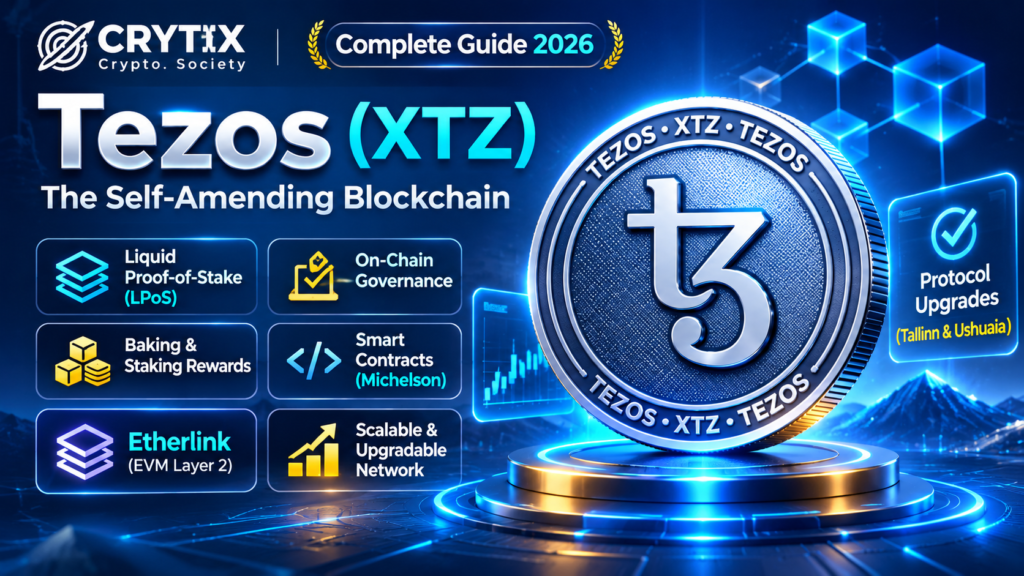
Tezos is commonly associated with Liquid Proof-of-Stake, a consensus design that allows token holders to participate in network security directly or support specialized validators. Unlike Proof-of-Work systems, participants do not need expensive mining equipment to help secure the blockchain. Instead, validators known as bakers provide the necessary infrastructure and stake-related commitments to participate in consensus.
Token holders can delegate their accounts to bakers or actively stake eligible funds with them. These arrangements allow people who do not operate their own nodes to participate in network activities. However, delegation and staking have different implications for token availability, rewards, and financial risk. Active staking temporarily locks selected funds and may expose those funds to penalties associated with validator misconduct, while ordinary liquid delegation does not require the same lockup. Understanding these differences is essential before deciding how to participate.
What Is Baking in Tezos?
Baking is the Tezos term for participating in block production and validation. Bakers operate network infrastructure, propose blocks when selected, and help confirm the validity of blockchain activity. Their responsibilities include maintaining reliable nodes, following consensus rules, and ensuring that transactions meet the protocol’s requirements. Under the current staking framework, operating an independent baker generally requires at least 6,000 tez in baking power, which can include qualifying funds staked by other participants.
Bakers receive protocol rewards for successful participation, although actual earnings depend on network conditions, available baking opportunities, operational performance, and protocol parameters. Bakers who violate certain security rules may face penalties, making reliable infrastructure and responsible administration important. Ordinary users can support bakers without maintaining their own servers, but they should still research validator history, capacity, commission policies, and security practices before committing tokens.
Tezos Staking vs Delegation: What Is the Difference?
Staking and delegation are related but distinct activities within the Tezos ecosystem. Delegation allows a token holder to assign voting and baking influence to a selected baker while generally retaining liquid control over the delegated funds. A baker may share rewards with delegators according to its own arrangements, but these payments are not identical to protocol-distributed staking rewards.
Active staking involves temporarily locking a selected amount of XTZ with a supporting baker. Eligible stakers can receive rewards distributed directly through the protocol, but their staked funds are subject to withdrawal delays and relevant slashing risks. The distinction is especially important for beginners who may assume every staking service offers identical protection. Users should review current requirements, baker capacity, reward terms, and withdrawal procedures instead of choosing a service solely because it advertises an attractive annual yield.
How to Stake Tezos (XTZ) Safely
XTZ holders can participate in staking through compatible wallets and the network’s supported staking interfaces. The process generally involves obtaining native XTZ, selecting a reliable baker, reviewing the available staking capacity, and deciding how much to commit. Users should retain enough liquid tez to cover transaction fees and should confirm whether the selected operation is delegation or active staking before approving it.
According to the official Tezos staking documentation, users can stake with a baker while retaining their tokens in their own account, although staked funds become temporarily unavailable for spending. The documentation also explains staking rewards, validator-related penalties, and withdrawal procedures. Participants should protect their recovery phrases, review wallet permissions carefully, and understand that rewards are variable. Staking does not eliminate the possibility of losses caused by falling XTZ prices or operational failures.
Tezos Tokenomics and XTZ Supply
XTZ follows an issuance-based monetary model rather than Bitcoin’s fixed maximum supply approach. Tezos does not have a hard lifetime cap on its total token supply. New tez can be issued through network reward mechanisms, while governance decisions and protocol changes can influence how issuance operates. Understanding this structure is important because token supply affects cryptocurrency valuation, staking incentives, and the long-term economics of network security.
In June 2024, Tezos introduced Adaptive Issuance through the Paris protocol upgrade. This mechanism adjusts issuance according to the proportion of tez actively staked, seeking to balance validator incentives with the economic cost of securing the blockchain. Instead of assuming a permanently fixed inflation rate, investors should examine current issuance parameters, staking participation, circulating supply, and ecosystem activity. A variable monetary policy can respond to changing conditions, but it does not guarantee that the cryptocurrency will become scarce or appreciate in value.
How Does Tezos On-Chain Governance Work?
Tezos is widely recognized for its self-amending governance system, which allows eligible stakeholders to participate in protocol upgrades. Developers can submit proposals for changing network functionality, while bakers participate in the voting process according to established governance rules. Proposed changes are evaluated through protocol-defined stages before approved upgrades can activate on the blockchain.
This design aims to reduce the need for disruptive disagreements that produce competing networks, sometimes called hard forks. However, on-chain governance does not eliminate political disagreements or guarantee that every approved technical change will produce favorable outcomes. Voting power can be unevenly distributed, while complex software proposals may be difficult for ordinary users to assess. Effective governance depends on transparent discussion, responsible baker participation, security testing, and a development community willing to evaluate competing ideas.
Tezos Smart Contracts and Michelson Technology
Tezos supports smart contracts through Michelson, a specialized language designed for blockchain execution and formal reasoning about program behavior. Michelson enables developers to define programmable rules for financial applications, digital assets, governance arrangements, and other decentralized services. Its design is particularly relevant to applications where developers want to examine contract behavior carefully and reduce certain forms of implementation error.
Formal verification techniques can be used to mathematically analyze whether software satisfies specified properties. While these techniques can strengthen confidence in carefully defined contract behavior, they do not automatically prove that every application is secure or economically sound. Developers must still consider incorrect assumptions, external dependencies, authorization problems, and potential attacks on financial incentives. Tezos also provides higher-level development tools that can make Michelson-based application development more accessible.
Tezos Protocol Upgrades in 2026: Tallinn and Ushuaia
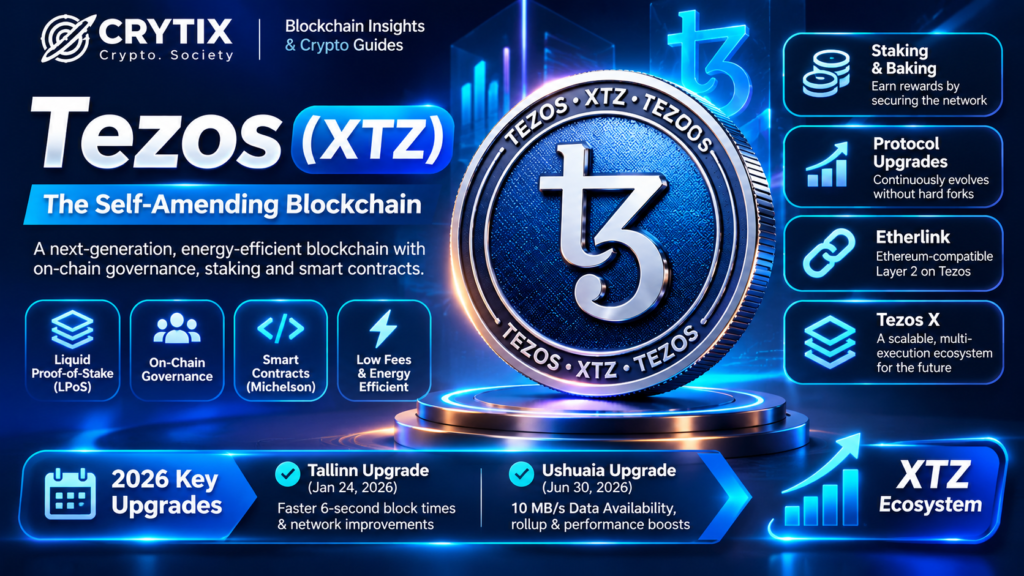
Tezos experienced two particularly important Layer 1 upgrades during 2026. The Tallinn upgrade activated on January 24 and reduced the target block interval to six seconds. It also introduced improvements related to validator attestations and storage efficiency for applications that maintain large address records. These changes were intended to improve transaction responsiveness and reduce infrastructure overhead.
The Ushuaia upgrade activated on June 30, becoming the network’s twenty-first protocol amendment. It increased Data Availability Layer bandwidth to 10 MB/s, approximately fifteen times the previous capacity. The upgrade also introduced dynamic confirmation timing for data availability attestations and improvements to rollup-related governance.
Importantly, the Ushuaia release included additional experimental features for testing rather than immediate mainnet use. These included post-quantum account capabilities and protocol-native liquid staking. Readers should distinguish between successfully activated improvements and features that still require additional evaluation or governance approval.
What Is Etherlink and Why Is It Important?
Etherlink is an Ethereum-compatible Layer 2 network built using Tezos Smart Rollup technology. It allows developers familiar with Ethereum tools to create applications that benefit from an EVM-compatible environment while using Tezos-related infrastructure. This can reduce development barriers for teams interested in expanding blockchain applications without abandoning familiar programming tools.
Etherlink supports applications involving decentralized finance, digital assets, and programmable transactions. Its role is especially important because it connects Tezos’s existing technology with the broader Ethereum development ecosystem. For a comparison of smart contract platforms, readers can explore Crytix10’s Ethereum blockchain and smart contracts guide. Etherlink’s practical success will depend on sustained application usage, liquidity, reliable interoperability, and security rather than EVM compatibility alone.
Tezos X and the Future of Blockchain Scalability
Tezos X represents a broader development direction focused on combining scalable execution, interoperability, and different smart contract environments. Its architecture builds on Tezos rollup infrastructure and aims to allow applications using different execution models to interact more efficiently. The vision includes stronger integration between Ethereum-compatible applications and Michelson-based systems.
This approach could make Tezos more flexible for developers who want to reuse existing tools while gaining access to specialized execution environments. However, roadmap features should not be confused with completed deployments. Developers and investors should evaluate which capabilities are active on mainnet, which are available for testing, and which remain under development. Sustainable growth will require secure implementation, useful applications, and a competitive developer experience.
Real-World Applications of Tezos Blockchain
Tezos can support digital payments, decentralized finance, tokenized financial instruments, collectibles, gaming assets, and enterprise applications. Its programmable contract infrastructure allows developers to create systems for transferring supported assets, managing digital ownership, and executing automated agreements. For organizations exploring tokenization, a blockchain can provide transparent transaction records and programmable transfer rules, although legal ownership still depends on real-world agreements and regulatory requirements.
Tezos also has a history of digital art and NFT applications, making creative ownership an established part of its ecosystem. Nevertheless, technology alone does not guarantee a successful product. Real-world applications must attract users, provide dependable services, maintain security, and comply with applicable laws. Investors should distinguish between experiments, announced partnerships, and commercially sustainable deployments.
Tezos vs Ethereum: Key Differences
Tezos and Ethereum both support smart contracts and decentralized applications, but their technological priorities differ. Ethereum has a large developer ecosystem, extensive financial infrastructure, and a broad network of Layer 2 scaling solutions. Tezos emphasizes formal on-chain governance, self-amending protocol upgrades, and an established Proof-of-Stake network that continues evolving through regular amendments.
The networks also use different smart contract environments on their main Layer 1 chains. Ethereum applications commonly use Solidity and EVM-related tools, while Tezos traditionally relies on Michelson-based technology. Etherlink provides a bridge between these development approaches by introducing Ethereum compatibility within the Tezos ecosystem. Neither blockchain is automatically superior; developers should consider security, liquidity, tooling, scalability, fees, and application requirements.
Is Tezos (XTZ) a Good Investment in 2026?
Tezos may interest investors who believe that decentralized governance, blockchain scalability, and programmable financial applications will remain important technologies. Its history of protocol upgrades, staking mechanisms, and development around Etherlink provides several areas for research. Nevertheless, sophisticated technology does not guarantee positive investment returns, and XTZ remains exposed to changes in cryptocurrency market sentiment.
A responsible investment assessment should examine network activity, transaction fees, circulating supply, token issuance, staking participation, developer activity, and the adoption of Etherlink-related applications. Investors should also evaluate competition from Ethereum, Solana, Avalanche, and other smart contract platforms. Cryptocurrency prices can experience substantial losses even when projects continue releasing useful software, so financial decisions should reflect individual risk tolerance rather than optimistic predictions.
Risks of Investing in Tezos Cryptocurrency
The main risks associated with XTZ include market volatility, changing liquidity, technological competition, and uncertainty surrounding future adoption. The cryptocurrency’s uncapped issuance model also requires investors to consider ongoing supply growth and how staking participation influences token economics.
Additional risks include malicious smart contracts, wallet compromise, phishing, custodial exchange failures, and validator-related penalties. Active staking can expose funds to slashing, while network upgrades may introduce software complexity or new operational requirements. Strong protocol design can reduce certain threats, but it cannot eliminate every financial or technical risk.
How to Buy and Store Tezos (XTZ) Safely
Users interested in purchasing XTZ should research exchanges that legally operate in their jurisdiction and support the native Tezos network. Important factors include security history, withdrawal fees, trading liquidity, supported payment methods, and available account protections. After purchasing, users can hold tokens through supported custodial services or transfer them to a compatible self-custody wallet.
Self-custody provides direct control over private keys but requires careful recovery procedures. Users should never disclose their recovery phrases, should verify addresses before transferring cryptocurrency, and should confirm whether the selected destination supports native Tezos or a specific Layer 2 network. Wallets used for staking should also provide clear information about baker selection, locked funds, and withdrawal conditions.
The Future of Tezos (XTZ) Beyond 2026
Tezos’s future will depend on the continued usefulness of its blockchain infrastructure, the quality of applications built within its ecosystem, and its ability to attract developers and users. Faster blocks, expanded data availability, and compatibility with Ethereum development tools could improve its competitiveness in decentralized finance and digital asset services.
Research into post-quantum security and liquid staking also demonstrates the ecosystem’s attention to future technical requirements. However, experimental functionality must undergo testing and appropriate governance before being treated as a live network feature. Ultimately, the long-term relevance of Tezos and the market performance of XTZ will depend on measurable adoption, sustainable network economics, security, and wider cryptocurrency market conditions.
FAQ,s
1. What is Tezos (XTZ) cryptocurrency?
Tezos is a decentralized blockchain platform supporting smart contracts, staking, and on-chain protocol upgrades. XTZ, also known as tez, is its native cryptocurrency.
2. Who created Tezos?
Tezos was founded by Arthur Breitman and Kathleen Breitman. Its mainnet launched in September 2018.
3. What is Tezos baking?
Baking is the process through which eligible Tezos validators propose and validate blocks, helping secure the network.
4. Can I stake XTZ?
Yes. Eligible users can stake XTZ with a baker through supported wallets. Rewards vary, and actively staked funds may be subject to lockup periods and slashing risks.
5. Does Tezos have a maximum supply?
No. XTZ does not have a hard lifetime supply cap. Its issuance is managed through protocol-defined monetary mechanisms, including Adaptive Issuance.
6. What is Etherlink?
Etherlink is an Ethereum-compatible Layer 2 network built on Tezos-related rollup infrastructure. It supports applications developed using familiar EVM tools.
7. Is Tezos better than Ethereum?
Both networks have different strengths. Tezos emphasizes self-amending governance, while Ethereum benefits from a large established developer and financial ecosystem.
8. Is Tezos quantum-resistant?
Tezos introduced post-quantum cryptographic features for testing in 2026, but this does not mean its entire mainnet was already fully quantum-resistant.
9. Can XTZ reach $10?
A $10 XTZ price is theoretically possible if market conditions supported that valuation, but there is no guarantee. Supply, liquidity, demand, and broader market conditions matter.
10. Is Tezos a good long-term investment?
Tezos offers established blockchain infrastructure and ongoing technical development, but XTZ remains a speculative cryptocurrency. Investors should evaluate adoption, token economics, competition, and financial risks.
Conclusion
Tezos (XTZ) is an established blockchain ecosystem recognized for its self-amending governance system, Proof-of-Stake consensus, smart contract functionality, and continuous protocol improvements. Its technology provides infrastructure for digital assets, decentralized finance, staking, and programmable blockchain applications. Upgrades such as Tallinn and Ushuaia demonstrate how Tezos continues adapting its infrastructure to evolving technical requirements.
For readers researching Tezos in 2026, understanding the relationship between blockchain innovation and cryptocurrency investment risk is essential. The ecosystem offers potentially useful technology, but sustainable adoption and token value depend on developer participation, real-world demand, competition, and financial market conditions. Reliable research and responsible risk management are more valuable than speculative price predictions.
Disclaimer: This article is for educational and informational purposes only and does not constitute financial, investment, legal, or tax advice. Cryptocurrency investments carry substantial risk, including possible loss of invested capital.