

Somebody in a Telegram group asks “bhai BDX ka rate kya hai in INR” and five people reply with five different numbers within the same minute. Nobody is wrong. That is just what a mid-cap privacy coin’s rupee price looks like once you check it across four exchanges at once.
Quick answer: 1 Beldex (BDX) is currently trading somewhere between ₹7.50 and ₹9.00 in India, depending on which exchange or aggregator you check at that exact moment. The gap looks small in percentage terms but it adds up once you’re converting a few thousand rupees worth of BDX, so always confirm the live rate on your own exchange before you place an order.
This piece stays focused on the rupee side of things specifically: what the INR conversion actually looks like right now, where Indian buyers can pick up BDX with a bank transfer or UPI, what the 30% tax bill does to your actual returns, and whether the price predictions floating around are worth a single rupee of your attention.
Beldex Coin Price in INR Right Now
As of late July 2026, BDX to INR sits roughly in the ₹7.50–₹9.00 band across major trackers. CoinMarketCap and CoinGecko both put it close to ₹8.07–₹8.09, Coinbase’s converter shows ₹8.10, and a couple of India-facing platforms have printed numbers as low as ₹7.47 and as high as ₹8.90 within the same week. That’s a real spread of nearly 15%, not a rounding error.
Why the disagreement? Beldex doesn’t have one canonical price. Every tracker pulls trades from a different basket of exchanges — MEXC, KuCoin, Gate, AscendEX, and a small handful of India-specific platforms — and averages them differently. Liquidity on BDX pairs is thin enough that a single large order on one exchange can nudge that exchange’s price a few paise away from everyone else’s for a while.
The practical takeaway: treat every number in this article, including the range above, as a reference point, not a quote you can trade on. Pull up a live converter or your exchange’s order book in the seconds before you actually buy or sell.
Beldex to INR Conversion Table
Here’s a rough sense of what different BDX amounts translate to at a working rate of roughly ₹8 per BDX. Recalculate before any real transaction, since the underlying price moves constantly.
| BDX Amount | Approx. Value in INR |
| 1 BDX | ₹8 |
| 5 BDX | ₹40 |
| 10 BDX | ₹80 |
| 50 BDX | ₹400 |
| 100 BDX | ₹800 |
| 500 BDX | ₹4,000 |
| 1,000 BDX | ₹8,000 |
| 10,000 BDX | ₹80,000 |
That last row matters more than it looks. 10,000 BDX is also the exact collateral a Beldex masternode operator needs to hold, so at current rupee rates, running a masternode from India means locking up roughly ₹75,000–₹90,000 worth of BDX, plus server costs, before a single reward lands.
What Is Beldex, in One Paragraph
Beldex is a privacy-focused cryptocurrency, originally forked from Monero’s codebase back in 2018, built around the idea that transactions, chat messages, and browsing shouldn’t leave a traceable trail. Its ecosystem now stretches past the coin itself into BChat (an encrypted messenger), BelNet (a decentralized VPN-style network), and a privacy browser, with BDX acting as the fuel for all of it. For a deeper walkthrough of the technology, masternode mechanics, and Beldex’s full price history in dollar terms, our Beldex coin rate guide covers that ground in detail — this article keeps its focus on the rupee side of the equation.
Beldex Price History in INR: A Rough Timeline
Rupee-denominated history for BDX is messier than the dollar figures most trackers quote, partly because INR pairs are newer and thinner than USD pairs. Still, a few reference points hold up across multiple sources:
- 2019 peak: Several trackers place Beldex’s all-time high in rupee terms around ₹16–₹17, hit in November 2019, back when BDX traded almost exclusively on a handful of smaller exchanges.
- A separate, higher all-time high near ₹32: CoinGecko’s INR-denominated chart shows an even higher spike, which likely reflects thin order books on specific exchanges rather than a broad market consensus — another reminder that “all-time high” isn’t a single agreed number for this coin.
- 2023 low: Following the broader 2022 crypto crash, BDX bottomed out at a rupee value that was a fraction of its 2019 peak, in line with what happened to most mid-cap altcoins that year.
- 2024–2026 consolidation: Over the past two years, the rupee price has mostly moved in a tighter band, generally holding within a few rupees either side of ₹8, with occasional double-digit percentage swings tied to broader Bitcoin sentiment rather than Beldex-specific news.
The rupee chart, when you actually pull it up, tells a calmer story than the “10x from here” narratives you’ll see on some prediction sites. It looks like a coin that had its speculative run years ago and has since settled into something closer to a working, mid-cap altcoin range.
How to Buy Beldex (BDX) in India
Exchanges That Support BDX/INR Trading
Indian buyers aren’t limited to converting through USDT on a foreign exchange, though that route works too. A handful of platforms list BDX directly against INR or otherwise make rupee purchases straightforward:
- WazirX and CoinDCX – frequently mentioned as the go-to route for converting BDX proceeds back to INR, and for onboarding with a straightforward KYC flow.
- BuyUcoin – runs a direct BDX/INR pair with UPI and bank transfer deposits, plus a systematic investment option for buyers who’d rather average in over time than time the market.
- Bitcoiva and Koinpark – smaller India-focused platforms that also carry BDX/INR order books, worth checking if the bigger exchanges show thin liquidity for your order size.
- International exchanges (MEXC, Gate, KuCoin) – carry the deepest BDX liquidity overall, though you’ll typically fund these through USDT rather than a direct rupee deposit.
Step-by-Step: Buying BDX With Rupees
- Pick an exchange that lists a BDX/INR pair, or one where you can convert INR to USDT first.
- Complete KYC — PAN, Aadhaar, and a bank statement or selfie verification cover most platforms.
- Deposit INR through UPI, IMPS, or a bank transfer.
- Search for the BDX/INR (or BDX/USDT) pair and place your order, comparing the rate against a live aggregator first.
- Move your BDX to a private wallet if you’re holding long-term rather than actively trading — masternode operators, in particular, will need this.
None of this is a recommendation to buy. It’s simply how the mechanics work if you’ve already decided BDX fits your portfolio.
Crypto Tax Rules for Beldex in India (2026)
This is the part most price-tracking articles skip entirely, and it’s arguably more important than the price itself.
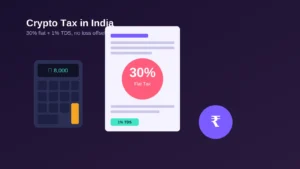
Under India’s current tax framework, gains from selling Beldex, like any other cryptocurrency, are taxed at a flat 30%, plus a 4% cess on top of that tax amount. There’s no distinction between short-term and long-term holding the way equities get one 30% applies regardless of whether you held BDX for a day or three years.
On top of that, a 1% TDS (Tax Deducted at Source) applies on crypto transactions once your annual trading value crosses ₹10,000 for most individuals, or ₹50,000 for specified categories of taxpayers. Your exchange deducts this automatically before the trade settles, so it shows up as a slightly smaller amount received rather than a separate bill.
The rule that catches people out most often: you cannot offset a loss on BDX against a gain on another coin, or against any other income. Losses simply don’t reduce your tax bill under the current framework, which makes position sizing and entry timing genuinely more consequential for Indian traders than for buyers in jurisdictions with normal capital-loss offsetting.
None of this is tax advice specific to your situation — rules get revised, and a chartered accountant familiar with virtual digital asset taxation is worth the consultation fee before you file.
What Actually Moves the Beldex Price in INR
Global Crypto Sentiment
BDX doesn’t move independently of the wider market. When Bitcoin rallies or sells off, mid-cap altcoins like Beldex tend to follow, usually with sharper percentage swings in both directions because of thinner order books.
The Rupee-Dollar Exchange Rate
Because BDX is priced in dollars on most exchanges before being converted to INR, a weakening rupee against the dollar can nudge the INR price of BDX upward even if the dollar price hasn’t moved at all, and vice versa. It’s a secondary effect, but a real one over months rather than days.
Privacy Coin Regulation
Privacy coins face a genuinely different regulatory climate than transparent chains like Bitcoin or Ethereum. Exchange delistings tied to anti-money-laundering rules in specific countries have hit privacy tokens as a category more than once in recent years, and any similar move tends to drag on BDX’s volume and price regardless of what’s happening with Beldex’s own development.
Ecosystem Usage
Growth in BChat or BelNet adoption, new exchange listings, and Beldex’s recent contract migration all feed into trading volume. A coin with actual usage outside pure speculation tends to hold up marginally better during broad downturns, though “marginally better” is not the same as “immune.”
Beldex Price Prediction: Should You Trust the Numbers?
Here’s the honest part, and it’s worth reading slowly before you act on anything a prediction site tells you.
Pull up five different Beldex price prediction pages and you’ll get five genuinely incompatible 2030 targets: one puts BDX around $0.19 by 2030, another projects $0.14, a third claims $0.82, a fourth suggests something closer to $0.51, and a fifth algorithm insists the coin won’t even reach $1 by 2050. Convert those into rupees and you’re looking at a 2030 target anywhere from roughly ₹12 to well over ₹65, depending entirely on which website you happened to click.
That’s not five analysts disagreeing over nuance. That’s five different mathematical models — moving averages, sentiment scores, historical volatility extrapolation — each producing a number that sounds precise and confident while resting on assumptions the sites rarely spell out. None of them have a working crystal ball, and none of them are liable if you lose money following the number.
The more useful exercise than picking a target price is understanding the range of plausible outcomes and the risk that comes with each: Beldex staying roughly where it is for years is entirely plausible given its 2024–2026 consolidation pattern, a return to its 2021 highs would require a broader altcoin rally that has nothing to do with Beldex specifically, and further downside is just as possible if privacy-coin regulation tightens. Treat every specific number, including anything in this section, as a scenario rather than a forecast.
Is Beldex a Good Investment for Indian Investors?
Ruthlessly honest answer: it depends on what you’re comparing it against, and the Indian tax structure changes that comparison more than most articles admit.
Beldex has genuine utility through its privacy ecosystem and a working masternode system, which puts it ahead of coins that exist purely as speculative tickers. It has also survived one full boom-and-bust cycle since 2018, which is more of a track record than most altcoins can claim.
Against that, an Indian investor faces the flat 30% tax on any gain with zero loss offsetting, a coin whose daily volume is a rounding error next to Bitcoin’s, and a regulatory category — privacy coins — that has faced more exchange delistings globally than transparent chains have. Add the currency-conversion layer between USD-denominated global prices and your actual rupee returns, and the effective bar for BDX to be “worth it” compared to a large-cap alternative is genuinely higher for an Indian holder than the headline price chart suggests.
This isn’t financial advice, and it isn’t a call to avoid Beldex either. It’s a reminder that the tax and regulatory environment you’re trading inside changes the math, not just the sentiment.
Frequently Asked Questions
What is the Beldex coin price in INR today?
BDX is currently trading roughly between ₹7.50 and ₹9.00, depending on the exchange and aggregator you check. The exact figure shifts constantly, so confirm the live rate before placing any order.
Which Indian exchanges support Beldex (BDX)?
BuyUcoin runs a direct BDX/INR pair, while WazirX and CoinDCX are commonly used to convert BDX proceeds to rupees. Bitcoiva and Koinpark also list BDX/INR order books for smaller order sizes.
How much tax do I pay on Beldex profits in India?
Gains are taxed at a flat 30% plus 4% cess, with an additional 1% TDS deducted on transactions above the annual threshold. Losses cannot be offset against gains or other income under current rules.
What was Beldex’s all-time high in INR?
Trackers disagree, with commonly cited figures around ₹16–₹17 from November 2019, though some INR charts show an isolated spike closer to ₹32 on thinner order books.
Is Beldex price prediction data reliable?
Not particularly. Different prediction models produce wildly different 2030 targets for BDX, sometimes by a factor of five or more, which says more about how speculative these algorithms are than about Beldex’s actual prospects.
The Bottom Line
The Beldex coin price in INR isn’t a fixed number worth memorizing it’s a live figure shaped by thin liquidity, rupee-dollar movement, and how privacy coins as a category are treated by regulators at any given moment. What’s more useful than chasing the exact rupee figure is understanding the mechanics behind it: how the conversion actually works, what buying through an Indian exchange involves, and what the 30% tax bill does to your real returns once you factor it in.
For the fuller technical picture of what Beldex is and how its dollar-denominated price has moved since 2018, see our Beldex coin rate guide. If you’re comparing BDX against other coins that Indian retail investors track closely, our Dogecoin price in India piece uses a similar rupee-first breakdown, and our World Coin to PHP article shows how the same currency-conversion volatility plays out for a different regional pair.
For background on how India currently treats virtual digital assets from a tax and regulatory standpoint, the Wikipedia entry on cryptocurrency is a useful neutral starting point.