

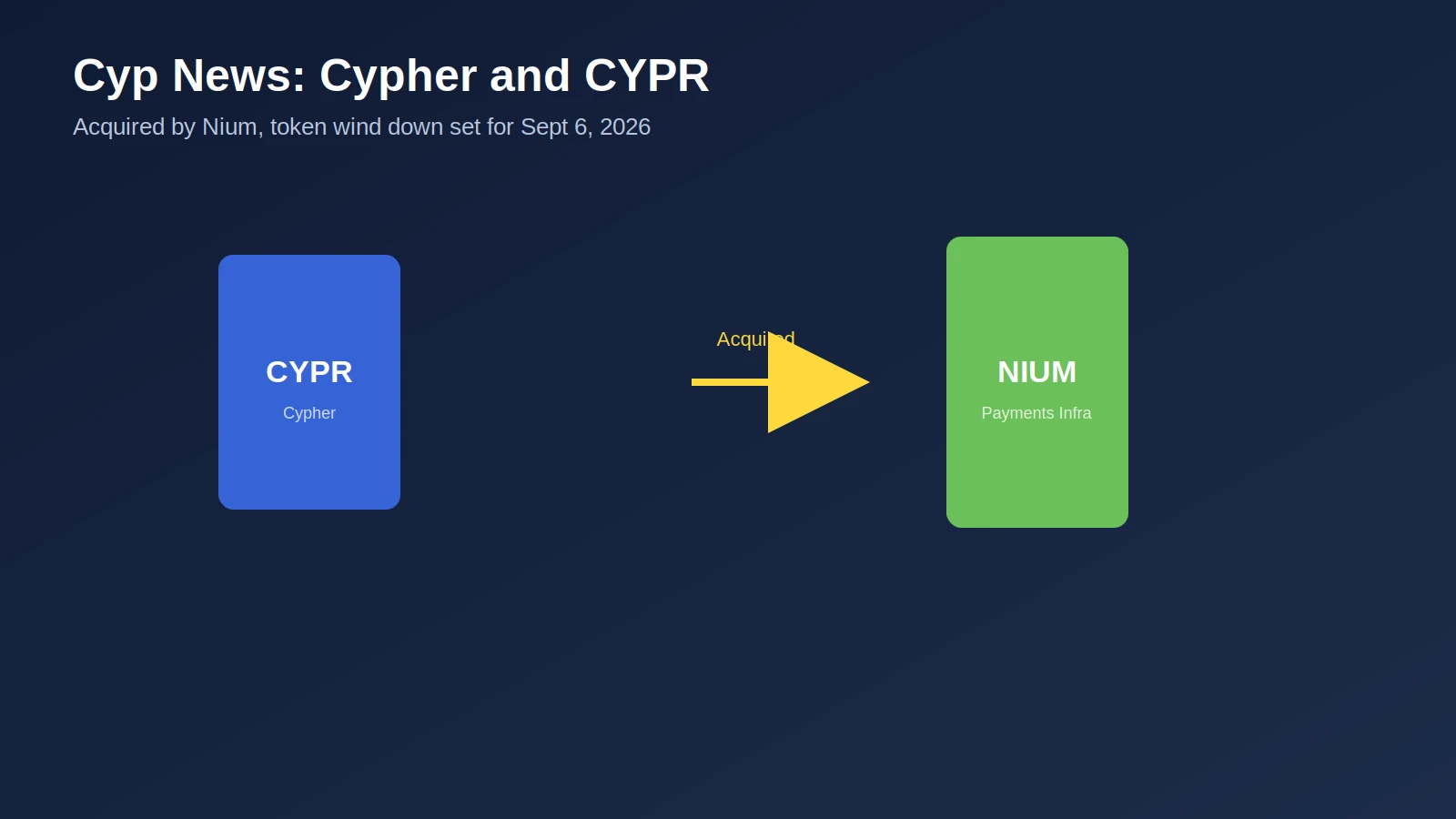
If you searched cyp news expecting a quiet week in crypto, this isn’t that. Cypher, the crypto payments company behind the CYPR token and one of the more talked about crypto Visa cards, has been acquired by Nium, a major cross border payments infrastructure company, and the entire CYPR token ecosystem is being shut down as a direct result. That’s not a rumor or a Twitter overreaction, it’s coming straight from Cypher’s own wind down page, with dates attached.
This piece walks through what actually happened, what the shutdown timeline looks like, what it means if you’re holding CYPR, and why a traditional payments company buying a crypto payments startup is a bigger story than the price chart alone suggests.
Cypher’s CYPR token ecosystem is being wound down following its acquisition by Nium
Quick Clarification Before We Go Further
Search cyp news and you’ll bump into a few unrelated things using the same short label. CYP Now is a well known publication in the UK covering children and young people’s services, completely unrelated to crypto. There’s also a barely traded, essentially dormant token listed under the ticker CYP on some data aggregators, distinct from Cypher’s actual token, which trades under CYPR. This article is specifically about Cypher and CYPR, the crypto payments platform currently in wind down after its acquisition by Nium, since that’s almost certainly the crypto story behind this search.
The Big Cyp News: Cypher Is Being Acquired by Nium
Here’s the headline. Nium, a global cross border payments infrastructure company operating across more than 190 countries and over 100 currencies, has acquired Cypher. As part of the deal, Cypher’s current consumer app, business card platform, and the CYPR token ecosystem are being gradually wound down, with the process completing on September 6, 2026.
Cypher’s founder, Kuberan Marimuthu, and the company’s engineering team are joining Nium as part of the acquisition, with Marimuthu stepping into a role as the company’s vice president of digital assets. Nium has framed the deal as bringing deep operational knowledge of crypto native infrastructure into its existing money movement network, rather than simply absorbing a competitor and shutting it down for cost cutting reasons.
That distinction matters. This isn’t a failed startup quietly disappearing, it’s a payments company with real usage numbers being folded into a much larger, traditionally regulated financial infrastructure player.
What Was Cypher, and Why Did It Matter?
Cypher launched in 2021, built around a multi chain crypto wallet, a crypto linked Visa card, and the CYPR token that powered rewards and governance within that ecosystem. The pitch was straightforward, let people spend crypto in the real world through a card that works basically anywhere Visa is accepted, without needing a separate off ramp step every time.
It actually gained meaningful traction. Data from Dune Analytics showed Cypher’s Visa card generated 20.5 million dollars in net spend volume in 2025, putting it in second place among major crypto card providers by that measure. That’s a genuinely useful proof point, crypto cards live or die on whether people actually use them for everyday spending rather than just holding them as a novelty, and Cypher’s numbers suggest real adoption rather than pure speculation.
What Did the CYPR Token Actually Do?
Before getting into the shutdown mechanics, it’s worth understanding what CYPR was actually for, since that context explains why the wind down matters beyond just a price chart going to zero.
CYPR functioned as a rewards and governance token layered on top of Cypher’s card and wallet products. Spending through the Cypher Card earned CYPR based on merchant specific allocations, meaning different merchants contributed different reward rates depending on how Cypher structured its epoch based distribution system. On top of the spend rewards, Cypher also ran a vote locking mechanism, where holders could lock their CYPR into veCYPR to gain additional benefits and a say in protocol decisions, similar to vote escrow models used across several other decentralized finance projects.
That layered structure, spend to earn, lock to gain more influence and rewards, is a fairly standard design in crypto loyalty systems, and it’s exactly the kind of thing that becomes meaningless the moment the underlying protocol has a hard shutdown date. Locked veCYPR doesn’t carry forward to whatever Nium builds next, and there’s been no indication that governance rights or accumulated lock benefits transfer to a future product in any form.
The CYPR Wind Down Timeline, Step by Step
If you’re holding CYPR or currently using a Cypher card, the dates below matter a lot more than the news headline itself.
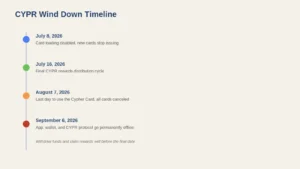
The full CYPR wind down schedule, from card loading disabled to final shutdown
July 8, 2026 marked the point where card loading was disabled and new card applications and issuance stopped entirely. If you didn’t have a Cypher card by that date, you weren’t getting one.
July 16, 2026 was the final rewards distribution cycle. Spending after that date no longer earns CYPR rewards, which is a meaningful cutoff if you were relying on card spend to accumulate tokens.
August 7, 2026 is the final day the Cypher Card works for actual purchases. After that, all active cards get canceled outright.
September 6, 2026 is the real end date. On this date, the mobile app, dApp, and business platform go fully offline, the withdrawal window closes, reward claims close, and the CYPR protocol is permanently wound down. Anything not withdrawn or claimed by this point is, functionally, gone.
Cypher has been explicit that any remaining card balance and locked funds are safe and withdrawable without fees up until that final date, so this isn’t presented as a rug pull or an emergency freeze, it’s a scheduled, communicated sunset.
What This Means If You’re Holding CYPR Right Now
If you have CYPR tokens, a Cypher card balance, or unclaimed rewards, the practical steps are more urgent than the general news cycle around this acquisition.
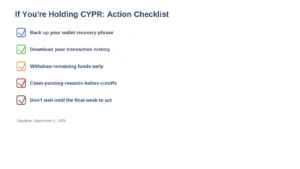
What CYPR holders should do before the September 6, 2026 shutdown
Back up your wallet recovery phrase or private keys before doing anything else. Once the app goes offline in September, self custody access to your funds depends entirely on having that recovery information saved somewhere outside the Cypher app itself.
Download your transaction history while the platform is still live. Once everything winds down, pulling records for tax purposes or personal accounting becomes significantly harder, if not impossible.
Withdraw remaining funds well before the September 6 deadline rather than right up against it. Deadlines involving platform shutdowns tend to see last minute congestion, and there’s no upside to cutting it close when the withdrawal window has been open for weeks.
Claim any pending rewards before the cutoffs listed above. Rewards not claimed by the relevant deadline aren’t retroactively recoverable once that stage of the wind down completes.
None of this is investment advice, and this isn’t the moment to be thinking about CYPR as something worth acquiring more of. A token tied to a protocol that’s actively being wound down has a clearly defined end state, and that’s a fundamentally different situation from a token facing ordinary market volatility.
Why Would Nium Buy a Company Just to Shut Its Token Down?
This is the part that trips people up, and it’s worth explaining clearly because it’s not actually contradictory.
Nium isn’t acquiring Cypher’s existing token ecosystem as a going concern, it’s acquiring the team, the technology, and the operational know how around crypto native payments infrastructure. Nium explicitly stated the deal gives it deep operational knowledge of building and scaling products for crypto native users, layered on top of infrastructure that already moves money across a huge number of countries and currencies through more traditional, regulated banking rails.
Shutting down the existing CYPR token and consumer facing app while retaining the team and rebuilding on Nium’s own infrastructure is a pretty standard acquisition pattern in fintech. The buyer wants the expertise and the underlying technology, not necessarily the specific token economics or brand of what they bought. Cypher itself has said publicly that a next version of the product is already being built directly on Nium’s infrastructure, so this looks less like an ending and more like a foundation swap.
For a broader sense of what the wallet side of this business actually involves technically, a cryptocurrency wallet is fundamentally a system for managing the public and private keys tied to on chain assets, and Cypher’s multi chain wallet product was built around exactly that core function before the card and token layers were added on top.
How This Fits a Broader Pattern of Crypto Card Consolidation
Cypher isn’t the first crypto card program to wind down, and it almost certainly won’t be the last. The crypto debit and credit card space has gone through repeated rounds of consolidation over the past several years, usually driven by the same underlying tension, running a card program means dealing with card network compliance, banking partnerships, and regulatory overhead in dozens of jurisdictions at once, which is expensive and genuinely hard to scale independently as a crypto native company.
What makes the Cypher situation different from a typical shutdown is the direction of the deal. This isn’t a card issuer quietly pulling out of the market because the economics stopped working, it’s an established, already regulated payments infrastructure company deciding the fastest path to serious crypto payment capability was acquisition rather than building from scratch. That’s a meaningfully different signal than a program simply folding under its own weight.
How the Market Reacted to the News
CYPR’s price behavior since the acquisition news has been genuinely volatile, which tracks with what you’d expect from a token facing a defined shutdown date rather than an open ended future. Trackers have shown the token trading at a small fraction of a cent, down more than 99 percent from its all time high near 47 cents set back in October 2025, with market capitalization in the tens of thousands of dollars range on some exchanges and low six figures on others depending on which trading pairs and data sources you’re comparing.
That kind of divergence between data sources is normal for a token in wind down, liquidity gets thinner, trading volume becomes erratic, and different exchanges end up reflecting very different snapshots of a market that’s rapidly shrinking rather than settling into any kind of stable price discovery.
Is This Good or Bad News for Crypto Payments Broadly?
Depends which angle you’re looking at it from, honestly.
For CYPR holders specifically, it’s clearly a mixed bag, funds are safe and withdrawable, but the token itself and the rewards ecosystem built around it have a hard expiration date. There’s no version of this where CYPR continues to exist as a functioning asset past September 6.
For the broader crypto payments space, this reads as a genuinely bullish signal rather than a cautionary tale. A large, traditionally regulated cross border payments company didn’t walk away from crypto card infrastructure, it bought the team and technology behind one of the more actively used products in that category. That’s a meaningful vote of confidence in crypto native payment rails from a company that already operates within established financial infrastructure rather than around it. If our recent piece on Wall Street’s growing institutional interest in tokenization is any indication, this kind of acquisition fits a broader pattern of traditional finance absorbing crypto payment infrastructure rather than competing against it from the outside.
Frequently Asked Questions
What is the latest cyp news in crypto right now?
The most significant recent development is Cypher’s acquisition by Nium, a global cross border payments company, which is resulting in the full wind down of the CYPR token ecosystem by September 6, 2026, with the underlying team and technology moving to Nium instead.
Is CYPR the same as CYP Now or the ticker CYP on other coin trackers?
No. CYP Now is an unrelated UK publication for children and young people’s services, and a separate, largely inactive token listed under ticker CYP exists on some crypto data sites but is distinct from Cypher’s CYPR token, which is the subject of the current acquisition news.
When does the CYPR token ecosystem officially shut down?
The CYPR protocol, along with Cypher’s mobile app, dApp, and business platform, is scheduled to go fully offline on September 6, 2026, which is also when the withdrawal window and rewards claim period close permanently.
Is my money safe if I have funds on Cypher right now?
Cypher has stated that remaining card balances and locked funds remain safe and can be withdrawn without fees any time before the September 6, 2026 deadline, though waiting until the last minute isn’t advisable given typical shutdown related congestion.
Should I buy CYPR because of this news?
No. CYPR is tied to a protocol with a confirmed, scheduled end date, which is a fundamentally different risk profile than ordinary market volatility. This article is informational and isn’t financial advice.
What happens to Cypher’s technology and team after the wind down?
Cypher’s founder and engineering team are joining Nium as part of the acquisition, and the company has indicated a next version of its product is already being built on top of Nium’s existing payments infrastructure.
Final Thoughts
The real cyp news story here isn’t a price crash or a scandal, it’s a traditional cross border payments giant deciding the fastest way into crypto native payment infrastructure was buying a team that had already built and proven it, spend numbers and all. If you’re holding CYPR or still using a Cypher card, the dates matter far more than the headlines, get your funds and records out well ahead of September 6, and treat the token itself as something with a fixed expiration rather than a long term hold.