

I used to think Wall Street was just a nickname, the kind of shorthand journalists use so headlines don’t run forty words long. Then I actually read through the SEC filings around Nasdaq’s tokenized equity approval this year, and it clicked: Wall Street isn’t a metaphor anymore for a big chunk of what’s happening in finance right now. It’s turning into a literal description of ledgers moving on-chain.
This piece covers what Wall Street actually is, where the name came from, what it means today, and the part most explainer articles skip entirely: how tokenization, spot crypto ETFs, and on-chain trading venues are quietly rewriting what happens on that eight-block stretch of Lower Manhattan.
Wall Street’s physical footprint is tiny. Its financial footprint circles the globe.
What Is Wall Street?
Wall Street is a physical street in the Financial District of Lower Manhattan, running about eight city blocks between Broadway and the East River. But when people say Wall Street, they almost never mean the pavement. They mean the entire American financial services industry: the banks, brokerages, exchanges, and asset managers whose decisions move markets far beyond New York.
Quick snippet answer: Wall Street is both a real street in Lower Manhattan and a metonym for the U.S. financial industry as a whole, including the New York Stock Exchange, major investment banks, and the brokerage firms that operate around it.
Where Did the Name Wall Street Come From?
The origin is more literal than most people expect. In 1653, Dutch colonists in New Amsterdam built a defensive wall and ditch along what’s now Wall Street, fearing an English land invasion. The wall came down decades later, but the name stuck to the street that replaced it.
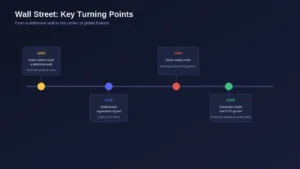
The street’s identity shifted from military defense to financial infrastructure over three and a half centuries.
What turned a defensive barrier into a financial capital was the Buttonwood Agreement of 1792. A group of local merchants and traders, tired of chaotic, unstructured auctions, agreed to trade securities with each other under fixed commission rules. That handshake deal under a buttonwood tree became the founding document of the New York Stock Exchange.
What Does Wall Street Mean Today?
Ask a hundred people what Wall Street means and you’ll get a hundred slightly different answers, and honestly, most of them are right. It depends on context.
- Literally: the physical street and the Financial District surrounding it
- Institutionally: the New York Stock Exchange, the Federal Reserve Bank of New York, and the brokerages headquartered nearby
- Symbolically: American big business, high finance, and capital markets broadly, wherever a firm is actually headquartered
- Culturally: a shorthand for wealth, risk-taking, and, depending who’s talking, either opportunity or inequality
That last point matters more than people give it credit for. Wall Street has carried both meanings, the route to quick riches and the symbol of exploitative finance, since at least the 19th-century Populist movement, and the 2011 Occupy Wall Street protests brought that tension back into the mainstream. The word itself is politically loaded in a way most financial terms aren’t.
The Institutions That Anchor Wall Street
The New York Stock Exchange
The NYSE remains the world’s largest stock exchange by total market capitalization, and it’s still physically located on Wall Street, a rarity now that most trading happens electronically and firms could technically be located anywhere.
The Federal Reserve Bank of New York
Tucked a few blocks from the exchange floor, the New York Fed executes the Federal Reserve’s monetary policy operations and oversees a huge share of the country’s banking supervision. It’s arguably more influential on daily market conditions than the exchange itself.
Brokerages, Investment Banks, and Commodity Exchanges
Major brokerage firms have historically clustered near Wall Street to stay close to the exchanges, alongside commodity venues like the New York Mercantile Exchange. That physical clustering is loosening as trading digitizes, but the institutional density here still shapes how U.S. capital markets function.
Wall Street’s On-Chain Shift: Where Crypto Actually Fits In
Here’s the part most Wall Street explainer content leaves out entirely, and it’s the most consequential shift happening on this topic right now. Traditional finance isn’t ignoring crypto infrastructure anymore. It’s adopting it, piece by piece, often without most retail investors noticing.
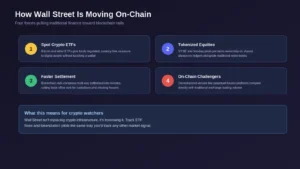
Four forces are pulling traditional market infrastructure toward blockchain rails.
Spot Crypto ETFs Opened the Door
Bitcoin and ether ETFs gave institutional money a regulated way to hold crypto exposure without managing private keys or custody directly. That single product category did more to normalize digital assets inside traditional portfolios than almost anything else in the last few years, and ether ETF inflows have at points outpaced bitcoin’s, a shift that reflects growing institutional conviction that Ethereum will serve as a settlement layer for stablecoin activity.
Tokenized Stocks Are No Longer Hypothetical
Nasdaq received regulatory approval to enable tokenized trading of Russell 1000 stocks and major index ETFs, with tokenized and traditional shares trading on the same order books and carrying identical investor rights. The NYSE has moved in parallel, pursuing its own tokenized securities platform and regulatory approval for extended trading hours. These aren’t crypto-native startups experimenting on the fringes. This is the oldest, most systemically important infrastructure in U.S. capital markets rebuilding itself on blockchain rails.
Settlement Speed Is the Real Motivation
The honest reason this is happening isn’t ideology, it’s cost. Large institutional back offices are realizing tokenization can cut a huge share of settlement and processing costs by compressing multi-day clearing cycles into minutes. When the economics work this cleanly, adoption tends to move faster than expected, even inside famously conservative institutions.
Decentralized Venues Are Now Real Competitors
On-chain perpetual futures platforms are demonstrating that blockchain-based trading infrastructure can compete directly with traditional exchange volume, not just theoretically but in measurable daily flow. If you want to see how retail-driven crypto narratives interact with this institutional shift in real time, our coverage of recent XRP market moves shows how quickly sentiment and Wall Street-adjacent news can swing a single asset’s price.
How to Read Wall Street Moves as a Crypto Investor
If you trade or hold crypto, Wall Street headlines aren’t background noise, they’re often leading indicators. Here’s what actually matters to track.
- ETF flow data: sustained inflows or outflows tell you more about institutional conviction than any single price candle
- Regulatory approvals: tokenization and exchange rule changes signal where large capital will be allowed to move next
- Rate decisions from the Federal Reserve: these ripple into risk appetite across both equities and crypto simultaneously
- Major bank and asset manager commentary: when firms like BlackRock or Citi publish tokenization forecasts, they’re often previewing where their own product roadmap is headed
For a broader read on how institutional price targets and predictions get formed, our breakdown of recent crypto price prediction commentary from Wall Street-adjacent analysts digs into how much weight those forecasts actually deserve.
Wall Street’s Biggest Historical Turning Points
A few moments did more to shape how the world sees Wall Street than any other stretch of its history. Worth knowing them, because the reactions to each one still echo through how markets are regulated today.
The 1929 Crash and the Birth of Modern Regulation
The 1929 crash didn’t just wipe out fortunes, it directly produced the regulatory architecture that still governs Wall Street: the SEC, mandatory disclosure requirements, and a permanent public skepticism toward unchecked speculation. Every disclosure rule a public company follows today traces back, in some way, to that collapse.
Occupy Wall Street and the Inequality Narrative
The 2011 Occupy Wall Street protests, running from September to November of that year, put wealth inequality and corporate accountability at the center of American political conversation in a way that hadn’t happened in decades. The movement didn’t rewrite financial law the way the 1929 crash did, but it permanently changed the cultural framing of the term Wall Street, adding an adversarial edge that shows up any time the phrase gets used in political speech today.
The 2008 Financial Crisis
Wall Street’s mortgage-backed securities exposure triggered a global financial crisis that reshaped bank capital requirements, stress testing, and how aggressively regulators now watch systemic risk. It’s the single event most responsible for why phrases like too big to fail entered everyday vocabulary.
Wall Street vs Main Street: Why the Distinction Matters
You’ll see this comparison constantly in financial commentary, and it’s worth understanding precisely. Wall Street refers to institutional finance, large-scale capital markets, hedge funds, and investment banks. Main Street refers to everyday consumers, small businesses, and local economic activity. The distinction gets invoked whenever someone argues that policy is favoring big financial institutions at the expense of ordinary households, and it’s one of the most durable framing devices in American economic debate. Understanding this split helps explain a lot of the political charge behind the word Wall Street that a purely financial definition misses.
Common Misconceptions About Wall Street
- Wall Street isn’t one company or one building, it’s a dense network of independent institutions with competing interests
- Not every major financial firm is headquartered on the actual street anymore, the term has outgrown its geography
- Wall Street and the stock market aren’t identical, the market is one part of a much broader financial ecosystem anchored there
- Tokenization pilots don’t mean Wall Street is becoming crypto-native overnight, Citi’s own research describes this as a slow, messy hybrid period rather than a sudden switch
Frequently Asked Questions
What is Wall Street known for?
Wall Street is known as the symbolic and physical center of American finance, home to the New York Stock Exchange, the Federal Reserve Bank of New York, and major brokerage firms. It’s used broadly as shorthand for the U.S. financial industry.
Is Wall Street a real street?
Yes. Wall Street is a real, roughly eight-block street in Lower Manhattan, New York City. It runs between Broadway and the East River and takes its name from a defensive wall Dutch settlers built there in 1653.
Why is it called Wall Street?
The name comes from an actual wooden and dirt wall built by Dutch colonists in 1653 for defense against a feared English invasion. The wall was later removed, but the street that took its place kept the name.
Is Wall Street moving into crypto?
Yes. Major institutions including Nasdaq and NYSE have received regulatory approval for tokenized stock and ETF trading, while spot bitcoin and ether ETFs have already pulled billions in institutional capital into regulated crypto exposure.
What’s the difference between Wall Street and the stock market?
Wall Street is the broader financial district and industry, while the stock market is one specific piece of it: the exchanges where shares are bought and sold. Wall Street also includes banks, brokerages, and regulatory bodies that sit outside the stock market itself.
Final Take
Wall Street has meant different things in different decades, a defensive wall, a trading spot under a tree, a symbol of both opportunity and excess. What’s happening now might be the most literal shift the term has seen in a century: the actual infrastructure behind these markets is starting to run on the same rails crypto has used for years. Whether that ends up being a genuine transformation or a slow-moving hybrid experiment, it’s worth watching closely if you have any exposure to either traditional markets or digital assets, because increasingly, they’re not separate stories anymore.