

A friend sent me a screenshot last month: a token called WAR up 600% in a week, right as a new conflict was dominating every news feed. My first reaction wasn’t excitement, it was suspicion. Coins that spike alongside headlines usually fade just as fast once the headline does. But WAR kept climbing, kept getting listed on new exchanges, and kept pulling in searches for war crypto coin. So I went and actually looked at the contract history, the exchange filings, and the volume data instead of repeating what every price-tracker page already says.
This isn’t another spec-sheet rewrite of a CoinMarketCap page. It’s a breakdown of what WAR actually is, why it moves the way it does, what changed across its three platform migrations, and the exact checks you should run before you put real money into it or anything like it.
WAR positions itself at the intersection of geopolitical news cycles and Solana-based speculation.
What Is WAR Crypto Coin?
WAR is a memecoin built on Solana, themed around global conflict, territorial disputes, and resource competition. It launched with zero presale allocation and no team token cut, which matters more than it sounds. A huge share of low-quality launches quietly reserve 15 to 30 percent of supply for insiders before the public ever gets a chance to buy. WAR didn’t do that, and that single decision is a big part of why early holders trusted it enough to keep it alive past week one.
Quick snippet answer: WAR crypto coin is a Solana-based memecoin that ties its identity to real-world war and geopolitical narratives rather than any technical product. It has no formal roadmap, no protocol revenue, and no governance utility. Price moves are driven almost entirely by news cycles and social attention.
How WAR Launched and Why It Kept Migrating Contracts
Most projects launch once and stay put. WAR didn’t. Understanding the migration history matters because every contract swap is a moment where a scam clone can slip in, or where legitimate holders can lose funds through a bad link.
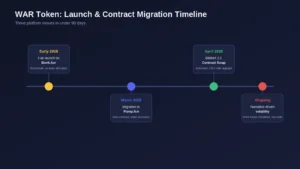
Three platform changes in under 90 days pushed WAR from a niche fair-launch token to a centralized-exchange listing.
Stage One: The Bonk.fun Fair Launch
WAR started life on Bonk.fun (formerly LetsBonk.fun), a Solana launchpad built for exactly this kind of community-first token. No presale, no VC allocation, just an open mint.
Stage Two: The Pump.fun Move
A few weeks in, the team pushed a migration announcement: the token would move to Pump.fun, with a defined window for holders to swap into the new contract before the old one was abandoned. This wasn’t unusual behavior for Solana memecoins chasing better discovery tools and deeper liquidity routing, but it’s exactly the kind of moment where fake migration links spread on social media. Anyone holding WAR during a migration window should always verify the contract address against the project’s official channel, never a reply-guy tweet.
Stage Three: The BitMart Contract Swap
The most recent shift was a backend 1:1 swap handled directly by BitMart when WAR listed there, letting the exchange support trading without requiring any manual action from users. This kind of exchange-side migration is lower risk than a public wallet-to-wallet swap, since the exchange controls both sides of the ledger.
If you’ve read our coverage on why coins with repeated contract migrations deserve extra scrutiny, you already know the pattern: each migration is a legitimate technical step, but it’s also a recurring opportunity for phishing. Treat every migration announcement as unverified until you’ve confirmed it on the project’s official Twitter or Discord.
Why a War-Themed Coin Is Trending Right Now
There’s no polite way to say this: WAR trends because war trends. Every time a geopolitical flashpoint dominates headlines, search volume for war crypto coin spikes, and traders pile into WAR looking for a way to speculate on attention itself, not on any underlying asset or event outcome.
That’s a real dynamic, and it’s worth naming directly. WAR isn’t hedging against conflict, and it isn’t a prediction market. It’s a sentiment token. When the news cycle heats up, volume follows. When it cools, volume dries up just as fast. Traders who understand this treat WAR like a short-term momentum play. Traders who don’t understand it end up holding a bag after the headline moves on.
WAR Coin Price Performance and Volatility
The price history reads like a textbook memecoin chart, just with sharper spikes tied to news timing rather than generic hype. Multi-hundred-percent moves within days aren’t rare here, and neither are 90%+ drawdowns from local highs.
- Explosive short-term rallies tied directly to breaking geopolitical news
- Sharp, fast corrections once attention shifts to the next story
- Trading volume that can swing by an order of magnitude within 48 hours
- Wide bid-ask spreads on smaller decentralized exchange pairs during low-volume periods
This kind of volatility profile isn’t unique to WAR. We’ve broken down the same pattern in our piece on why bitcoin and altcoin drawdowns accelerate during macro stress events, and the mechanics are nearly identical here, just compressed into a smaller-cap, thinner-liquidity token where the swings are more violent in both directions.
WAR Tokenomics: Supply, Allocation, and What’s Missing
The supply structure is simple by design. A fixed total supply, no vesting schedule, and no team allocation carve-out at launch. That simplicity cuts both ways.
- No presale or insider allocation at the original fair launch
- Fixed maximum supply with no ongoing emissions or inflation mechanism
- No staking rewards, no protocol revenue share, no governance token utility
- Liquidity concentrated on a mix of decentralized exchanges and a growing number of centralized listings
What’s missing is any documentation of how liquidity provider tokens are handled, whether they’re locked, burned, or sitting in a wallet the team could pull from. That single gap is the first thing a cautious buyer should chase down before assuming this is a clean setup.
Where to Buy WAR Crypto Coin
Access has broadened as WAR picked up centralized exchange listings, but decentralized exchanges on Solana remain the deepest liquidity source for most trading pairs.
Buying Through a Solana DEX Aggregator
Most traders route through an aggregator like Jupiter, connecting a Solana wallet such as Phantom or Solflare, then swapping SOL or a stablecoin for WAR. Before you confirm any swap, paste the contract address into a block explorer and compare it against the project’s official social channels. This one habit prevents the majority of fake-token losses in the memecoin space.
Buying Through a Centralized Exchange
Where WAR has centralized listings, buying is closer to a normal spot trade: fund your account, search the ticker, and place the order. The tradeoff is custody. You’re trusting the exchange to hold the asset securely rather than controlling your own private keys.
Is WAR Crypto Coin Safe? The Honest Risk Breakdown
No sugar coating here. WAR carries every risk you’d expect from a narrative-driven memecoin, plus a few specific to its migration history.
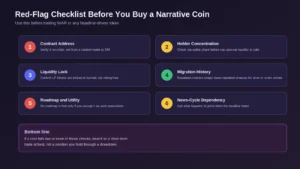
Run this checklist before buying WAR or any other news-cycle-driven token.
- Zero underlying utility, so price has no fundamental floor beyond what buyers are willing to pay
- Repeated contract migrations create repeated windows for phishing and scam clones
- Concentrated holder wallets can trigger sharp dumps with little warning
- Price is directly tethered to unpredictable, fast-moving news cycles
- No roadmap means no accountability structure if community interest evaporates
This is the same investor-protection lens we applied in our deep dive on documented red flags in newer speculative tokens, and it applies just as directly here. A coin can be technically legitimate, launched fairly, and still be an extremely risky place to put money.
WAR Coin vs Other Geopolitical and Narrative Memecoins
WAR isn’t the only token trying to turn current events into a trading product, but it’s positioned itself more clearly than most. Where a lot of narrative coins try to layer on fake utility promises, WAR leans into being purely speculative and says so. That honesty is refreshing, but it doesn’t make the asset less risky, it just makes the risk easier to see. Compared to celebrity-name meme tokens or random animal-themed coins riding unrelated hype, WAR at least has a coherent, explainable reason for its price action: it moves with the news. That’s a lower bar than most competitors clear, but it’s still a bar.
WAR Coin Price Prediction: What Realistic Scenarios Look Like
Nobody can responsibly hand you a target price for a token like this, and any article that does is guessing. What can be said with more confidence is the shape of the range.
- Bullish scenario: renewed geopolitical tension plus broader Solana memecoin momentum pushes WAR back toward recent highs
- Bearish scenario: attention fades, broader crypto market turns risk-off, and WAR drifts toward prior support levels
- Base case: WAR continues trading in wide swings correlated to news volume, with no stable equilibrium price
Treat any specific dollar target you see elsewhere as a guess dressed up as analysis. The honest prediction is volatility, not a number.
How to Evaluate Any War-Themed or News-Driven Crypto Coin
WAR won’t be the last coin trying to monetize a news cycle. Here’s the framework worth applying to the next one, and the one after that.
- Pull up the contract on a block explorer and check top-holder concentration before anything else
- Confirm whether liquidity provider tokens are locked or burned, not just promised
- Count the migrations. Each one is a legitimate technical event and a phishing opportunity at the same time
- Ask what happens to demand once the news cycle moves on, because it always does
- Size any position as pure speculation capital, never as a portfolio core holding
For a deeper background on how memecoins as a category work and where they fit in the broader crypto asset landscape, Wikipedia’s entry on meme coins is a useful starting reference.
Frequently Asked Questions
What is WAR crypto coin?
WAR is a Solana-based memecoin themed around global conflict and geopolitical narratives. It has no presale allocation, no formal roadmap, and no protocol utility. Its price is driven almost entirely by news-cycle attention and social momentum rather than any underlying product.
Is WAR coin a good investment?
WAR carries high volatility, concentrated risk, and zero fundamental utility. It can suit short-term speculative traders who understand memecoin dynamics, but it’s not built for long-term holding or anyone looking for a stable store of value.
Where can I buy WAR crypto coin?
WAR trades on Solana decentralized exchanges through aggregators like Jupiter, and on a growing number of centralized exchanges following recent listings. Always verify the current contract address before swapping, since the token has migrated platforms multiple times.
Why did WAR coin migrate contracts multiple times?
WAR moved from Bonk.fun to Pump.fun for better discovery and liquidity tools, then underwent an automatic 1:1 contract swap when BitMart listed it. Each migration was platform-driven rather than a sign of project instability, but each also created a window where scam clones could appear.
Is WAR coin the same as other war-themed tokens?
No. Multiple unrelated tokens use war, warrior, or conflict branding across different chains. Always confirm the exact contract address rather than relying on the ticker symbol WAR alone, since ticker collisions are common in the memecoin space.
Final Take
WAR crypto coin is exactly what it presents itself as: a speculative, narrative-driven Solana memecoin that trades on attention rather than fundamentals. That’s not automatically a bad thing, plenty of traders make money on exactly this kind of momentum. What matters is going in with clear eyes. Verify every contract address, understand that no roadmap means no accountability, and never mistake a viral price chart for a sound long-term investment. If you’re going to trade the news, trade it with capital you can afford to lose entirely.