

Type blackrock $1.2 billion crypto sales into Google right now and you’ll get headlines from at least three or four different weeks in 2026, all describing more or less the same dollar figure. That’s not a coincidence, and it’s not a typo repeating itself across news sites either. BlackRock’s Bitcoin and Ethereum ETFs have crossed the 1.2 billion dollar outflow mark multiple times this year, and if you’re trying to figure out what’s actually going on, which week the headlines are even talking about matters more than most articles bother explaining.
This piece sorts out which event is which, walks through the mechanics of what “BlackRock selling crypto” actually means in ETF terms, and covers the specific, more mysterious trade that a lot of these headlines get tangled up with.
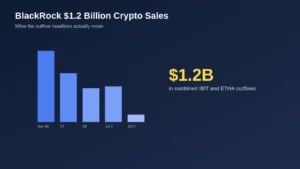
BlackRock’s crypto ETFs have posted roughly $1.2 billion in outflows across several separate weeks in 2026
Wait, Which $1.2 Billion Sale Are We Talking About?
Here’s the part most coverage skips past. Searches for blackrock $1.2 billion crypto sales could reasonably be pointing at any of these.
A combined Bitcoin and Ethereum ETF outflow of roughly 1.2 billion dollars during the last week of January 2026, one of the earlier signs of institutional profit taking this year.
A weekly outflow period in late May 2026, where BlackRock’s iShares Bitcoin Trust and Ethereum products together shed over 1.2 billion dollars, part of a broader stretch that saw U.S. spot Bitcoin ETFs post their heaviest weekly outflow of the year at that point.
A separate, single, unusually large over the counter trade on May 26, 2026, where roughly 1.26 to 1.29 billion dollars of IBIT shares changed hands in one dark pool transaction, distinct from the aggregate weekly outflow figures and genuinely stranger in its own right.
Another combined outflow period during the five trading days ending July 2, 2026, where BlackRock’s Bitcoin and Ethereum ETFs together recorded around 1.225 billion dollars in net withdrawals, with Bitcoin responsible for more than 99 percent of that total.
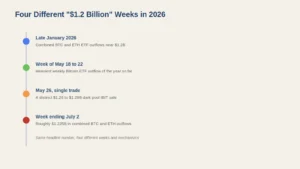
Four separate weeks in 2026 have each produced a roughly $1.2 billion BlackRock crypto outflow headline
If your search brought you here expecting one clean event, it’s actually a pattern that’s repeated across the year rather than an isolated headline. That pattern itself is the real story, and we’ll get into why it keeps happening.
The Most Recent Move: Week Ending July 2, 2026
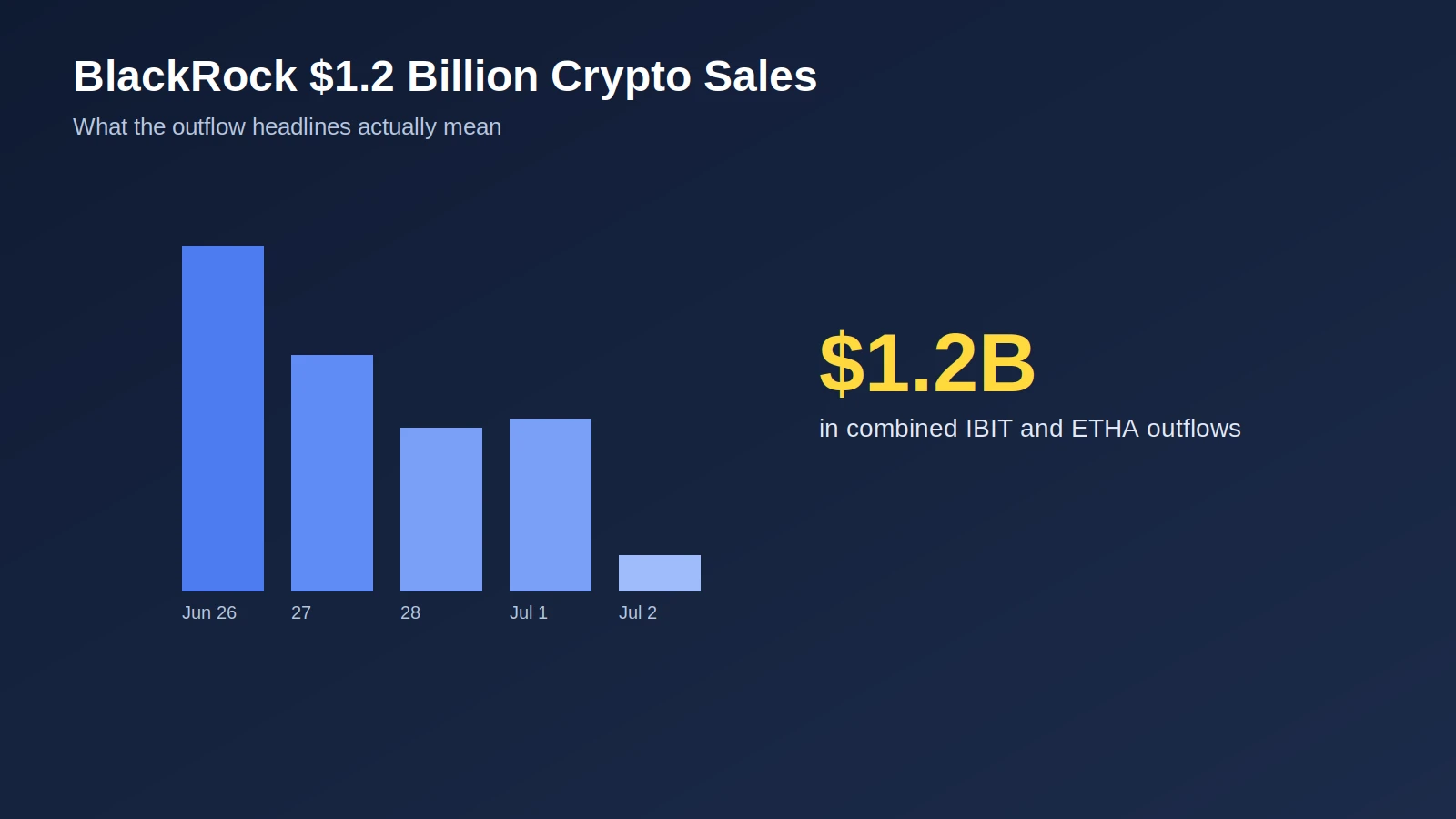
The freshest instance of this headline centers on the five trading days ending July 2, 2026. BlackRock’s iShares Bitcoin Trust, ticker IBIT, recorded cumulative outflows of approximately 1.22 billion dollars over that stretch, with daily withdrawals of 444.5 million, 300.4 million, 212.4 million, 219.4 million, and 40.4 million dollars across the five sessions.
Combined with its Ethereum products, BlackRock’s total net crypto ETF outflows for that week landed around 1.225 billion dollars, and Bitcoin accounted for over 99 percent of it. Ethereum was almost a rounding error by comparison during that specific week, which is worth noting since the two assets don’t always move together in these flow reports.
The broader market told a similar story. U.S. spot Bitcoin ETFs as a category posted net outflows on four of the five trading days that week, before a 223.5 million dollar inflow on July 2 partially offset the damage. It wasn’t enough to erase the week’s losses, but it did show buyers were still willing to step back in once the selling pressure eased.
Is BlackRock Actually Selling, or Is This Something Else?
This is the single biggest point of confusion in how these headlines get framed, and it’s worth being precise about it, because “BlackRock sold crypto” implies a proprietary trading decision, and that’s not really what’s happening here.
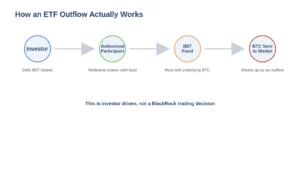
The ETF redemption process behind these outflow headlines
Spot Bitcoin and Ethereum ETFs work through a creation and redemption mechanism. When investors want out of a fund like IBIT, authorized participants redeem ETF shares, and the fund has to sell the underlying Bitcoin or Ethereum it holds to fund those redemptions. The outflow figure you see in the headlines reflects investor behavior, people and institutions pulling money out of the fund, not BlackRock making an independent call to reduce its own crypto exposure.
One Yahoo Finance piece covering the May outflows put it plainly, the selling came from BlackRock’s customers, not from BlackRock itself, with roughly 15,000 BTC being sent in daily deposits to Coinbase Prime specifically to meet those ETF redemptions. That’s a meaningful distinction for anyone trying to read investor sentiment into these numbers correctly, the fund manager isn’t the one deciding to exit, it’s executing on behalf of the people who already decided to.
Understanding this matters if you’re trying to interpret what these outflows say about institutional confidence in Bitcoin broadly. It’s investor redemptions flowing through an exchange traded fund structure, which is a fundamentally different signal than the asset manager itself deciding crypto no longer belongs in its business.
The Mysterious May 26 Dark Pool Trade Deserves Its Own Explanation
Separate from the weekly outflow totals, there’s a specific transaction that a lot of coverage conflates with the broader trend, and it deserves to be treated on its own.
On May 26, 2026, a single sale of somewhere between 1.26 and 1.29 billion dollars in IBIT shares was executed in one over the counter dark pool trade, at roughly a 2.3 percent discount to the prevailing market price. Analysts flagged the size as one of the largest single trades of its kind ever seen on the fund. NYDIG’s global head of research, Greg Cipolaro, examined the trade and concluded the pricing pattern, selling at a meaningful discount rather than working the order through the open market gradually, suggested the seller wanted out of the position immediately rather than executing a routine basis trade unwind.
Here’s the detail that made it genuinely strange rather than just large: the actual net redemption figures from the fund during that window only accounted for a fraction of the total trade size, meaning a large portion of those shares appear to have been bought by another party rather than redeemed outright. That gap is exactly why this specific trade got so much attention separately from the ordinary outflow reporting, it doesn’t fully explain itself through public data, and the identity and motive of the seller were never confirmed.
Why the Selling Keeps Concentrating in Bitcoin, Not Ethereum
Across nearly every one of these outflow periods in 2026, Bitcoin has represented the overwhelming majority of the dollar figure, while Ethereum products have behaved noticeably differently, sometimes even attracting inflows during the same stretch that Bitcoin bled hundreds of millions.
During the July 2 week, Ethereum ETFs actually posted net inflows of 14.8 million and 29 million dollars on the final two days, ending a prior stretch of losses. A similar pattern showed up in earlier periods too, with BlackRock’s ETHB fund pulling in fresh capital even while its Bitcoin fund faced heavy redemptions. The likely explanation isn’t complicated, Bitcoin ETFs are simply larger and more liquid, meaning they absorb a bigger share of both inflows and outflows in absolute dollar terms, while Ethereum’s institutional holder base has behaved somewhat more steadily through the same volatility.
What This Means for Bitcoin’s Price
These outflow periods have coincided with real price pressure, though not the kind of structural breakdown that headline dollar figures sometimes imply on their own.
During the heaviest outflow week in late May, Bitcoin dipped to a low near 74,300 dollars before recovering toward 77,000, with the bounce reportedly driven more by short term futures traders than committed long term buyers. Total assets across the entire spot Bitcoin ETF category fell from roughly 107.75 billion dollars in mid May to about 94.17 billion dollars by month end, a meaningful contraction, but ETFs collectively still held around 1.3 million BTC even after the selling, which several analysts have framed as a cooling in demand rather than a structural unwind of institutional positioning.
How IBIT’s Size Makes These Numbers Look Bigger Than They Are
Part of why BlackRock keeps showing up in these headlines specifically, rather than other issuers, comes down to sheer scale. IBIT has consistently been the largest spot Bitcoin ETF in the U.S. market since spot Bitcoin ETFs launched, meaning it naturally processes a bigger share of both inflows and outflows in absolute dollar terms than smaller competing funds from other asset managers.
A billion dollar outflow week from IBIT doesn’t necessarily represent a larger percentage move than a much smaller dollar outflow from a competitor’s fund with a fraction of the assets under management. Comparing dollar figures across different funds without adjusting for their relative size is a common way these headlines end up sounding more dramatic than the underlying percentage shift actually is. That’s not to say a billion dollar plus outflow week is meaningless, it clearly isn’t, but the scale of IBIT itself is part of why it keeps generating these specific headlines more often than other funds tracking the same asset.
Should You Read This as Bearish for Crypto Long Term?
It’s tempting to treat any headline with “$1.2 billion” and “sale” in it as an automatic bad sign, but the fuller picture is more mixed than that framing suggests.
Redemption driven outflows reflect existing ETF holders taking profits or reducing exposure, which is normal portfolio behavior during a volatile stretch rather than evidence that institutions are abandoning crypto as an asset class. The fact that ETFs still hold well over a million BTC combined, even after several rounds of billion dollar plus outflows, suggests the core institutional base hasn’t evaporated, it’s just adjusting position size in response to price swings like any other asset class would see during a rough quarter.
That said, repeated outflows at this scale across January, May, and July do suggest genuine caution among a meaningful slice of ETF holders rather than a one off blip, and it’s worth taking that pattern seriously rather than dismissing each instance as noise.
What Everyday Investors Should Actually Take From This
If you’re not managing institutional size positions, the practical takeaway isn’t to panic sell because a headline mentioned a big number, it’s to understand what that number actually represents before reacting to it.
A weekly ETF outflow figure tells you what existing fund holders did with their money that week, not what BlackRock as a company believes about Bitcoin’s future, and definitely not a signal calibrated for someone holding a much smaller, longer term position. Treating every billion dollar outflow headline as a reason to trade is how a lot of retail investors end up reacting to institutional portfolio rebalancing that has very little to do with their own situation or time horizon.
This isn’t investment advice, and none of the flow data above should be read as a recommendation to buy or sell anything. It’s context for understanding a recurring headline, not a signal to act on.
Frequently Asked Questions
What does the blackrock $1.2 billion crypto sales headline actually refer to?
It’s referred to multiple separate events across 2026, including outflow periods in January, late May, and the week ending July 2, plus a distinct single dark pool trade on May 26. Each instance involves roughly the same dollar figure but represents a different week or transaction.
Did BlackRock decide to sell $1.2 billion of Bitcoin and Ethereum on its own?
No. These figures reflect ETF investors redeeming shares, which forces the fund to sell underlying Bitcoin or Ethereum to meet those redemptions. It’s investor driven outflow activity, not a proprietary decision by BlackRock to reduce its own crypto holdings.
What was unusual about the May 26, 2026 trade specifically?
A single over the counter sale of roughly 1.26 to 1.29 billion dollars in IBIT shares was executed at a notable discount in one dark pool transaction, with the scale and pricing pattern suggesting a large investor exiting the position quickly rather than a routine trade.
Why does Bitcoin account for most of these outflows compared to Ethereum?
Bitcoin ETFs are larger and more liquid than their Ethereum counterparts, so they naturally represent a bigger share of both inflows and outflows in dollar terms, and Ethereum products have periodically attracted inflows during the same stretches Bitcoin faced heavy redemptions.
Does this mean institutions are losing confidence in Bitcoin?
Not necessarily. Spot Bitcoin ETFs still collectively hold well over a million BTC even after repeated billion dollar plus outflow weeks in 2026, suggesting portfolio rebalancing and profit taking rather than a wholesale institutional exit from the asset class.
Final Thoughts
The blackrock $1.2 billion crypto sales headline isn’t describing one dramatic event, it’s a number that’s recurred across at least four distinct periods in 2026, each with its own context and mechanics behind it. Understanding that these are largely investor redemptions flowing through an ETF structure, plus one genuinely unusual single trade in late May, gives you a much clearer read on what’s happening than treating every repeat of that headline as fresh, standalone news. If you’re trying to gauge where Bitcoin actually stands amid this outflow pattern, our breakdown of on chain bottom signals is a useful next read for separating short term flow noise from the metrics that matter over a longer horizon.