

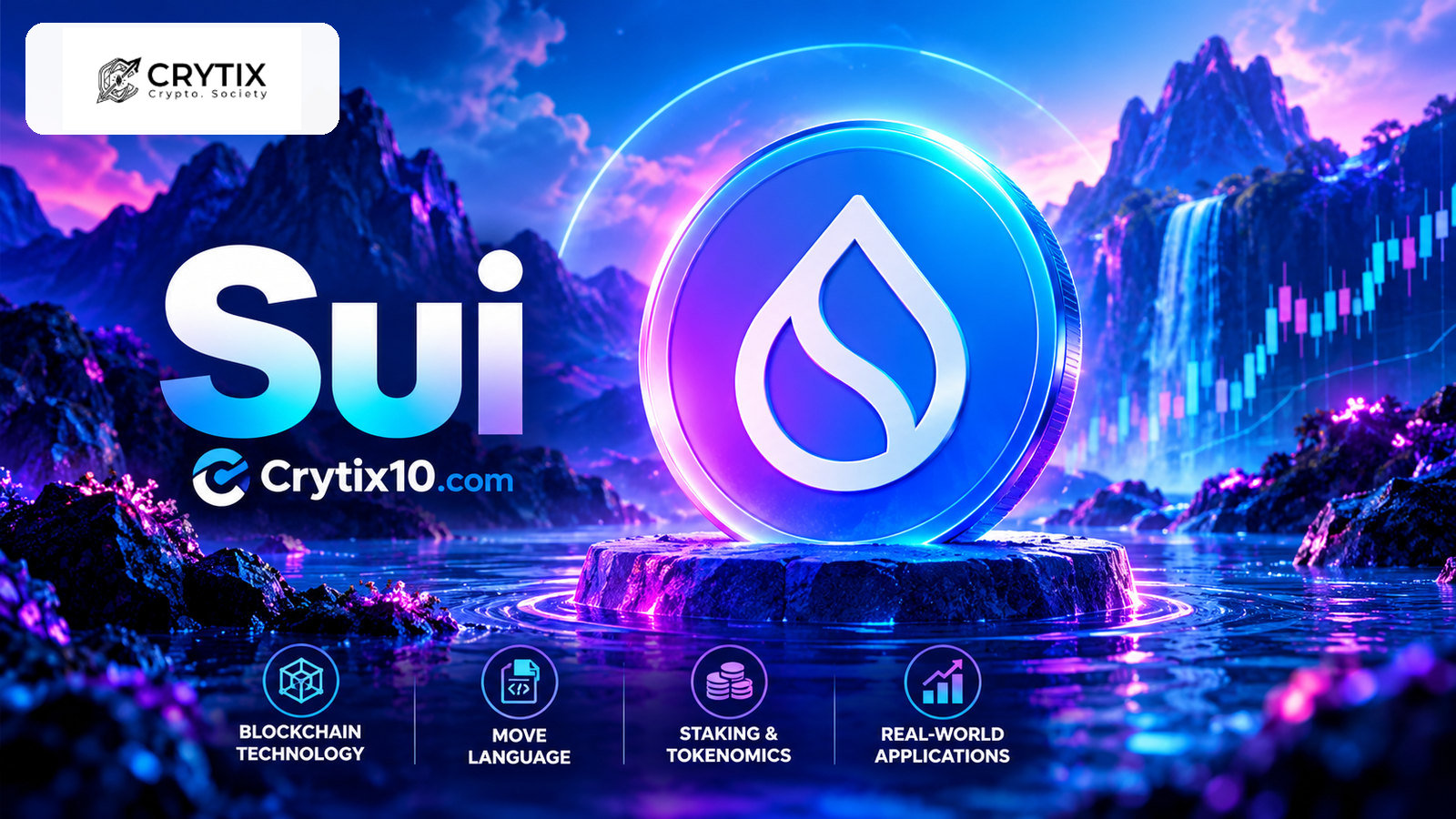
Sui (SUI) is a Layer 1 blockchain platform designed to support fast transactions, scalable decentralized applications, digital assets, and innovative Web3 experiences. As the cryptocurrency industry continues evolving in 2026, Sui has attracted attention for its object-centric blockchain architecture, Move programming language, and ability to process certain transactions in parallel. Unlike traditional blockchain systems that organize most activities around accounts and sequential transaction execution, Sui represents blockchain assets and application states as programmable objects. This design creates opportunities for efficient processing, flexible asset ownership, and application development across decentralized finance, gaming, digital commerce, and other blockchain-related sectors.
The SUI cryptocurrency plays a central role in the ecosystem by supporting transaction fees, staking, network security, and other economic activities. However, evaluating Sui requires understanding more than the market price of its native token. Its technology introduces a different approach to managing digital assets, while its Delegated Proof-of-Stake consensus system provides incentives for validators and token holders. This comprehensive guide explains what Sui is, how its blockchain works, why the Move language matters, how staking and tokenomics operate, and which opportunities and risks may influence its future.
What Is Sui (SUI)?
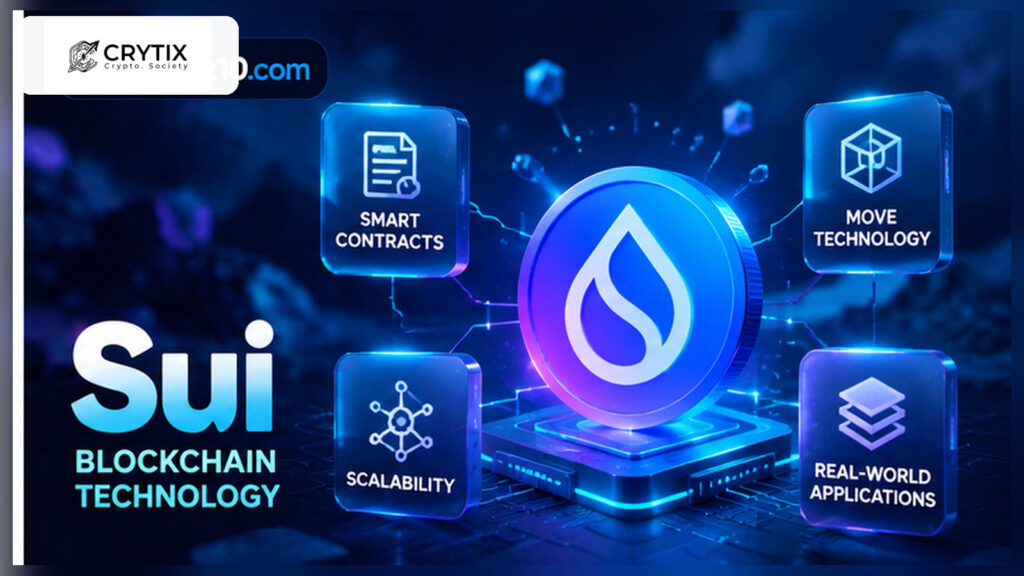
Sui is an open-source Layer 1 blockchain designed for decentralized applications that require efficient transaction execution and flexible digital asset management. The network supports smart contracts, token transfers, decentralized financial applications, blockchain games, and other Web3 services. Its mainnet officially launched on May 3, 2023, following development involving Mysten Labs, a technology company founded by former Meta blockchain and cryptography researchers. Sui was created to address challenges associated with blockchain scalability, transaction processing, and the complexity of developing secure digital asset applications.
Unlike many account-based blockchains, Sui organizes much of its application data around objects. These objects can represent digital coins, collectibles, game assets, or other programmable resources. Depending on ownership and access requirements, some transactions can be processed without competing for the same shared state. This architectural difference allows Sui to optimize particular categories of operations while still supporting complex applications that require coordinated consensus. The SUI token provides the economic foundation for transaction processing and network validation.
The History and Development of Sui Blockchain
Sui was developed by Mysten Labs, whose founding team includes Evan Cheng, Adeniyi Abiodun, Sam Blackshear, George Danezis, and Kostas Chalkias. Several members previously worked on Meta’s blockchain initiatives, where they gained experience in distributed systems, digital asset infrastructure, and the Move programming language. This background influenced Sui’s focus on secure asset ownership, efficient blockchain execution, and developer-friendly infrastructure. Following its development and testing stages, Sui launched its public mainnet in May 2023.
Since launch, the ecosystem has expanded through improvements in consensus technology, developer tools, decentralized finance infrastructure, gaming applications, and wallet functionality. Projects such as DeepBook demonstrate how Sui’s infrastructure can support onchain financial markets, while authentication technologies such as zkLogin aim to simplify user access. The network has also experienced operational challenges. During January and May 2026, Sui encountered mainnet disruptions that were subsequently investigated and resolved. These incidents highlight why blockchain performance claims must be considered alongside reliability, security, and the ability of developers to respond effectively to technical problems.
How Does Sui Blockchain Technology Work?
Sui uses an object-centric blockchain architecture that organizes digital assets and application information into programmable objects. Every object has identifiable properties, including ownership and version information, allowing the network to track changes as transactions occur. Instead of requiring all operations to modify one global execution state, Sui can identify whether a transaction affects an individually owned object or shared resources. This distinction is important because transactions involving independent objects may be processed more efficiently than operations competing for the same shared state.
Sui combines this object model with a consensus framework operated by validators. Transactions involving shared objects require coordinated ordering to ensure that participants agree on the resulting state. Other transactions can follow optimized processing paths depending on their characteristics and protocol requirements. This arrangement is intended to improve throughput and reduce unnecessary contention, although actual transaction performance depends on application design, network activity, transaction complexity, and available validator resources. Sui’s technology is therefore best understood as a specialized approach to blockchain execution rather than a guarantee that every transaction will always be instantaneous.
What Makes Sui Different from Traditional Blockchains?
One distinguishing feature of Sui is its ability to represent assets as independently managed objects instead of treating every asset interaction as a change within a shared account-based state. In conventional smart contract networks, applications often operate through contracts that update shared balances or storage structures. Sui provides developers with additional flexibility by allowing them to define objects with explicit ownership and access rules. These properties can simplify certain asset-oriented applications and provide opportunities for parallel execution.
Another advantage is its support for programmable transaction blocks, which allow developers to combine multiple operations within a single transaction. For example, an application may transfer an asset, interact with a protocol, and perform related actions together, subject to transaction rules. Sui also provides features such as sponsored transactions, enabling applications to cover gas fees for users under supported arrangements. These capabilities can improve user experiences, particularly for people unfamiliar with cryptocurrency wallets and transaction fees. Nevertheless, application security and reliability remain dependent on proper implementation.
Understanding the Sui Move Programming Language
Move is a programming language designed for secure digital asset management and smart contract development. Sui uses a specialized version known as Sui Move, which adapts the language to its object-based architecture. Rather than representing every digital asset as an ordinary numerical entry, Move provides resource-oriented programming concepts intended to help developers manage ownership and transfers safely. This approach is especially relevant for applications handling tokens, collectibles, financial positions, and other blockchain assets.
Sui Move allows developers to define objects, establish permissions, control how assets can be transferred, and implement rules governing application behavior. Its type system and asset management model are designed to prevent certain common programming mistakes, such as accidentally duplicating resources. However, no programming language automatically eliminates every smart contract vulnerability. Developers must still test their applications, review access controls, consider economic attack scenarios, and obtain appropriate security audits. Move provides useful tools for secure development, but responsible engineering remains essential.
How Does Sui Achieve Scalability and Fast Transactions?
Sui’s scalability strategy combines parallel execution opportunities, efficient transaction scheduling, and validator-based consensus. Transactions involving independent objects can avoid some of the contention associated with applications that repeatedly update shared resources. This allows the network to process compatible workloads concurrently rather than forcing every operation through one strictly sequential execution path. Applications that rely heavily on shared objects still need coordinated ordering, but Sui’s architecture provides mechanisms intended to handle these requirements efficiently.
The network has also developed consensus technology designed to improve performance and transaction finality. Mysticeti became an important part of Sui’s consensus evolution, supporting efficient agreement among validators. However, transaction throughput figures observed in controlled tests should not be treated as guaranteed real-world performance. Blockchain applications have different computational requirements, and actual results depend on infrastructure, network conditions, and transaction composition. Users should assess practical reliability, fees, and application performance rather than comparing cryptocurrency platforms solely through headline transactions-per-second claims.
What Is the SUI Token Used For?
SUI is the native cryptocurrency that supports the operation and economic security of the Sui blockchain. One of its primary functions is paying gas fees for transaction execution and data storage. Users generally need SUI when submitting transactions, interacting with smart contracts, or transferring assets through ordinary wallet operations. SUI also supports the network’s staking mechanism, allowing token holders to delegate stake to validators who participate in securing the blockchain.
Beyond transaction fees and staking, SUI functions as a liquid digital asset within the broader ecosystem. It may be used in supported decentralized financial applications, trading markets, liquidity pools, and other blockchain-based services. The token also has a role in governance-related activities under the network’s economic design. Nevertheless, the relationship between ecosystem growth and token valuation is not automatic. Investors should evaluate whether expanding usage produces sustainable demand for SUI and how that demand compares with token distribution and broader cryptocurrency market conditions.
Sui Tokenomics: Maximum Supply and Distribution
Sui has a maximum total supply of 10 billion SUI tokens. This capped supply is a fundamental feature of the network’s monetary model and distinguishes it from cryptocurrencies with unlimited lifetime issuance. However, maximum supply is not equivalent to circulating supply. Only a portion of the total allocation is available for unrestricted market trading at any particular time, with remaining tokens becoming available according to release schedules and ecosystem-related allocations.
At mainnet launch, approximately 5% of the maximum supply was circulating, while other tokens were allocated for purposes involving community development, early contributors, investors, staking-related incentives, and ecosystem support. Token unlocks are particularly important for investors because additional circulating supply can affect market liquidity and the balance between buyers and sellers. A limited maximum supply does not guarantee price appreciation, especially when the circulating supply continues increasing over time. Evaluating SUI tokenomics requires examining scheduled unlocks, distribution concentration, network activity, and demand for the underlying cryptocurrency.
Understanding Sui Gas Fees and the Storage Fund
Sui uses a gas fee model that accounts for both computational execution and blockchain data storage. When users submit transactions, they pay fees reflecting the processing work required and the storage resources associated with creating or modifying onchain objects. Validators coordinate a reference gas price during network epochs, helping establish a predictable framework for transaction pricing. This design aims to encourage efficient processing while compensating network operators for their services.
An important component of Sui’s economics is its storage fund. When transactions create blockchain data that must remain available, part of the storage-related cost contributes to the fund. The fund helps compensate validators for the long-term responsibility of storing historical blockchain information. Certain operations that delete previously stored data can qualify for partial storage rebates. This mechanism is intended to distribute storage costs more fairly across time rather than requiring future validators to bear every cost created by earlier users. The storage fund can also affect circulating token availability, although these economic characteristics should not be interpreted as guarantees of future token value.
How Does Sui Proof-of-Stake Work?
Sui uses a Delegated Proof-of-Stake consensus model in which validators secure the network and participate in transaction processing. Validators must operate suitable infrastructure and maintain SUI stake, while other token holders can delegate their tokens to eligible validators. The amount of stake associated with a validator contributes to its role and voting power within the network’s consensus framework. Validators are expected to operate reliably, follow protocol rules, and process transactions correctly.
Sui operates using epochs that last approximately 24 hours on its mainnet. At epoch boundaries, the network can update validator participation, stake allocations, and other operational parameters. Staking rewards come from eligible transaction fees and scheduled staking subsidies, while validator commissions and performance influence the rewards received by delegators. Misbehavior or poor validator performance can lead to penalties or reduced rewards under applicable network rules. This system is designed to align validator incentives with network reliability, although its effectiveness depends on decentralized participation and responsible operation.
How to Stake SUI Cryptocurrency
SUI holders can participate in native staking through compatible wallets and supported validator interfaces. The process typically involves obtaining SUI, connecting a supported wallet, selecting an eligible validator, reviewing the staking details, and confirming the delegation transaction. Most users do not need to operate their own validator infrastructure because delegated staking allows them to support existing network operators.
Before staking, participants should review validator commissions, performance history, expected reward conditions, and withdrawal procedures. Rewards are variable rather than guaranteed, and validator performance may influence the amount earned. Staked assets also remain exposed to changes in the market price of SUI. Liquid staking protocols may provide additional flexibility, but they introduce smart contract, liquidity, and token-pricing risks. Users should obtain wallet software through trustworthy official sources and avoid any platform promising guaranteed high returns.
Sui Blockchain and Decentralized Finance (DeFi)
Decentralized finance is an important application category within the Sui ecosystem. Developers use Sui’s smart contract infrastructure to create decentralized exchanges, lending protocols, liquidity markets, and other financial applications. The blockchain’s object model and programmable transaction capabilities can support complex financial operations, while its processing architecture may help applications manage certain transaction workloads efficiently.
DeepBook is an example of financial infrastructure developed for the Sui ecosystem. It provides an onchain central limit order book designed to support liquidity and trading functionality for compatible applications. Other decentralized services may build around lending, swaps, collateral management, and asset-related transactions. However, participating in decentralized finance introduces risks involving smart contract exploits, liquidity shortages, token volatility, oracle errors, and potential liquidation. Users should evaluate the security and financial design of individual applications rather than assuming that every project built on Sui is equally reliable.
Gaming, NFTs and Digital Asset Ownership on Sui
Sui’s object-centric structure is particularly relevant to applications involving digital ownership. Blockchain games can use programmable objects to represent characters, equipment, collectibles, or other in-game assets. Developers may establish rules controlling how those assets are transferred, modified, or combined. This flexibility can support interactive digital economies and applications in which ownership records are important.
Non-fungible tokens and digital collectibles can also be created through Sui’s smart contract system. Unlike static representations of ownership, programmable assets may support changing attributes or interactions governed by application logic. However, technical flexibility does not guarantee that blockchain games or NFT collections will attract a sustainable audience. Projects must still provide enjoyable experiences, dependable infrastructure, reasonable transaction costs, and meaningful reasons for users to participate. Digital asset ownership can also involve intellectual property and platform-related restrictions that users should understand.
Sui Wallets and User-Friendly Blockchain Access
Wallet accessibility is an important part of the Sui ecosystem because complicated authentication and transaction approval processes can discourage mainstream users. Sui supports several wallet approaches, including conventional self-custody wallets and technologies intended to make onboarding easier. One notable feature is zkLogin, which uses zero-knowledge cryptography to support authentication through familiar identity providers while maintaining blockchain-related security properties.
This approach can make certain applications more approachable for users who are unfamiliar with traditional cryptocurrency recovery phrases. Nevertheless, wallet security depends on the implementation, recovery mechanisms, and services involved. Users should understand whether they control their private keys, how accounts can be recovered, and what happens if they lose access to an authentication provider. Convenient wallet experiences can reduce friction, but they do not remove phishing, malicious applications, or the possibility of approving unwanted transactions.
Sui vs Solana: What Is the Difference?
Sui and Solana are both Layer 1 blockchain platforms designed to support high-performance decentralized applications, but their architectures differ. Solana uses its own execution model and validator-based infrastructure, while Sui emphasizes object-centric asset management and Move smart contracts. Both networks seek to support applications requiring efficient processing, including financial markets, digital payments, and gaming-related services.
Solana benefits from an established ecosystem of developers, trading infrastructure, and decentralized applications. Sui offers a different approach to asset ownership and transaction processing that may be useful for particular categories of applications. Neither blockchain is universally superior. Developers should compare programming requirements, transaction behavior, operational reliability, ecosystem liquidity, decentralization, and long-term maintenance needs before choosing a network. Investors should also avoid assuming that a faster theoretical transaction benchmark automatically makes one cryptocurrency a better financial investment.
Sui vs Ethereum: Key Differences
Ethereum is a widely established blockchain platform with extensive smart contract infrastructure and a large ecosystem of Layer 2 networks. Sui takes a different architectural approach by using Move, programmable objects, and parallel execution opportunities. Ethereum applications commonly use Solidity and Ethereum Virtual Machine-based infrastructure, while Sui applications are designed around Sui Move and its object model.
These differences affect programming patterns, wallet compatibility, transaction handling, and developer tooling. Ethereum provides a mature environment with broad application adoption and established standards, while Sui emphasizes a more specialized model for programmable digital assets. Developers evaluating either platform should consider ecosystem compatibility, contract security, available liquidity, interoperability, transaction costs, and user requirements rather than relying exclusively on headline performance statistics.
Is Sui (SUI) a Good Investment in 2026?
Sui may interest investors who believe that scalable blockchain infrastructure, Move-based applications, and digital asset ownership will remain important to the cryptocurrency industry. Its established mainnet, capped supply, staking system, and growing application ecosystem offer several measurable characteristics for research. However, technological development does not automatically translate into positive investment returns. SUI remains a speculative cryptocurrency whose market value can be affected by liquidity, token unlocks, broader economic conditions, investor sentiment, and competition.
An informed investment assessment should examine developer participation, decentralized application usage, staking activity, network fees, validator reliability, and changes in circulating token supply. Investors should also consider whether the economic demand generated by applications is sufficient to support a particular market valuation. A high level of transaction activity does not necessarily indicate equally high financial value, especially if many transactions involve low-value activities. No specific SUI price target for 2026 or later years can be guaranteed.
Major Risks of Investing in SUI Cryptocurrency
Market volatility is a major risk for SUI holders. Cryptocurrency prices can change rapidly because of speculative trading, economic developments, regulatory decisions, or changing expectations about blockchain adoption. Token unlocks may create additional selling pressure under certain market conditions, although their actual impact depends on holder behavior and available liquidity. Competition from Solana, Ethereum, Avalanche, and other networks could also affect Sui’s ability to attract developers and sustainable economic activity.
Technical reliability is another important consideration. Sui experienced network disruptions during 2026, demonstrating that even advanced blockchain infrastructure can encounter operational problems. Smart contract vulnerabilities, wallet compromise, phishing, decentralized finance exploits, and application-level failures present further risks. Staking introduces validator-related considerations, while custodial exchanges create dependence on third-party platforms. Investors should understand these issues and avoid committing funds needed for essential financial obligations.
How to Buy and Store SUI Safely
People interested in purchasing SUI should research reputable cryptocurrency exchanges that support the native Sui network and operate legally in their jurisdiction. Important considerations include trading fees, withdrawal charges, liquidity, security policies, and account verification requirements. Before making a purchase, users should verify that they are acquiring the intended cryptocurrency and understand the difference between native SUI and similarly named assets on other blockchain networks.
After purchasing, users can hold SUI through supported custodial services or transfer it to a compatible self-custody wallet. Self-custody provides control over cryptographic credentials but requires secure backup and recovery practices. Users should verify destination addresses, confirm network compatibility, and consider sending a small test transaction before transferring larger amounts. Strong authentication, trustworthy wallet downloads, and careful review of transaction approvals can help reduce avoidable security risks.
The Future of Sui Blockchain in 2026 and Beyond
Sui’s future depends on its ability to attract useful applications, maintain network reliability, and provide infrastructure that solves practical problems for developers and users. Its object-centric architecture, Move programming language, staking system, and support for user-friendly authentication create opportunities across digital finance, gaming, digital commerce, and other Web3 applications. Continued infrastructure development may support more sophisticated applications and improved user experiences.
Nevertheless, long-term adoption will depend on practical results rather than technological potential alone. Sui must demonstrate operational resilience, maintain strong security practices, support sustainable developer activity, and compete effectively with other blockchain ecosystems. For SUI holders, token distribution, circulating supply changes, staking incentives, and actual network demand will remain important economic considerations. The project’s continued technical development is worth monitoring, but its future cryptocurrency valuation cannot be predicted with certainty.
FAQs
1. What is Sui (SUI) cryptocurrency?
Sui is a Layer 1 blockchain designed for decentralized applications, digital assets, and efficient transaction processing. SUI is its native cryptocurrency, used for transaction fees, staking, network security, and ecosystem activities.
2. Who created Sui blockchain?
Sui was developed by Mysten Labs, whose founding team includes former Meta blockchain researchers Evan Cheng, Adeniyi Abiodun, Sam Blackshear, George Danezis, and Kostas Chalkias.
3. When was Sui launched?
Sui launched its public mainnet on May 3, 2023, enabling developers and users to interact with the live blockchain.
4. What is the maximum supply of SUI?
Sui has a maximum total supply of 10 billion SUI tokens. The circulating supply is lower and changes as scheduled token allocations become available.
5. Can I stake SUI cryptocurrency?
Yes. Eligible SUI holders can delegate their tokens to validators through supported wallets and staking services. Rewards depend on validator performance, protocol conditions, and other factors.
6. What makes Sui different from Solana?
Sui uses an object-centric architecture and Sui Move smart contracts, while Solana uses a different execution and programming model. Both aim to support scalable decentralized applications.
7. Is SUI a good long-term investment?
SUI may interest investors researching blockchain infrastructure, but its future price performance is uncertain. Token unlocks, network adoption, market volatility, and competition should be considered.
8. Can Sui reach $10?
SUI could theoretically reach $10 if market demand supported the corresponding valuation, but there is no guarantee. Investors should consider its 10 billion maximum supply, circulating supply, liquidity, and market conditions.
9. Is the Sui blockchain secure?
Sui uses Delegated Proof-of-Stake and advanced blockchain technology, but no network or application is entirely risk-free. Technical disruptions, wallet attacks, and smart contract vulnerabilities remain possible.
10. What is the future of Sui in 2026?
Sui’s future depends on developer adoption, application quality, reliable network infrastructure, economic sustainability, and competition. Continued improvements may support adoption, but future investment performance is not guaranteed.
Conclusion
Sui (SUI) represents a distinctive approach to blockchain infrastructure through its object-centric architecture, Move programming language, and parallel transaction processing capabilities. Since launching in May 2023, the network has developed an ecosystem involving decentralized finance, programmable digital assets, gaming, and new wallet technologies. Its native SUI cryptocurrency supports transaction fees, staking, and broader blockchain operations, while its capped supply and storage fund contribute to the network’s economic design.
For readers researching Sui in 2026, understanding both its technology and its limitations is essential. The network offers promising infrastructure for developers and users, but cryptocurrency investments remain exposed to volatility, token unlocks, technical failures, and competitive market conditions. Long-term outcomes will depend on sustainable adoption, operational security, developer participation, and the economic demand generated by real applications. Investors should prioritize reliable information and careful risk assessment rather than speculative price predictions.
Disclaimer: This article is provided for educational and informational purposes only. It does not constitute financial, investment, legal, or tax advice. Cryptocurrency investments involve substantial risk, including the possibility of losing invested capital.