

Every few months somebody discovers altcoins for the first time and asks the same question. Is this just a fancy label for anything that is not Bitcoin, or is there real substance behind it? The honest answer is both. The term itself is simple. The category it describes is anything but. As of 2026 there are more than 17,000 tracked cryptocurrencies, and the overwhelming majority of them are altcoins. Some run real infrastructure that other blockchains depend on. Some are dead projects still limping along on low liquidity exchanges. A handful are outright jokes that somehow carry nine figure valuations. If you are going to put money anywhere near this space, or even just want to understand what people are talking about, you need a working map of which is which, not another recycled definition.
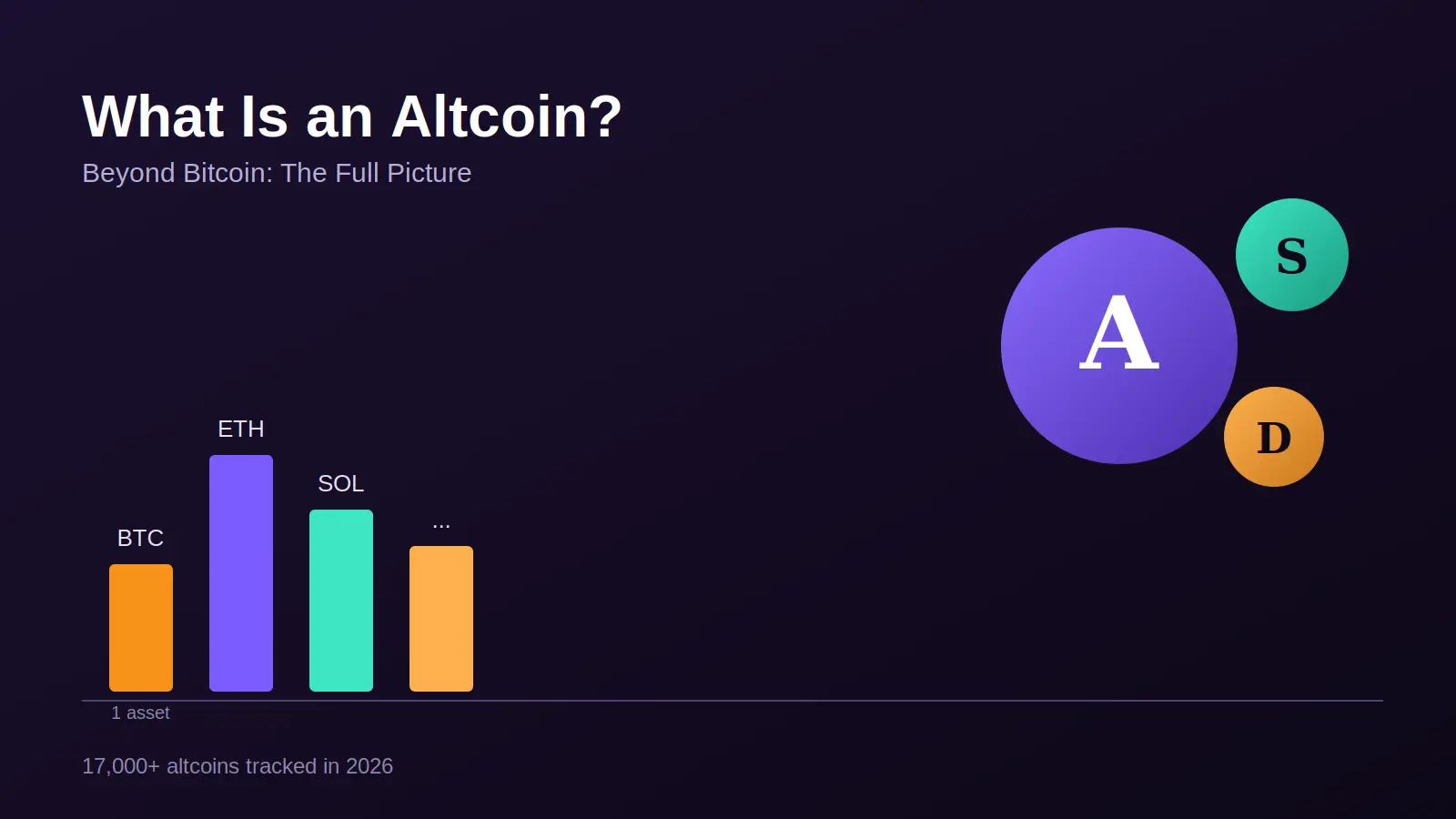
What Is an Altcoin?
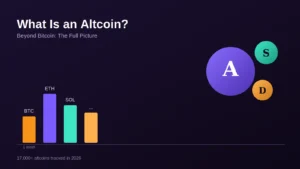
An altcoin is any cryptocurrency that is not Bitcoin. The word is short for alternative coin. That single definition covers Ethereum, stablecoins like USDT and USDC, meme tokens like Dogecoin, DeFi governance tokens, and thousands of smaller projects most people have never heard of. Ethereum is the second largest cryptocurrency by market cap and still counts as an altcoin under the strict definition, even though most traders mentally separate it from the rest of the pack.
Why the Label Barely Means Anything Anymore
Litecoin usually gets credit as the first altcoin, launched in 2011 as a faster, lighter version of Bitcoin’s code. Back then altcoin was a useful shorthand. Everything that was not Bitcoin fit in one bucket because there was not much else going on.
That stopped being useful a long time ago. Calling Ethereum an altcoin puts it in the same sentence as a coin someone launched last week with a dog logo and no working product. Calling USDT an altcoin lumps a payment rail that settles billions in daily volume together with a governance token nobody actually uses. The category is too wide to tell you anything about risk, purpose, or quality on its own. Anyone doing real research skips past the label fast and asks what the project actually does.
The Main Types of Altcoins You Will Actually Run Into
Smart Contract Platforms
These are blockchains built to run programs, not just move a currency from one wallet to another. Ethereum started this category. Solana, Cardano, and Avalanche now compete on speed and transaction fees. If you want a sense of how uneven fortunes get even among well known builders in this exact category, look at this Charles Hoskinson net worth breakdown, which lays out why even a project founder’s wealth is hard to pin down.
Stablecoins
USDT and USDC exist to hold a steady one to one peg with the US dollar. People use them to move value around without touching a bank, and to park funds during volatility without fully cashing out to fiat. They are altcoins by definition, but they behave nothing like the rest of the market.
DeFi and Governance Tokens
These give holders a vote on how a protocol operates, things like lending rates on Aave or fee structures on Uniswap. Value here is tied to actual usage of the platform, at least in theory. In practice a lot of governance tokens trade purely on speculation with almost nobody voting.
Layer 2 and Scaling Tokens
Arbitrum, Optimism, and similar projects process transactions off the main Ethereum chain to cut costs and speed things up. Their tokens usually cover governance and sometimes fees. This category has grown fast because Ethereum’s base layer fees pushed developers to look for cheaper alternatives.
Meme Coins
Dogecoin, Shiba Inu, and whatever launched on a meme this week. No underlying utility beyond community and attention. Some make early holders rich. Most go to zero once the attention moves on. Treat this category as entertainment money, not investment money, and you will sleep better.
Oracle and Infrastructure Tokens
Chainlink is the clearest example. These projects do not run their own blockchain economy so much as feed real world data, prices, weather, sports results, into smart contracts that need it. Useful, unglamorous, and often overlooked by people chasing the next 100x.
How Altcoins Actually Work Under the Hood
Strip away the marketing and every altcoin does one of three things. It forks existing code and tweaks a parameter, like block time or supply cap. It builds a new smart contract platform with its own consensus mechanism, usually proof of stake at this point since proof of work fell out of favor for anything except Bitcoin. Or it deploys as a token on top of an existing chain, most commonly Ethereum or Solana, without needing its own blockchain at all.
That last category is worth understanding because it is the fastest and cheapest way to launch a coin, and also the easiest way to launch a scam. Deploying a token contract takes minutes and costs almost nothing. A working blockchain with real security guarantees takes years and serious engineering. When you see a brand new project claiming to have built a blockchain in three months, that claim deserves scrutiny.
What Altcoin Season Actually Means
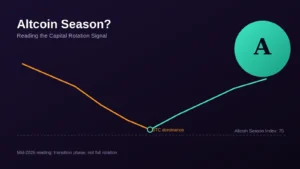
Altcoin season describes a stretch of the market cycle where capital rotates out of Bitcoin and into altcoins, pushing altcoin prices up faster than Bitcoin’s. The Altcoin Season Index measures how many of the top 50 coins outperformed Bitcoin over the trailing 90 days. A reading above 75 counts as confirmed altseason.
As of mid 2026 the index has been sitting closer to the 50s, which puts the market in a transition phase rather than a full blown altseason. That distinction matters because a lot of content online treats every altcoin pump as the start of a new supercycle. It usually is not. Older cycles saw capital spread almost evenly across the market. More recent on chain data suggests money now concentrates around projects with actual users and revenue, not just a low market cap and a big narrative. That is a meaningfully different market than 2017 or 2021, and treating it the same way will cost you.
How to Evaluate an Altcoin Before You Buy
This is the part most guides skip because it takes actual work instead of a listicle. Before putting money into any altcoin, check these things yourself.
Token distribution. Pull up the tokenomics page and see what percentage sits with the team, early investors, and the public. Anything north of 30 to 40 percent held by insiders with a short unlock schedule is a setup for the team to sell into you.
Real usage versus speculation. Check on chain data, active addresses, transaction volume, total value locked for DeFi projects, rather than trusting the marketing site. A coin with a huge market cap and almost no on chain activity is priced on hope, not fundamentals.
Code and audit history. Has the smart contract been audited by a firm with a track record, and are those audit reports public? No audit on a project holding user funds is a hard pass.
Team transparency. Anonymous teams are not automatically a scam, Bitcoin’s creator is anonymous too, but anonymity plus a huge insider token allocation plus a brand new project is a combination worth avoiding.
Liquidity depth. Check how much money actually sits in the trading pairs. Thin liquidity means you can move the price with a small buy and get stuck unable to sell without crashing it yourself.
None of this guarantees a good outcome. It just filters out the worst decisions before you make them.
Red Flags That Should Make You Walk Away
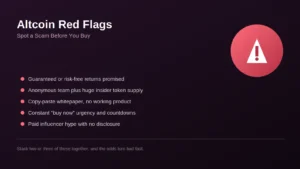
Some patterns show up again and again in projects that eventually collapsed or turned out to be scams. Guaranteed returns or risk free staking yields above what any legitimate business generates. A whitepaper that reads like it was copied from three other projects and stitched together. Constant pressure to buy right now before some deadline that conveniently resets every week. A team that has been building for two years with nothing shipped except a token and a Telegram group. Influencer promotion with no disclosure that they were paid, which is common enough that regulators have started fining people over it.
None of these guarantee a scam on their own. Stack two or three together and the odds get bad fast.
The Risks Nobody Should Sugarcoat
Most altcoins lose the majority of their value over time, and a large share go to zero eventually. That is not pessimism, it is the base rate for a market this crowded and this young. Add regulatory risk on top, since a shifting legal landscape can change a project’s legal status overnight. Add exchange risk, since a coin delisted from major platforms loses most of its liquidity fast. Add smart contract risk, since even audited code gets exploited sometimes. And add straightforward rug pull risk for anything new and unaudited.
None of this is financial advice, and nothing here should be read as a recommendation to buy or avoid any specific coin. Do your own research, size positions like you could lose all of it, and never invest money you need for anything else.
Altcoins vs Bitcoin: What Actually Separates Them
Bitcoin has a hard capped supply of 21 million coins and a single, narrow purpose: peer to peer digital money secured by proof of work. Most altcoins layer on extra functionality, smart contracts, faster settlement, governance, or specialized use cases, and plenty of them run flexible or inflationary supply models instead of a hard cap.
That extra functionality is the whole selling point of the altcoin market. It is also the source of most of its risk, since more moving parts means more ways for something to break, get exploited, or get mismanaged. Bitcoin’s simplicity is a security feature. An altcoin’s complexity is a bet that the added utility is worth the added risk.
Frequently Asked Questions
Is Ethereum an altcoin?
Yes. Ethereum is a cryptocurrency that is not Bitcoin, so it meets the technical definition of an altcoin. Its size and role as the leading smart contract platform lead many traders to treat it as its own category, but by strict definition it still qualifies.
What was the first altcoin?
Litecoin, launched in 2011 by Charlie Lee, is widely credited as the first altcoin. It forked Bitcoin’s code and adjusted block time and total supply. For background on the original design it was adapting, see Bitcoin on Wikipedia.
Are altcoins a good investment?
It depends entirely on the specific coin, your risk tolerance, and your time horizon. Some altcoins have produced large returns. Most lose value over time or go to zero. Treat any altcoin purchase as a high risk position, size it accordingly, and never invest more than you can afford to lose.
How many altcoins exist in 2026?
Estimates put the number of tracked cryptocurrencies above 17,000 as of 2026, and the vast majority of those are altcoins. Most have negligible trading volume, and a large share are inactive or abandoned projects still technically listed on tracking sites.
What is the difference between an altcoin and a token?
An altcoin usually runs on its own blockchain with its own consensus mechanism. A token is deployed on top of an existing blockchain, most often Ethereum or Solana, using a smart contract rather than independent network infrastructure. Many altcoins are technically tokens rather than coins with their own chain.
Where This Leaves You
The word altcoin tells you almost nothing about quality on its own. It is a category that includes serious infrastructure and worthless jokes side by side. The only way to tell them apart is the boring, unglamorous work, checking token distribution, verifying real usage, reading audit reports, and staying skeptical of anything promising guaranteed returns. Do that consistently and you will avoid most of the disasters that make headlines. Skip it and the odds are not in your favor.