

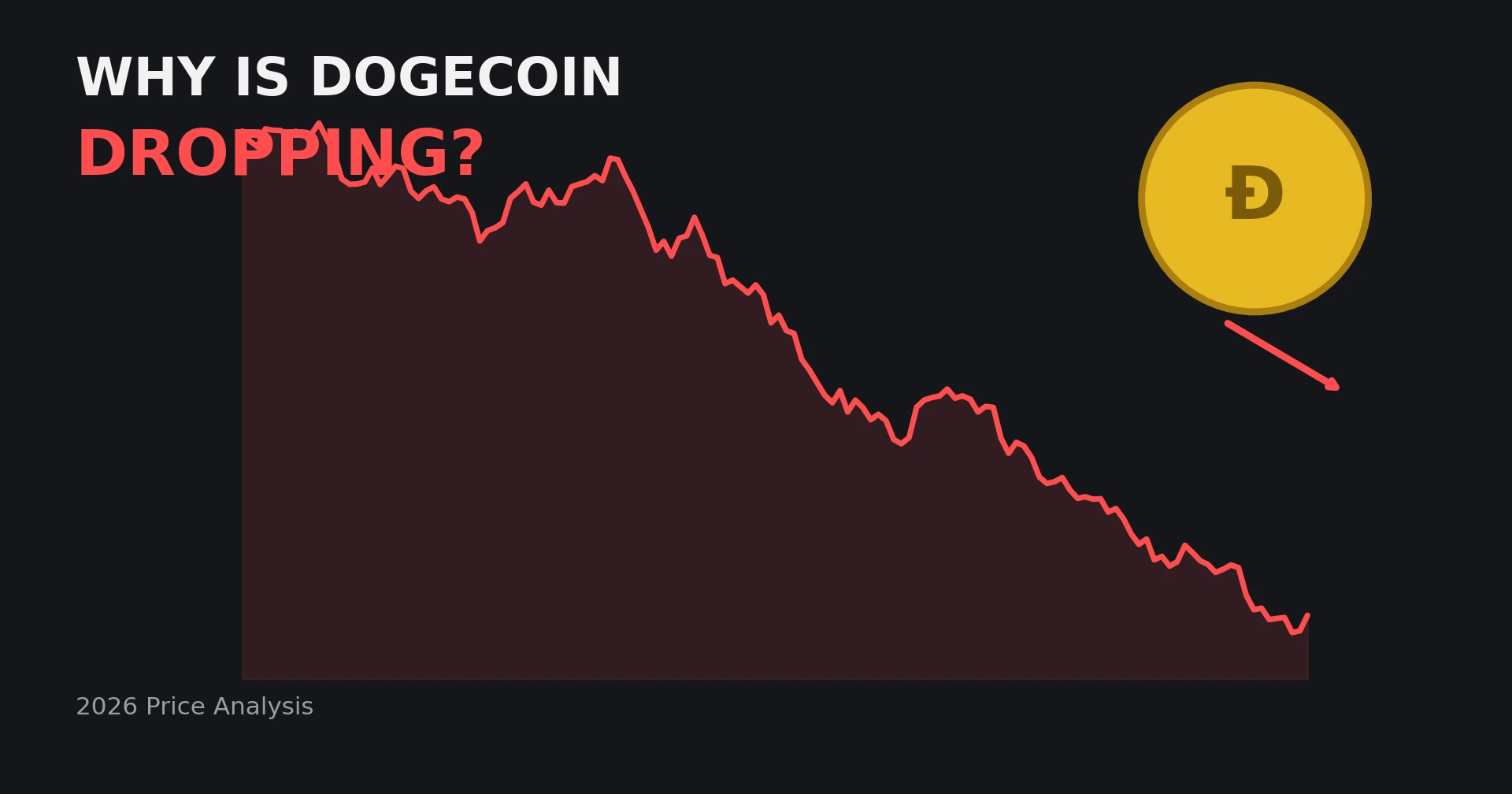
Here is the part that trips people up. Dogecoin has an ETF now. A real one, trading on Nasdaq since January. Its corporate arm just merged with a public company and started trading under its own ticker. By most measures that count as good news for a coin that used to run purely on memes and Elon Musk tweets. And yet DOGE is sitting around $0.073, roughly 90 percent below where it peaked back in 2021, and it just lost 30 percent of its value in June alone. If institutional adoption was supposed to fix the price, the chart did not get the message. Here is what is actually driving the drop, not the recycled “market sentiment is bearish” line every other page repeats.
You Might Also Like
Why Is XRP Dropping? The Real Reasons Behind the 2026 Slide · Bitcoin Crash 2026: What’s Actually Driving It and What Comes Next · Dogecoin Price Today in India | What Is DOGE Worth?
Why Is Dogecoin Dropping, the Short Answer
Dogecoin is dropping because four separate pressures are hitting it at once. Bitcoin’s own slide is dragging the whole memecoin sector down with it, the coin’s unlimited annual supply keeps adding fresh sell pressure every single day, a small number of whale wallets can trigger outsized swings whenever they move, and the broader market is sitting in Extreme Fear with no clear catalyst to reverse it. None of these alone explains a 90 percent drawdown. Stacked together during a risk-off stretch, they explain it easily.
Dogecoin’s Price Right Now, By the Numbers
Before getting into causes, here is exactly where things stood as this was written, late July 2026.
| Metric | Where things stand (late July 2026) |
| Current price range | Roughly $0.070 to $0.077 |
| Decline from cycle high | About 90% below the $0.73 peak reached in May 2021 |
| June 2026 monthly drop | Roughly 30% in a single month |
| Critical support | $0.070 to $0.072, with an air pocket toward $0.06 if it breaks |
| Key resistance | $0.078, then the psychological $0.10 level |
| RSI reading | Low to mid-30s, neutral to oversold territory |
| Fear and Greed Index | Around 21, in Extreme Fear territory |
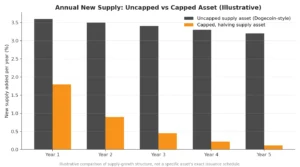
| Annual new supply | 5.26 billion DOGE minted per year, no supply cap |
Reason One, Bitcoin’s Own Slide Is Dragging Dogecoin With It
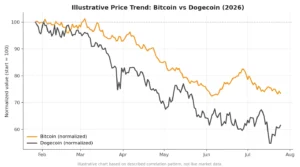
Dogecoin does not trade in isolation. Over a rolling five year window, DOGE and Bitcoin have held a correlation coefficient around 0.67, and shorter windows have pushed that as high as 0.85. When Bitcoin struggles, memecoins tend to struggle harder, since Dogecoin behaves like a higher-beta, more volatile cousin of Bitcoin rather than an independent asset with its own demand story. Bitcoin has spent 2026 well off its prior highs, and every leg down in BTC has dragged DOGE along with it, usually by a wider margin. This is the single biggest reason Dogecoin’s chart looks the way it does right now. Fix Bitcoin’s trend, and Dogecoin’s odds of stabilizing improve immediately. Leave Bitcoin weak, and no amount of DOGE-specific good news changes much.
Reason Two, an Unlimited Supply That Never Stops Growing
Here is a detail that gets glossed over constantly. Dogecoin has no maximum supply. Roughly 5.26 billion new DOGE enter circulation every year, which works out to a persistent inflation headwind of around 3.4 percent annually on top of whatever price pressure already exists. Compare that to an asset with a hard cap, where scarcity does at least some of the work of holding value over time. Dogecoin has to generate enough fresh demand every single year just to offset new supply before price can even hold flat, let alone rise. During a period when demand is already soft, that constant drip of new coins onto the market acts like a slow leak in a tire. It is not dramatic on any single day, but it adds up fast over months.
Reason Three, a Small Number of Wallets Can Move the Entire Market
Roughly 90 percent of Dogecoin’s circulating supply sits in a relatively small number of wallets. There is no staking mechanism locking that supply up, no DeFi protocol requiring it as collateral, and no vesting schedule slowing down when holders can sell. That means a handful of large holders can exit a meaningful chunk of their position within days if they choose to, and on-chain data has shown exactly that kind of behavior. One accumulation window in July 2025 saw roughly 310 million DOGE bought within 48 hours, while a separate stretch in November 2025 saw about 1 billion DOGE sold across a single week. Whale wallets moving in either direction produce sharp, fast price swings that have nothing to do with news headlines. June’s roughly 30 percent monthly decline lines up closely with a wave of long position liquidations, with more than $130 million in leveraged long bets wiped out as the price fell through key support levels.
Reason Four, Extreme Fear and a Broader Risk-Off Mood
The Crypto Fear and Greed Index has been sitting around 21, deep in Extreme Fear territory, for weeks. That kind of sentiment reading typically shows up alongside falling retail participation, thinner trading volume, and less appetite for speculative assets generally, exactly the category Dogecoin has always belonged to. Broader consumer spending data has echoed the same caution. Quarterly earnings from consumer brands through 2025 and into 2026 pointed to households tightening discretionary spending, and speculative assets like meme coins are usually among the first things people pull back from when they feel less confident about their own finances. Dogecoin was built entirely on hype and social momentum rather than any underlying utility, so it has essentially zero cushion when that hype dries up.
The Confusing Part, Why Institutional Backing Hasn’t Helped Yet
This is the detail most coverage skips past entirely, and it is genuinely the most interesting piece of the story. 21Shares launched TDOG, a Dogecoin ETF, on Nasdaq on January 22, 2026, with physically backed 1:1 exposure and the formal endorsement of House of Doge, the Dogecoin Foundation’s corporate arm. That same House of Doge completed a merger with Brag House Holdings and began trading on Nasdaq under the ticker HODO on July 1, 2026. On paper, that is exactly the kind of institutional infrastructure that is supposed to stabilize a speculative asset, regulated custody, a public listing, a formal foundation structure standing behind it. And the price kept falling anyway. Reported ETF inflows have stayed in the tens of millions of dollars range, which is a meaningful vote of confidence from institutional allocators, but it is nowhere near large enough to offset the retail and whale selling pressure described above. Institutional wrapper products can improve an asset’s long-term legitimacy without doing anything to change short-term price action, and that is precisely the gap Dogecoin is sitting in right now.
Key Support and Resistance Levels Worth Watching
If you are trying to make sense of where Dogecoin goes from here, two zones matter more than any single prediction. The $0.070 to $0.072 range is the support level the entire market is watching right now, and multiple technical analysts have pointed to a developing double-bottom pattern in this exact zone, the kind of setup that has historically preceded short-term bounces in prior cycles. A confirmed break below that floor opens up room toward $0.06, where the next real buying interest would likely show up. On the upside, Dogecoin needs to clear and hold $0.078 first, then the far more meaningful psychological level at $0.10, before anyone can reasonably argue the downtrend has actually ended rather than just paused. Until that resistance breaks convincingly, the broader technical picture stays bearish regardless of any short-term relief rally.
Is Dogecoin’s Meme-Coin Identity Finally Catching Up With It
It is worth being honest about this part. Dogecoin was created in 2013 as a joke, a parody of the speculative frenzy already building around Bitcoin at the time. It has never had a hard supply cap, never built a dominant real-world payments use case despite occasional merchant acceptance news, and its biggest price moves have historically tracked celebrity attention rather than product milestones. That origin story was fine during a bull market chasing momentum. It becomes a real liability during a stretch like this one, when investors are rotating toward projects with clearer utility stories, actual revenue, or regulatory clarity. Dogecoin still has one of the largest, most loyal retail communities in crypto, and that counts for something. It does not, on its own, generate the kind of fresh demand needed to outpace 5.26 billion new coins a year during a fear-driven market.
What Would It Take for Dogecoin to Actually Turn Around
A few things would need to line up together. Bitcoin stabilizing first is close to a hard requirement, given how tightly Dogecoin’s price tracks it. A sustained shift out of Extreme Fear back toward neutral sentiment would need to show up in the Fear and Greed Index for more than a few days at a time, not just a single green candle. And ETF inflows into TDOG would need to scale up meaningfully from their current tens-of-millions-per-month pace to actually absorb the ongoing new supply and whale-driven selling. None of these are impossible. None of them are close to guaranteed on any specific timeline either.
Should You Be Worried If You’re Holding Dogecoin
This is not financial advice, and no single article should be the deciding factor in what anyone does with money they cannot afford to lose. What is genuinely true is that Dogecoin’s decline has tracked a broad, risk-off period across the entire crypto market rather than any specific failure unique to the project itself, and the underlying institutional infrastructure around it, ETF approval, a public corporate structure, foundation backing, has continued expanding even while the price fell. That does not guarantee a recovery on any timeline, and Dogecoin’s structural weaknesses, unlimited supply and heavy whale concentration chief among them, are not going away regardless of what the price does next. Only invest what you can genuinely afford to lose, and base any decision on your own research and risk tolerance rather than a single price forecast, including this one.
Frequently Asked Questions
Why is Dogecoin price dropping in 2026?
Dogecoin is dropping due to Bitcoin’s own market-wide slide dragging memecoins down with it, an unlimited annual supply of roughly 5.26 billion new coins adding constant sell pressure, whale wallets capable of triggering sharp swings with no lock-up mechanism to slow them, and a broader market stuck in Extreme Fear sentiment for weeks.
Will Dogecoin recover in 2026?
Recovery depends heavily on Bitcoin stabilizing first, sentiment shifting out of Extreme Fear for a sustained stretch, and ETF inflows scaling up enough to absorb ongoing new supply and whale selling. Analyst price ranges for the rest of 2026 vary widely, from roughly $0.06 in bearish scenarios to $0.15 to $0.20 if multiple catalysts align.
Does Dogecoin have a maximum supply?
No. Dogecoin has no supply cap, and roughly 5.26 billion new DOGE enter circulation every year through mining rewards, creating a persistent inflation headwind of about 3.4 percent annually that has to be offset by fresh demand just to hold price steady.
Why did the Dogecoin ETF launch not stop the price from falling?
The TDOG ETF, launched by 21Shares in January 2026, brought regulated institutional exposure to Dogecoin, but reported inflows have stayed in the tens of millions of dollars, far too small to offset the much larger selling pressure coming from whale wallets and the coin’s constant new supply.
Is Dogecoin a good investment right now?
This is not financial advice. Dogecoin has gained real institutional infrastructure through its ETF and corporate restructuring, but it remains a highly speculative asset with an unlimited supply and heavy whale concentration. Any decision should be based on personal research and risk tolerance, not a single article.
The Real Answer
Dogecoin’s drop is not one mysterious event, it is four ordinary pressures landing at the same time, a weak Bitcoin market, an ever-growing supply, whale-driven volatility, and fear-heavy sentiment across crypto broadly. The institutional pieces, TDOG and the HODO listing, are real and represent genuine long-term legitimacy for the project. They simply are not large enough yet to outweigh the other four forces. For a fuller look at how Bitcoin’s own decline is shaping this entire cycle, see our Bitcoin Crash 2026 coverage, and for the closest comparison case in the memecoin and altcoin space right now, our Why Is XRP Dropping breakdown walks through a strikingly similar pattern of good news failing to move the price.